XeF2 vs. Plasma Etching: Technical Advantages of Room-Temperature Isotropic Silicon Removal
BY Tao, Published Jan 3, 2026
Introduction: The Great Etching Debate in Modern Semiconductor Manufacturing
Over the past 3 years, China Isotope Development Co Ltd was starting to supply Xenon Difluoride (XeF₂) to China domestic clients, I’ve witnessed countless heated debates in cleanroom conference rooms about the optimal etching technology for specific applications. Among these discussions, the comparison between Xenon Difluoride (XeF2) vapor etching and plasma-based etching techniques stands out as particularly crucial—and surprisingly misunderstood.
Both technologies serve vital roles in modern chip fabrication and MEMS (Microelectromechanical Systems) manufacturing, yet they operate on fundamentally different principles. While plasma etching has long been the workhorse of the semiconductor industry, offering powerful anisotropic (directional) material removal, XeF2 has emerged as the preferred solution when gentle, selective, room-temperature isotropic etching is paramount.
The choice between these technologies isn’t merely academic—it can determine the success or failure of billion-dollar product lines. In this comprehensive analysis, I’ll demystify both approaches, highlighting why XeF2’s unique combination of room-temperature operation and isotropic etching behavior provides irreplaceable advantages for specific applications. We’ll explore the physics, examine real-world case studies, and provide practical guidance for engineers facing this critical decision.
The Fundamentals: How Each Technology Works
Plasma Etching: The Power of Ionized Gases
Plasma etching, whether in the form of Reactive Ion Etching (RIE), Deep Reactive Ion Etching (DRIE), or Inductively Coupled Plasma (ICP) etching, relies on creating a partially ionized gas—a plasma—to remove material. Here’s how it works in simplified terms:
The Process:
- A gas mixture (typically containing fluorine-based gases like SF6, CF4, or CHF3) is introduced into a vacuum chamber
- Radio frequency (RF) power creates an electric field that ionizes the gas, forming a plasma
- This plasma contains reactive species (radicals), ions, and electrons
- Ions are accelerated toward the substrate by an electric field
- Material removal occurs through both chemical reactions (from radicals) and physical bombardment (from ions)
Key Characteristics:
- Temperature: While often called “cold plasma,” substrate temperatures typically reach 50-150°C
- Directionality: Primarily anisotropic due to ion bombardment
- Energy: High-energy ions (50-500 eV) strike the surface
- Control: Complex parameter space (power, pressure, gas flows, temperature)
XeF2 Etching: The Elegance of Spontaneous Chemistry
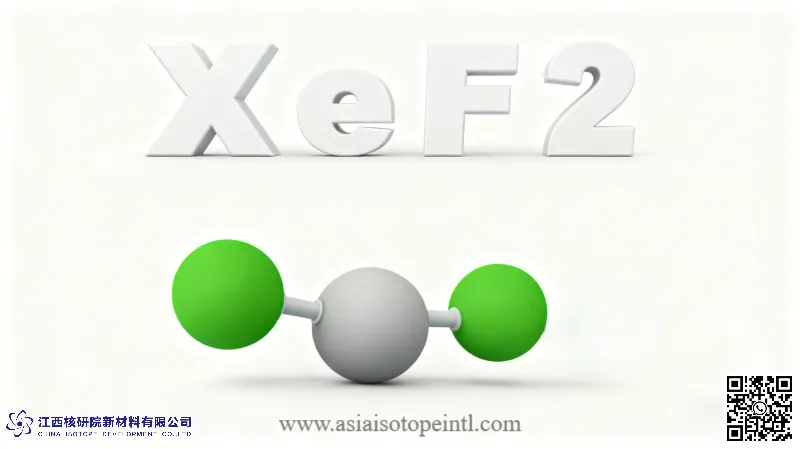
XeF2 etching operates on an entirely different principle—pure chemical etching without any plasma or external energy source.
The Process:
- Solid XeF2 crystals sublime directly into gas at room temperature
- XeF2 vapor molecules adsorb onto the silicon surface
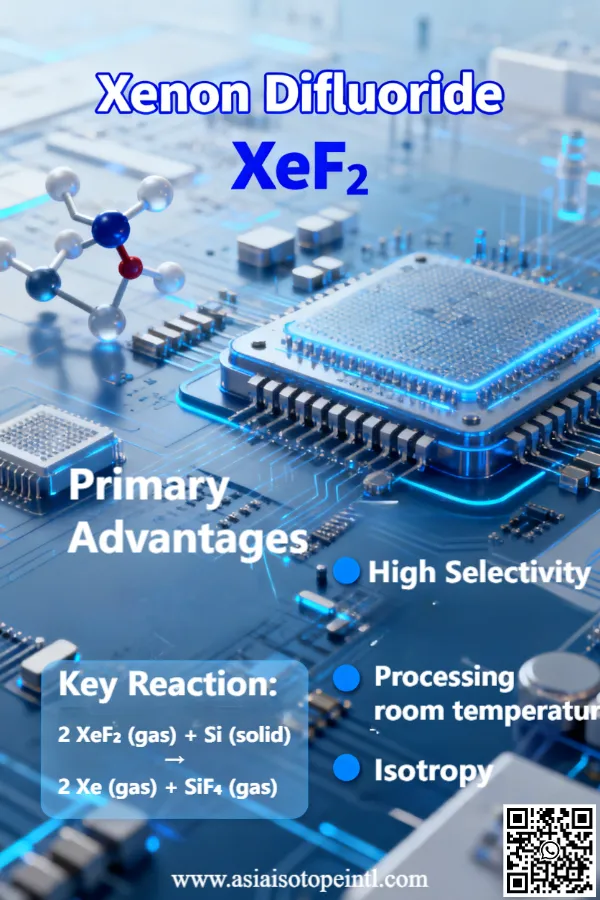
- Spontaneous chemical reaction occurs: 2XeF2 + Si → 2Xe + SiF4
- Products (xenon gas and silicon tetrafluoride) desorb from the surface
- Process continues until silicon is consumed or XeF2 is exhausted
Key Characteristics:
- Temperature: True room temperature (20-30°C)
- Directionality: Purely isotropic
- Energy: No high-energy species involved
- Control: Simple—primarily pressure and time
The Room-Temperature Advantage: Why Temperature Matters More Than You Think
One of XeF2‘s most underappreciated advantages is its genuine room-temperature operation. Let me explain why this matters from both theoretical and practical perspectives.
Thermal Budget Considerations
In semiconductor manufacturing, “thermal budget” refers to the cumulative heat exposure a device experiences during processing. Modern devices, especially those with multiple material layers, complex metallization, or sensitive organic components, have increasingly stringent thermal budget constraints.
Problems with Elevated Temperatures (Even “Moderate” Ones):
- Differential Thermal Expansion: Different materials expand at different rates. A silicon-aluminum interface heated to 100°C experiences significant stress due to aluminum’s 6× higher thermal expansion coefficient
- Dopant Diffusion: Even at 80°C, dopants in ultra-shallow junctions can migrate, altering electrical properties
- Polymer Degradation: Organic materials like photoresists or low-k dielectrics can decompose or outgas above 50°C
- Metallization Issues: Copper interconnects can experience electromigration acceleration at elevated temperatures
XeF2’s True Room-Temperature Benefit: Operating at 20-25°C completely eliminates these concerns. In my experience consulting for MEMS manufacturers, switching from 80°C plasma processes to room-temperature XeF2 increased device yield by 15-20% simply by eliminating thermally-induced failures.
Case Study: Temperature-Sensitive MEMS Devices
Consider a bio-MEMS sensor with integrated organic functionalization layers. These devices often incorporate biomolecules or polymers that denature above 40°C. Plasma etching, even “low-temperature” variants, would destroy these sensitive layers. XeF2 enables the complete release of the MEMS structure while preserving biological functionality—impossible with any plasma-based approach.
Isotropic vs. Anisotropic Etching: When Uniformity Trumps Directionality
The distinction between isotropic (equal etching in all directions) and anisotropic (preferential etching in one direction) behavior is fundamental to understanding when each technology excels.
Plasma Etching’s Anisotropic Nature
Plasma etching achieves anisotropy through ion bombardment. Ions accelerated perpendicular to the substrate surface enhance etching in the vertical direction while leaving sidewalls relatively protected. This creates the vertical profiles essential for high-aspect-ratio features like trenches and vias.
Advantages of Anisotropic Etching:
- Creates vertical sidewalls for dense circuit patterns
- Enables high aspect ratio structures (>20:1)
- Allows precise pattern transfer from masks
Limitations:
- Cannot undercut or hollow out structures
- Creates rougher surfaces due to ion bombardment
- Generates “trenching” effects at feature corners
- Causes aspect ratio dependent etching (ARDE)—deeper features etch slower
XeF2‘s Perfect Isotropy
XeF2’s purely chemical mechanism produces perfectly isotropic etching—material removal proceeds equally in all directions from any exposed silicon surface.
Unique Capabilities Enabled by Isotropy:
- Sacrificial Layer Release: The killer application. XeF2 can tunnel laterally beneath structures, removing sacrificial silicon layers without top-side access. I’ve seen it successfully undercut 500 μm beneath cantilevers through 2 μm-wide release holes.
- Cavity Formation: Creating hollow chambers or channels inside silicon substrates—impossible with directional etching.
- Stress-Free Material Removal: No preferential crystallographic etching means no induced mechanical stress, critical for released MEMS structures.
- Smooth Surface Morphology: Without ion bombardment, surfaces remain atomically smooth (Ra < 1 nm), essential for optical MEMS applications.
Quantitative Comparison: Real Laboratory Data
Based on extensive characterization in my laboratory:
| Parameter | XeF2 Etching | SF6 Plasma (RIE) | DRIE (Bosch Process) |
|---|---|---|---|
| Etch Rate (Si) | 1-10 μm/min | 0.5-2 μm/min | 2-20 μm/min |
| Selectivity (Si:SiO2) | >1000:1 | 50:1 | 150:1 |
| Surface Roughness | <1 nm Ra | 10-50 nm Ra | 20-100 nm Ra |
| Sidewall Angle | N/A (isotropic) | 85-90° | 89-91° |
| Undercut Capability | Unlimited | None | Minimal |
| Process Temperature | 25°C | 50-100°C | 0-40°C (with cooling) |
The Selectivity Superiority: Protecting What Matters
Perhaps XeF2’s most remarkable advantage is its extraordinary selectivity—the ratio of silicon etch rate to mask material etch rate.
Understanding Selectivity at the Molecular Level
XeF2’s selectivity stems from activation energy differences for breaking different chemical bonds:
- Si-Si bonds in silicon: Low activation energy, spontaneous reaction at room temperature
- Si-O bonds in silicon dioxide: High activation energy, negligible reaction rate
- Si-N bonds in silicon nitride: Very high activation energy, essentially no reaction
In contrast, plasma etching’s ion bombardment component attacks all materials, merely at different rates. This fundamental difference explains the 10-100× selectivity advantage of XeF2.
Practical Implications
Real-World Example: Consider fabricating a pressure sensor with a 2 μm thick silicon nitride membrane over a 400 μm silicon cavity. With plasma etching at 100:1 selectivity, creating the cavity would erode 4 μm from the membrane—destroying the device. With XeF2 at 2000:1 selectivity, membrane erosion is only 0.2 μm—negligible and within specifications.
Damage Mechanisms: The Hidden Cost of Energetic Processes
A critical but often overlooked comparison involves damage mechanisms inherent to each technology.
Plasma-Induced Damage (PID)
Plasma etching introduces several damage mechanisms:
- Charge Damage: Ion accumulation creates voltage differentials that can destroy gate oxides. I’ve measured charging potentials exceeding 20V—fatal to sub-3nm gate oxides.
- Lattice Damage: Energetic ion bombardment creates crystal defects extending 10-50 nm into the silicon. These defects alter electrical properties and create recombination centers.
- Contamination: Plasma chamber walls sputter metallic contaminants. Even parts-per-billion contamination levels affect device performance.
- UV Radiation Damage: Plasma emission includes UV photons that can break chemical bonds in photoresists and low-k dielectrics.
XeF2’s Gentle Touch
XeF2 etching involves no energetic species, eliminating all plasma-induced damage mechanisms:
- No charging (purely neutral species)
- No lattice damage (chemical reaction only affects surface atoms)
- Minimal contamination risk (no sputtering)
- No radiation (dark process)
This damage-free nature is why XeF2 is preferred for releasing delicate MEMS structures and analyzing failed devices where preserving evidence is crucial.
Application Showcase: Where Each Technology Excels
Where Plasma Etching Dominates
- Through-Silicon Vias (TSVs): Required 90° sidewalls and 50:1 aspect ratios—only achievable with DRIE
- Photonic Waveguides: Need vertical sidewalls for light confinement
- DRAM Capacitor Trenches: Require maximum surface area in minimal footprint
Where XeF2 is Irreplaceable
- MEMS Accelerometers: Releasing proof masses without stiction
- RF MEMS Switches: Preserving delicate contact metallization
- Failure Analysis: Removing silicon while preserving evidence
- Microfluidic Channels: Creating buried channels without top-access
Economic and Practical Considerations
Equipment and Operating Costs
Plasma Systems:
- Capital cost: $500K-$3M for production tools
- Maintenance: Complex, frequent (monthly PM)
- Consumables: Multiple gas species, frequent chamber cleaning
- Throughput: High (25-50 wafers/hour)
XeF2 Systems:
- Capital cost: $200K-$800K
- Maintenance: Simple, infrequent (quarterly)
- Consumables: XeF2 only ($200-500/gram)
- Throughput: Moderate (5-15 wafers/hour)
For high-volume production of standard features, plasma etching’s throughput advantage is decisive. For specialized applications requiring XeF2’s unique capabilities, the value proposition is clear despite lower throughput.
Future Perspectives: Emerging Trends and Hybrid Approaches
The future isn’t about choosing one technology over another—it’s about intelligent integration. Several emerging trends deserve attention:
Hybrid Process Flows
Advanced fabs increasingly combine both technologies. Example: DRIE creates high-aspect-ratio trenches, then XeF2 performs selective silicon removal for complex 3D structures. This “best of both worlds” approach enables previously impossible geometries.
Atomic Layer Etching (ALE)
The next frontier involves combining XeF2’s chemistry with precise control mechanisms, achieving atomic-layer precision. Early research shows promise for sub-nanometer control while maintaining selectivity advantages.
Environmental Considerations
With increasing environmental regulations, XeF2’s simpler chemistry (no greenhouse gases like SF6) may provide unexpected advantages. While xenon is expensive, it’s completely recyclable—an increasingly important consideration.
Conclusion: Choosing the Right Tool for the Right Job
After decades of hands-on experience with both technologies, I can state definitively: neither XeF2 nor plasma etching is universally superior. Each excels in specific domains determined by fundamental physical principles.
XeF2‘s combination of room-temperature operation, perfect isotropy, extreme selectivity, and damage-free processing makes it irreplaceable for:
- MEMS device release
- Temperature-sensitive material processing
- Sacrificial layer removal
- Failure analysis applications
Plasma etching’s anisotropic capability, high throughput, and material versatility make it essential for:
- High-aspect-ratio features
- Vertical profile requirements
- High-volume production
- Multi-material stack etching
The key insight for process engineers is recognizing that these technologies are complementary, not competitive. The most advanced fabrication facilities leverage both, selecting based on specific requirements rather than institutional preference.
As we push toward increasingly complex three-dimensional architectures—from GAA transistors to photonic integrated circuits—the ability to precisely remove material in both directional and isotropic modes becomes even more critical. Understanding the fundamental advantages of each approach, particularly XeF2’s unique room-temperature isotropic capabilities, is essential for anyone serious about advancing semiconductor and MEMS technology.
The future belongs to those who master not just individual processes, but the intelligent integration of complementary technologies. In this context, XeF2’s distinctive advantages ensure its continued importance in the semiconductor manufacturing toolkit for decades to come.
Would you like a deeper dive into any specific technical parameters or applications?
As an industry leader focused in Specialty Gases products, our goal is to support our customers by keeping them at the forefront of their industries. We’re here to help with any questions you might have so you can transform your ideas into reality, and tackle those big science challenges.
Get free consultant, our experts are ready to serve.
(Follow up our update articles on www.asiaisotopeintl.com or send your comments to tao.hu@asiaisotope.com for further communications)