Space-Grade Xenon Gas for Satellites: Purity Control, Storage Engineering, and Mission-Critical Reliability
BY Tao, Published Feb 1, 2026
Introduction: The Invisible Workhorse of Modern Space Exploration
When we think of satellite technology, our minds often drift to sophisticated electronics, solar panels, and intricate antenna systems. Yet, one of the most critical components enabling long-duration space missions operates silently in the background: space-grade xenon gas. As a researcher who has spent decades working with specialty gases for aerospace applications, I can confidently say that xenon represents one of the most fascinating intersections of materials science, engineering precision, and mission-critical reliability.
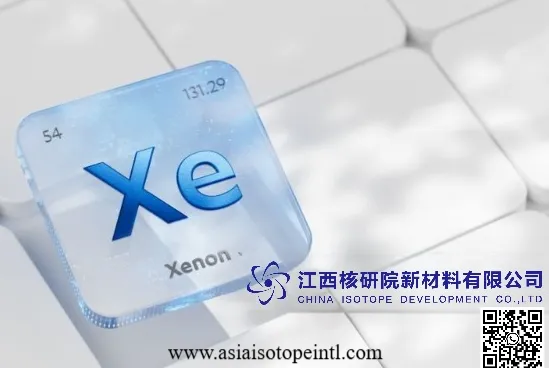
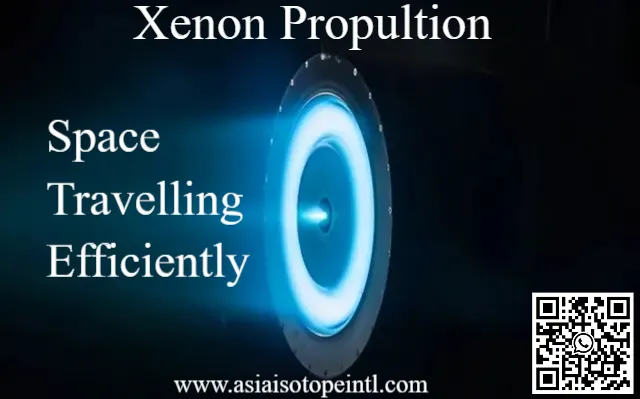
Xenon, a noble gas residing in Group 18 of the periodic table, has become the propellant of choice for electric propulsion systems aboard satellites and deep-space probes. Its unique atomic properties—high atomic mass (131.29 u), excellent ionization characteristics, and chemical inertness—make it indispensable for ion thrusters and Hall-effect thrusters that enable station-keeping, orbital adjustments, and interplanetary travel. However, the journey from terrestrial xenon production to space-qualified gas involves extraordinary levels of purification, meticulous storage engineering, and uncompromising quality assurance protocols.
As China Isotope Development Co Ltd was starting to supply High Purity Xenon Gas to the world clients, I’ll guide you through the technical landscape of space-grade xenon: what makes it different from industrial-grade alternatives, how we achieve and maintain the extreme purity levels required, the engineering challenges of storing this precious resource, and the reliability frameworks that ensure mission success when failure is not an option.
Understanding Space-Grade Xenon: Why Purity Matters Beyond Measure
The Noble Gas That Powers Electric Propulsion
Xenon’s dominance in satellite propulsion isn’t accidental. In electric propulsion systems, xenon atoms are ionized—stripped of one or more electrons—and then accelerated through electromagnetic fields to generate thrust. The process seems straightforward, but the devil resides in the details. Even trace contamination can cascade into catastrophic consequences.
Consider this: a commercial communications satellite may carry 50-150 kilograms of xenon, representing years of operational life. The xenon purity directly impacts thruster performance, fuel efficiency, and hardware longevity. Contaminants like water vapor, hydrocarbons, nitrogen, or oxygen can poison cathode surfaces, degrade discharge chamber components, and reduce ionization efficiency. What might seem like parts-per-million contamination at launch can compound over a 15-year mission into premature thruster failure.
Defining Space-Grade: The Purity Hierarchy
In the specialty gas industry, we categorize xenon into several grades:
- Industrial Grade: 99.9% to 99.99% purity, suitable for lighting and general applications
- Research Grade: 99.999% (5N) purity for laboratory use
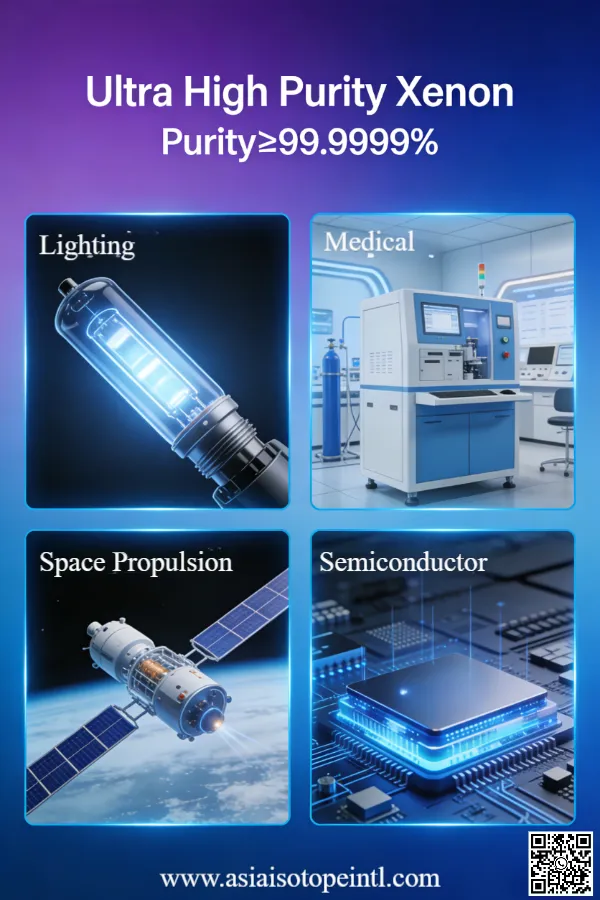
- Space Grade: 99.9995% (5N5) to 99.9999% (6N) or higher, with stringent controls on specific impurities
Space-grade specifications extend far beyond overall purity percentages. Mission requirements typically mandate:
- Total hydrocarbon content: < 0.5 ppm (parts per million)
- Water vapor: < 0.1 ppm
- Nitrogen and oxygen combined: < 0.5 ppm
- Krypton (the most challenging impurity to remove): < 10 ppm
- Rare gases (Ne, Ar): < 1 ppm each
- Carbon dioxide and carbon monoxide: < 0.1 ppm each
These specifications aren’t arbitrary. Each contaminant poses specific threats. Hydrocarbons can polymerize under plasma conditions, coating cathode surfaces. Water vapor introduces oxygen that can oxidize cathode materials. Nitrogen and oxygen affect plasma chemistry and thrust vectoring precision. Krypton, being chemically similar to xenon, is particularly insidious because it requires specialized separation techniques.
Purity Control: The Art and Science of Ultra-Pure Xenon Production
Source Material and Primary Purification
Xenon is extraordinarily rare, comprising only 0.087 parts per million of Earth’s atmosphere. The production process begins with cryogenic air separation, where xenon accumulates alongside krypton in the “rare gas” fraction. This initial concentrate typically contains 10-40% xenon mixed with krypton and trace amounts of other gases.
The first purification challenge is krypton removal. Given their similar physical properties (krypton boiling point: -153.4°C; xenon: -108.1°C), conventional distillation alone proves insufficient for space-grade separation. We employ multi-stage processes:
1. Cryogenic Distillation Cascades: Multiple rectification columns operating at progressively refined temperature and pressure profiles can achieve initial separation to approximately 99.9% xenon purity.
2. Absorption/Desorption Cycles: Activated carbon or specialized molecular sieves preferentially adsorb xenon over krypton at specific temperature ranges. By cycling between absorption at liquid nitrogen temperatures (-196°C) and controlled desorption, we achieve additional purification.
3. Photochemical Separation: For the highest purity requirements, some facilities employ photochemical methods where krypton is selectively ionized using wavelength-specific UV radiation, allowing electromagnetic separation of ionized krypton from neutral xenon.
Secondary Purification: Removing Reactive Contaminants
Once krypton levels are reduced, attention turns to reactive impurities:
Oxygen and Moisture Removal: Heated getter materials—typically titanium, zirconium, or specialized rare-earth alloys—chemically bind oxygen, nitrogen, and water vapor. The xenon stream passes over getter beds maintained at 400-700°C, where contaminants react to form solid compounds while xenon remains unreacted.
Hydrocarbon Elimination: Catalytic oxidation converts hydrocarbons to carbon dioxide and water, which are subsequently removed by molecular sieve beds. Palladium-based catalysts operating at elevated temperatures achieve hydrocarbon levels below 0.1 ppm.
Final Polishing: Ultra-high purity molecular sieves (3Å and 4Å pore sizes) remove residual moisture and carbon dioxide to sub-ppm levels. This final polishing often occurs in cleanroom environments (Class 100 or better) to prevent recontamination.
Analytical Verification: Measuring What Matters
Achieving space-grade purity is meaningless without verification. We employ multiple analytical techniques:
Gas Chromatography-Mass Spectrometry (GC-MS): Identifies and quantifies organic contaminants down to parts-per-billion levels. This technique is essential for detecting unexpected hydrocarbon species.
Plasma Emission Spectroscopy: Ionizes sample gas and analyzes emission spectra to identify elemental contaminants. Particularly effective for detecting rare gas impurities.
Moisture Analyzers: Specialized sensors using chilled mirror hygrometry or cavity ring-down spectroscopy measure water vapor to 0.01 ppm precision.
Oxygen Analyzers: Electrochemical or paramagnetic sensors detect oxygen levels below 0.1 ppm.
Each production batch undergoes comprehensive testing, with certificates of analysis documenting impurity levels for every specified contaminant. For mission-critical applications, third-party verification by independent laboratories provides additional assurance.
Storage Engineering: Containing Purity from Earth to Orbit
Terrestrial Storage: The Containment Challenge
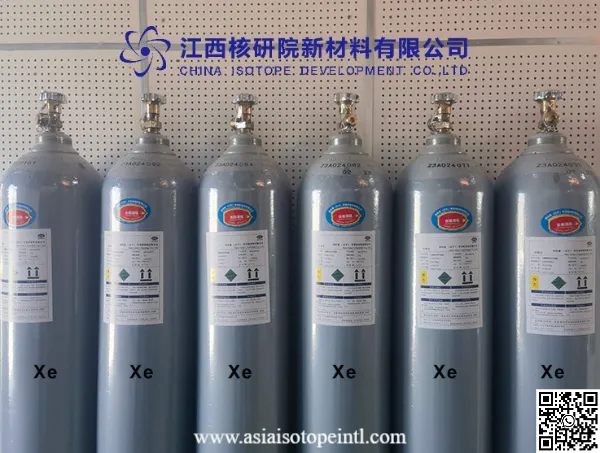
Maintaining ultra-high purity from production through launch presents formidable engineering challenges. Xenon’s chemical inertness works in our favor, but physical contamination and outgassing from storage materials remain constant threats.
Storage Cylinder Materials: Space-grade xenon requires specialized containers:
- Electropolished Stainless Steel: 316L stainless steel with interior surfaces electropolished to reduce surface roughness below 0.4 μm Ra (roughness average). This minimizes surface area for contaminant adsorption.
- Passivation Treatment: Chemical passivation creates a chromium-oxide layer that prevents iron leaching and reduces reactive sites.
- Valve Systems: Ultra-high purity valves with metal-to-metal seals (no elastomers that outgas hydrocarbons). Diaphragm valves are preferred for critical applications.
Pre-Conditioning Protocols: Before filling with space-grade xenon, storage cylinders undergo rigorous preparation:
- Cleaning: Multiple solvent washes (typically high-purity isopropyl alcohol followed by acetone) remove manufacturing residues
- Baking: Heating to 150-200°C under vacuum drives off absorbed moisture and volatile contaminants
- Purging: Multiple evacuation/purge cycles with ultra-high purity nitrogen or argon
- Leak Testing: Helium leak detection to 1×10⁻⁹ std cm³/s sensitivity ensures hermetic sealing
Storage Pressure Considerations: Xenon is typically stored at 13.8-20.7 MPa (2,000-3,000 psi) at room temperature. Higher pressures increase storage density but also increase the risk of valve seal degradation over time. The balance between volumetric efficiency and long-term seal integrity requires careful engineering judgment.
Spacecraft Xenon Storage Systems: Engineering for the Void
Once xenon reaches orbit, storage requirements intensify dramatically. The spacecraft xenon propellant management system (XPMS) must function flawlessly in vacuum, thermal extremes, and radiation environments for years or decades.
Storage Tank Design Philosophy:
Modern satellite xenon tanks employ one of two primary approaches:
1. Conventional High-Pressure Tanks: Titanium or composite overwrapped pressure vessels (COPVs) store xenon at 10-15 MPa. These systems are mechanically simple but require pressure regulators to deliver gas to the thruster at controlled pressures (typically 0.2-0.4 MPa).
- Advantages: Proven heritage, no moving parts in the tank itself, thermally passive
- Challenges: Mass penalty (tank walls must withstand high pressure), pressure decay affects flow characteristics over mission life
2. Supercritical Storage Systems: Maintain xenon near its critical point (temperature: 16.6°C, pressure: 5.84 MPa) where liquid and gas phases merge. These systems use heaters to keep xenon supercritical and pump liquid xenon to the thruster.
- Advantages: Higher storage density, precise flow control, consistent delivery pressure
- Challenges: Requires active thermal management, increased system complexity
Material Selection and Compatibility:
Spacecraft storage systems face unique material challenges:
- Atomic Oxygen Resistance: In low Earth orbit, atomic oxygen can degrade external tank surfaces. Protective coatings or aluminum alloys resist this erosion.
- Thermal Cycling: Orbital temperature swings (-180°C in Earth’s shadow to +120°C in sunlight) stress material joints and seals. Coefficient of thermal expansion matching prevents leak paths.
- Radiation Hardening: Electronics controlling valves and heaters must withstand total ionizing dose often exceeding 100 krad over mission life.
Flow Control and Delivery:
Precise xenon delivery to the thruster involves:
- Pressure Regulators: Maintain consistent downstream pressure despite upstream pressure decay as propellant depletes
- Isolation Valves: Latch valves (typically pyrotechnic or motorized) isolate the storage system from thrusters when not in use
- Flow Meters: Mass flow controllers or flow meters provide feedback for thrust vectoring and propellant budgeting
- Filters: Sub-micron filters capture any particle contamination before it reaches the thruster
Propellant Gauging: Knowing how much xenon remains is critical for mission planning. Techniques include:
- Pressure-Volume-Temperature (PVT) Method: Calculates mass from measured pressure, known volume, and temperature using real gas equations of state
- Thermal Gauging: Measures thermal properties changes as propellant density changes
- Bookkeeping: Integrates flow meter data over time to track consumption
Each method has limitations; spacecraft often employ multiple techniques with cross-validation algorithms.
Quality Assurance Frameworks: Engineering Certainty into Uncertainty
Supply Chain Integrity
Space missions represent multi-million to multi-billion dollar investments. A single contamination event could compromise years of development. Consequently, space-grade xenon supply chains implement unprecedented quality controls.
Vendor Qualification: Suppliers undergo exhaustive audits evaluating:
- Production facility cleanliness and process controls
- Analytical laboratory capabilities and certifications
- Quality management systems (typically AS9100 aerospace standard)
- Traceability systems tracking each production batch from raw material to final delivery
Batch Testing and Certification: Every xenon batch receives:
- Certificate of Analysis: Documenting all specified impurities with analytical methods and detection limits
- Batch Traceability: Unique identifiers linking xenon to specific production runs, purification cycles, and storage cylinders
- Chain of Custody: Documentation tracking every transfer point from production to spacecraft integration
Sampling Protocols: Representative sampling is critical. Gas sampling from high-pressure cylinders follows strict procedures:
- Purge sampling lines thoroughly to eliminate dead volume contamination
- Sample from cylinder at representative pressure/temperature conditions
- Use sampling cylinders pre-cleaned and conditioned to same standards as storage cylinders
- Analyze samples within specified timeframes (xenon itself is stable, but sampling containers may exhibit time-dependent contamination)
Mission-Specific Testing
Beyond standard purity verification, mission-critical applications often require specialized testing:
Thruster Compatibility Testing: Actual thruster hardware is operated using the specific xenon batch planned for flight. Performance parameters—thrust, specific impulse, discharge voltage stability—are characterized and compared against baseline values obtained with reference-grade xenon.
Accelerated Life Testing: Simulates years of thruster operation in weeks using concentrated duty cycles. Post-test inspection of cathode and anode wear patterns can reveal contamination effects invisible to chemical analysis.
Plasma Diagnostics: Optical emission spectroscopy of the thruster discharge plasma can detect trace contaminants that alter plasma chemistry, even when chemical analysis shows compliance.
Documentation and Heritage
Aerospace quality assurance is fundamentally about documentation. For space-grade xenon:
Material Review Boards (MRBs): Any deviation from specification—however minor—triggers MRB review. Cross-functional teams of propulsion engineers, materials scientists, and mission planners evaluate whether the deviation poses mission risk.
Flight Heritage: Once a particular xenon production process and supplier have successfully supported a mission, that heritage becomes valuable. New missions preferentially source from suppliers with proven flight records.
Failure Investigations: When thruster anomalies occur, xenon purity is always investigated. Forensic analysis of returned hardware (on rare missions with sample return) or detailed plasma diagnostic data from orbit can implicate or exonerate propellant quality.
Mission-Critical Reliability: When Failure Is Not an Option
Reliability Engineering Principles
Space missions operate under unique constraints: no maintenance, no resupply, no second chances. Reliability engineering for xenon systems embraces several core principles:
1. Redundancy: Critical components—valves, pressure transducers, heaters—are often duplicated. If a primary xenon isolation valve fails closed, a parallel redundant path ensures propellant access.
2. Fault Tolerance: Systems are designed to operate through credible failure modes. A pressure regulator failure doesn’t necessarily end the mission if thrusters can tolerate wider pressure variations.
3. Derating: Components operate well below their maximum ratings. A valve rated for 10,000 cycles might perform only 100 cycles in a mission, providing safety margin against wear-out.
4. Cleanliness Protocols: During spacecraft integration, xenon system components are protected by cleanroom environments and contamination controls. Even brief exposure to particulates or volatile compounds can compromise mission-life performance.
Case Studies: Learning from Success and Failure
Dawn Mission (NASA): Launched in 2007 to explore asteroids Vesta and Ceres, Dawn carried 425 kg of xenon—the largest xenon load in deep space history. The mission demonstrated over 11 years of ion thruster operation, validating xenon storage and delivery systems for extreme-duration missions. Meticulous purity control enabled thruster performance that exceeded predictions.
Intelsat Anomalies: Several commercial communications satellites in the early 2000s experienced premature electric propulsion system degradation. Investigation implicated hydrocarbon contamination in the propellant supply. These incidents drove industry-wide improvements in purity specifications and testing protocols. The lesson: even parts-per-million contamination can have parts-per-billion consequences in sensitive thruster components.
Hayabusa2 (JAXA): Japan’s asteroid sample-return mission operated ion thrusters for thousands of hours across interplanetary distances. Post-flight analysis of telemetry data showed thruster performance remained remarkably stable, testament to xenon purity and storage system design. The mission returned samples from asteroid Ryugu in 2020, proving that well-engineered xenon systems enable audacious exploration objectives.
Future Challenges: Scaling for Next-Generation Missions
As space exploration evolves, xenon systems face new demands:
Electric Propulsion for Large Satellites: Next-generation telecommunications satellites and mega-constellations increasingly rely on electric propulsion for orbit raising and station-keeping. These applications require larger xenon masses (200-400 kg per satellite) with corresponding storage and handling challenges.
Deep Space Missions: Mars missions, asteroid mining concepts, and outer planet exploration demand xenon systems operating reliably for decades. Radiation exposure accumulates, thermal cycling intensifies, and resupply impossibility raises stakes. Advanced materials, improved predictive reliability models, and possibly in-space xenon recycling may become necessary.
Lunar and Martian ISRU: Future in-situ resource utilization might extract xenon from planetary atmospheres (Mars has trace xenon). Developing space-based purification systems to achieve space-grade quality from indigenous resources would revolutionize deep space logistics.
Alternative Propellants: While xenon dominates today, its scarcity and cost drive research into alternatives like krypton (more abundant but lower performance) or metallic propellants (bismuth, iodine). However, xenon’s performance advantages and extensive flight heritage ensure its continued primacy for demanding missions.
Conclusion: The Foundation of Modern Space Access
Space-grade xenon exemplifies the invisible infrastructure enabling humanity’s expansion beyond Earth. Behind every satellite maintaining our communications networks, every deep space probe exploring distant worlds, lies an intricate chain of materials science, chemical engineering, and quality assurance that transforms a rare atmospheric gas into a mission-critical resource.
The journey from 87 parts-per-billion in Earth’s atmosphere to 99.9999% purity aboard a spacecraft represents thousands of hours of engineering refinement, analytical verification, and operational validation. Each part-per-million of contamination removed, each leak-tight seal verified, each batch test completed contributes to the reliability that transforms engineering drawings into functioning satellites.
As we venture further into the solar system—establishing lunar bases, exploring Mars, visiting asteroids—the demands on propulsion systems will only intensify. Space-grade xenon will remain central to these endeavors, but the standards will evolve. Perhaps future generations will look back on today’s “ultra-pure” xenon the way we now view the early aerospace materials that seemed cutting-edge in their time but which we’ve long since surpassed.
For now, those of us working at the intersection of specialty gases and aerospace engineering continue refining the processes, improving the analytics, and validating the systems that make space access reliable. It’s meticulous work, often invisible to the public, but absolutely fundamental to humanity’s space-faring future.
The next time you use GPS navigation, stream satellite television, or see images from a distant world, remember: somewhere in that technological chain, ultra-pure xenon atoms are being accelerated to tens of thousands of meters per second, providing the gentle but persistent thrust that keeps our eyes on the cosmos and our feet reaching for the stars.
Would you like a deeper dive into any specific technical parameters or applications?
As an industry leader focused in Specialty Gases products, our goal is to support our customers by keeping them at the forefront of their industries. We’re here to help with any questions you might have so you can transform your ideas into reality, and tackle those big science challenges.
Get free consultant, our experts are ready to serve.
(Follow up our update articles on www.asiaisotopeintl.com or send your comments to tao.hu@asiaisotope.com for further communications)