Xenon Gas in Cutting‑Edge Research: Vacuum‑UV Emission, Plasma Dynamics, and Extreme‑Condition Experiments
BY Tao, Published Feb 1, 2026
Xenon is a “spectroscopy-first” noble gas: it produces strong vacuum‑ultraviolet (VUV) light through atomic lines and excimers (short‑lived excited molecules), which is why it sits at the center of modern VUV sources and detectors. Plasma researchers love xenon because it is heavy (good momentum transfer), easy to ionize in practical devices, and “chemically quiet,” which helps isolate plasma physics from chemistry. Also, Extreme‑condition science uses xenon as both a target and a tool: from shock‑compressed xenon up to 840 GPa to xenon metallization near 132 GPa, xenon is a benchmark material for warm dense matter and insulator‑to‑metal transitions.
1 Why Xenon Is a “Research‑Grade” Gas (Not Just a Commodity)
Xenon’s reputation in advanced labs is not driven by rarity alone—it’s driven by how predictably xenon behaves when you push it into regimes where most gases become “messy.”
Three properties matter most:
- Chemical inertness (in normal lab conditions)
Xenon is a noble gas, so it typically does not form stable compounds at ambient conditions. That means when you see changes in a xenon experiment (light output, plasma stability, detector response), they are often dominated by physics (fields, collisions, energy levels) rather than uncontrolled chemistry. - High atomic mass
Xenon is heavy. In plasmas, that makes xenon ions excellent “momentum carriers,” which influences sheath behavior, sputtering thresholds, and wave‑particle interactions. In propulsion and cross‑field devices, it also helps deliver measurable thrust or ion flux at reasonable power levels (even in non-space research rigs). Hall-thruster plasma research literature is full of xenon for exactly these reasons. - Bright VUV emission pathways
Xenon can radiate efficiently in the VUV through both atomic line emission and excimer emission (broadband, quasi‑monochromatic bands). Xenon excimer lamps centered around 172 nm are a well-established example, and liquid/gas xenon scintillation clusters around the ~175–177 nm region in many detector contexts.
From an experimentalist’s perspective, xenon is valuable because it gives you strong signals (photons, ions, shock response) while letting you keep cause-and-effect clean.

2 Vacuum‑UV (VUV) Emission in Xenon: Where the Photons Come From
2.1 What “Vacuum‑UV” Really Means (and why it changes your lab design)
The term vacuum‑ultraviolet usually refers to roughly 100–200 nm wavelengths. The reason the word vacuum appears is practical: air strongly absorbs light in this band, so VUV optics and spectroscopy often require evacuated paths or controlled purge environments.
That single constraint reshapes everything:
- window materials (many common glasses become opaque),
- detectors and coatings,
- cleanliness (trace organics can “fog” optics under VUV),
- and even how you route cables and feedthroughs.
This is why xenon VUV research is inseparable from vacuum engineering discipline, not just spectroscopy.
2.2 Atomic line emission: xenon as a calibration-friendly VUV source
When xenon atoms are excited—by electron impact, discharge, or beam excitation—they emit discrete spectral lines. A classic electron‑impact study reports xenon far‑UV emission lines in the 110–160 nm band, including lines at 129.56 nm and 146.96 nm (and others).
For labs, these atomic lines are useful in two ways:
- As signal: they let you measure electron energy distributions, excitation rates, and optical thickness effects.
- As reference: they provide check points for wavelength calibration, instrument function verification, and plasma diagnostics.
When you need authoritative spectral line references, many teams lean on NIST’s critically evaluated atomic spectroscopy resources.
Practical note: atomic line intensity can be strongly influenced by self‑absorption (“optical thickness”). In dense xenon discharges, your strongest transitions can re‑absorb within the plasma volume, flattening intensity profiles and shifting apparent emission zones. This is one reason researchers often compare:
- low-pressure optically thin conditions (good for “truth” spectra),
- versus high-pressure application conditions (good for device relevance).
2.3 Excimer emission: the 172 nm xenon workhorse
An excimer (excited dimer) is a molecule that is stable only in an excited state. Xenon forms excimers such as Xe₂* in discharges. When Xe₂* relaxes, it emits a strong band centered around 172 nm, which sits squarely in the VUV.
Xenon excimer (“excilamp”) systems at λ ≈ 172 nm are widely discussed as high-power, mercury-free VUV sources, and reported efficiencies can be high in optimized designs (often cited around the order of tens of percent, with some reports at ~40% in specific configurations).
Why researchers care about Xe₂* emission:
- It is intense and relatively narrowband compared with broadband plasma continua.
- It is an accessible pathway to study VUV photochemistry, surface activation, and photon-driven plasma-surface interactions.
- It also provides a controlled platform to test materials compatibility under VUV irradiation (polymers, coatings, optical windows).
2.4 Xenon scintillation: VUV light as a “signal carrier” in particle and nuclear physics
Xenon is not only a source of VUV photons—it is also a medium that converts energy deposition into VUV light (scintillation). That is why xenon (gas or liquid) is central to modern rare‑event detectors.
Recent spectroscopy work in dual-phase xenon time projection chambers reports:
- liquid scintillation with a peak around 177.1 nm (with a measured bandwidth),
- and gas electroluminescence peaking around 173.28 nm under certain conditions.
Detector engineering papers often treat ~175 nm as a representative mean wavelength for xenon scintillation and design reflectors/coatings accordingly.
Why this matters beyond particle physics:
Scintillation in xenon is a model system for studying:
- excimer formation kinetics,
- recombination physics,
- impurity quenching (O₂, H₂O, hydrocarbons),
- and VUV photon transport in complex geometries.
Those same mechanisms show up—sometimes invisibly—in VUV lamps and xenon plasmas. Cross-fertilization between “detector xenon” and “plasma xenon” is much stronger than many people realize.
2.5 EUV edge case: xenon ions and the 13.4 nm region
If you push xenon into higher ionization states (for example in vacuum spark or intense discharge plasmas), xenon ions can emit strongly in the extreme ultraviolet (EUV) region. NIST has documented high-resolution spectra of xenon ions in the ~9.5–15.5 nm range, including lines around 13.4 nm, a region historically relevant to EUV lithography research.
Even if your current work is “only VUV,” the EUV side matters conceptually:
- it reminds you that xenon emission changes dramatically with electron temperature and ionization state,
- and it connects low-temperature excimer physics to high-energy-density plasma spectroscopy.
3 Getting Reliable VUV Data: Optics, Materials, and the “Hidden Enemies” (Water & Organics)
3.1 Window and optics reality: MgF₂ is popular for a reason
One of the first engineering walls you hit in xenon VUV work is simple: what material can your photons pass through?
Magnesium fluoride (MgF₂) windows are widely used because they transmit deeply into the UV/VUV. Representative product data frequently highlights meaningful transmission even near 120 nm (often cited as >50% transmission at 120 nm for certain thicknesses).
This matters because:
- fused silica/quartz that works at 254 nm can fail at VUV,
- coatings that are stable in visible can degrade under VUV photon flux,
- and even fingerprints or pump oil backstreaming can create absorption films.
Expert rule of thumb:
In VUV experiments, surface cleanliness can be a first-order variable, not a second-order nuisance. If your signal drifts over days, don’t assume “instrument instability”—suspect contamination layers or outgassing first.
3.2 Purity and quenching: why “99.999% xenon” can still disappoint
Researchers sometimes assume “5N xenon” automatically guarantees strong VUV emission or stable scintillation. In practice, the identity of the remaining ppm matters more than the headline purity.
Two problem categories dominate:
- Electronegative species (especially oxygen and water) that capture electrons or alter recombination pathways.
- Organics (pump oils, plasticizers, solvent residues) that can deposit as films under VUV exposure and/or introduce new absorption bands.
This is exactly why major xenon-detector programs obsess over reflectivity and VUV compatibility of internal surfaces (PTFE, metals, coatings), because the optical system is part of the “detector physics.”
3.3 What to measure (if you want publishable, reproducible VUV claims)
If your work involves VUV emission intensity, spectrum shape, or lifetime measurements, a “mission-critical” measurement set usually includes:
- Moisture (H₂O) at ppb–ppm levels using suitable analyzers
- O₂ level (because oxygen is a brutal quencher in many discharge/scintillation contexts)
- Total hydrocarbon or VOC screening (especially if polymers or adhesives exist anywhere near the optical line-of-sight)
- Outgassing history of chambers and seals (bake-out logs, leak checks)
This is less glamorous than plasma theory—but it’s the difference between “a nice lab demo” and “a dataset that survives peer review.”
4 Xenon Plasma Dynamics: A Playground for Instabilities, Transport, and Diagnostics
“Plasma dynamics” sounds abstract until you remember what it means experimentally: how charge, energy, and neutrals move in a real device—and how that motion reorganizes itself through instabilities.
Xenon is a favorite working gas for plasma dynamics because it allows:
- strong ion signals at modest power,
- visible/VUV diagnostic access,
- and relatively simple chemistry (you’re not fighting reactive radicals every minute).
4.1 Hall-thruster-class xenon plasmas (used as research platforms even outside space programs)
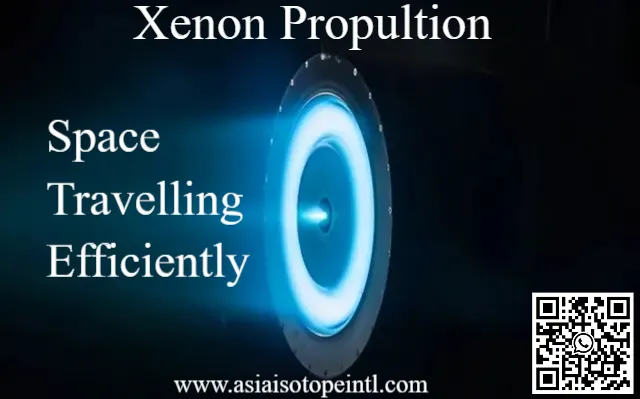
Hall thrusters are famous in space propulsion, but their real contribution to research is that they are compact cross-field plasma laboratories.
A well-cited overview by Choueiri catalogues oscillations across wide frequency bands in Hall thrusters (kHz to tens of MHz) and connects observed behavior to candidate instability mechanisms, including azimuthal drift-wave-like structures that can form rotating spokes.
Modern simulation work continues to emphasize “spoke” behavior as a key channel for electron transport in E×B configurations—simulations of wall-less Hall thrusters report rotating structures with strong coupling to neutral depletion and enhanced cross-field transport.
Why a special-gases expert cares:
The gas is not just “fuel.” Xenon controls:
- neutral density profiles (which set ionization regions),
- collisionality (which affects instability thresholds),
- and impurity sensitivity (which can quietly shift discharge modes).
So when two labs report different instability behavior “at the same power,” check xenon flow control accuracy, purity, and thermal state before arguing about theory.
4.2 Plasma diagnostics where xenon makes your life easier (and harder)
Easier:
- Xenon’s emission lines/bands can provide strong optical signals for spectroscopy (VUV, UV, visible depending on state).
- Heavy ions can make certain ion-energy distributions easier to resolve with typical electrostatic analyzers.
Harder:
- Xenon plasmas can be optically thick in strong lines at higher pressures, complicating inversion from brightness to density.
- VUV diagnostics add vacuum/optics constraints and increase sensitivity to contamination.
That tension is why the most successful xenon plasma labs treat optics and cleanliness as part of plasma physics, not as “support engineering.”
5 Extreme‑Condition Xenon Experiments: Warm Dense Matter, Shocks, and Metallization
If VUV xenon research is about photons and states, extreme-condition xenon research is about something more dramatic: how matter reorganizes when pressure and temperature are forced into regimes where intuition fails.
5.1 Shock-compressed xenon up to 840 GPa: why this result is a benchmark
A landmark experimental study shock-compressed liquid xenon up to 840 GPa, combining measurements with density functional theory (DFT) comparisons and equation-of-state development.
Why xenon is chosen for shock/EOS benchmarking:
- Its high atomic number makes it relevant to radiative properties and high-energy-density modeling.
- It provides a stringent test of EOS models in regimes where ionization and compression are both strong.
- It is a useful “bridge material” between lighter noble gases and heavier, more chemically complex systems.
In practical terms, xenon is one of those materials where experimental EOS data becomes a community reference point for validating simulation pipelines.
5.2 Xenon metallization near 132 GPa: an elegant insulator-to-metal transition story
Under static high pressure in diamond-anvil cells, xenon shows an insulator-to-metal transition consistent with band-gap closure, with optical evidence indicating a transition around 132(5) GPa.
This is scientifically important because it demonstrates, in a “chemically simple” element, that:
- even noble gases can undergo profound electronic reconfiguration,
- pressure alone can close band gaps and create metallic behavior,
- and optical diagnostics can capture the transition in a relatively direct way.
For students and early-career researchers, xenon metallization is one of the cleanest case studies of pressure-driven electronic phase change.
5.3 Xenon in laboratory astrophysics: radiative shocks in a controlled cell
Xenon’s high atomic number makes it excellent for radiative shock experiments: the shocked plasma can radiate strongly, which helps researchers reproduce astrophysically relevant regimes (radiative precursors, cooling zones) at laboratory scale.
For example, published laboratory radiative-shock work describes shocks driven in cells filled with xenon gas (e.g., around 0.2 bar in one reported setup), enabling time-resolved measurements and model comparisons.
More recent experimental reports continue to use xenon gas in laser-driven radiative shock platforms and explicitly connect the parameter space to core-collapse supernovae analogs.
This is where xenon becomes a “physics amplifier”: it helps radiation matter enough that you can observe and measure it in a finite laboratory apparatus.
5.4 High-pressure xenon scintillation: extreme conditions meet photonics
High-pressure xenon is also studied as a scintillator medium for radiation detection. One experimental study reports high-pressure xenon scintillation performance around 40 bar, including reported light yield and energy resolution figures in the context of gamma spectroscopy development.
Why this belongs in the “extreme-condition” conversation:
- Dense xenon changes electron transport and recombination physics.
- Photon transport becomes more sensitive to absorption and scattering.
- Engineering constraints (pressure vessels, window materials, cleanliness) become first-order design drivers.
This is a beautiful example of xenon connecting materials engineering, photon physics, and instrument performance.
6 A Reliability Mindset for Xenon Research: What Seasoned Labs Standardize
Even though your topic is “cutting-edge research,” the labs that publish consistently tend to standardize the same fundamentals.
6.1 Standardize gas handling the way you standardize electronics
If you want stable VUV emission or stable plasma modes, treat your xenon system as a precision instrument:
- Use metal-sealed regulators/valves when possible (to reduce outgassing).
- Bake and evacuate volumes that see VUV optical paths.
- Keep a “materials blacklist” near VUV lines-of-sight (certain elastomers, some adhesives, contaminated plastics).
6.2 Standardize calibration references
- Use NIST-grade references and databases for spectral line checks when you can.
- Document detector sensitivity drift (VUV photodetectors can degrade or drift with exposure and contamination).
- Record pressure, temperature, and flow histories: xenon behavior is sensitive to density and electron collision rates.
6.3 Standardize a “contamination suspicion protocol”
When data shifts:
- Check for leaks / backstreaming / outgassing
- Check oxygen/moisture
- Check optics contamination
- Only then argue about new plasma physics
This mindset is not pessimism—it’s how high-output labs protect their time.
7 What’s Next: Emerging Directions Where Xenon Research Is Moving Fast
7.1 Better krypton/xenon separation (because supply purity is not trivial)
As xenon demand grows across technology sectors, Kr/Xe separation remains important. Materials science work continues to explore adsorption-based separation approaches as alternatives or complements to cryogenic processes, including modern MOF-based strategies that explicitly target trace krypton handling.
For advanced research, this matters because:
- krypton can be an unwanted impurity in some detector and spectroscopy contexts,
- and separation capability affects cost and availability of “research-clean” xenon.
7.2 VUV materials and coatings engineered specifically for xenon scintillation bands
Research on VUV-reflective coatings and VUV transport in detector materials highlights how much performance can be gained—or lost—by surface science at ~175 nm.
Expect more crossover between:
- particle physics detector coatings,
- semiconductor VUV surface processing,
- and plasma-facing material studies.
7.3 Extreme-condition xenon as an EOS “anchor” for simulation pipelines
Shock-to-DFT validation efforts in xenon are not slowing down; xenon remains a favored material to cross-check EOS modeling in regimes where ionization, compression, and radiation all compete.
Closing perspective (from a special-gases Manufacturer)
Xenon is one of the rare materials that can credibly sit in the center of three different frontiers at once:
- VUV emission science (atomic lines, excimers, scintillation),
- plasma dynamics (instabilities, transport, cross-field physics),
- extreme-condition physics (shock compression, metallization, radiative shocks).
And the common thread is not “xenon is expensive”—it’s that xenon gives you strong, interpretable signals in regimes where many other media become chemically or diagnostically chaotic.
If you treat xenon as a precision research tool—purity-controlled, contamination-managed, and instrumented with VUV-aware engineering—it will reward you with data that is both publishable and genuinely revealing.
Would you like a deeper dive into any specific technical parameters or applications?
As an industry leader focused in Specialty Gases products, our goal is to support our customers by keeping them at the forefront of their industries. We’re here to help with any questions you might have so you can transform your ideas into reality, and tackle those big science challenges.
Get free consultant, our experts are ready to serve.
(Follow up our update articles on www.asiaisotopeintl.com or send your comments to tao.hu@asiaisotope.com for further communications)