Octafluorocyclopentene (C5F8): The Eco-Friendly Revolution in High-Precision Semiconductor Etching
BY Tao, Published Jan 30, 2026
Introduction: When Environmental Responsibility Meets Technological Excellence
Throughout my experience in the specialty gas industry, I’ve witnessed a fundamental transformation in how we approach semiconductor manufacturing. In the early days of my career, process optimization meant one thing: maximizing yield and throughput, often with little consideration for environmental impact. Nowaday, we face a more nuanced challenge—delivering the precision required for cutting-edge microelectronics while dramatically reducing our environmental footprint.
It isn’t merely about regulatory compliance or corporate public relations. The semiconductor industry’s climate impact has become a legitimate concern that demands genuine solutions. Enter Octafluorocyclopentene (C₅F₈)—a compound that represents something increasingly rare in modern manufacturing: a technology that simultaneously improves process performance while substantially reducing environmental harm.
As someone who has evaluated hundreds of etching chemistries across diverse applications, I can state with confidence that C₅F₈ represents a watershed moment. It proves that we don’t need to choose between technological advancement and environmental stewardship. We can—and must—achieve both.
The Environmental Challenge: Semiconductor Manufacturing’s Hidden Climate Impact
Before discussing solutions, let’s establish the scope of the problem. The semiconductor industry, despite its relatively small physical footprint compared to heavy industries, has an outsized climate impact driven largely by process gas emissions.
The Perfluorocompound Problem
Perfluorocarbons (PFCs)—fully fluorinated compounds used extensively in chip manufacturing—are among the most potent and persistent greenhouse gases known to science. Consider these sobering facts:
Carbon tetrafluoride (CF₄), a traditional etching gas, has a Global Warming Potential (GWP) of 7,390 times that of carbon dioxide over a 100-year period. Even more troubling, CF₄ has an atmospheric lifetime of approximately 50,000 years. Yes, you read that correctly—emissions released today will continue warming our planet for five hundred centuries.
Hexafluoroethane (C₂F₆), another common etchant, boasts a GWP of 12,200 and an atmospheric lifetime exceeding 10,000 years. A single kilogram of C₂F₆ released into the atmosphere has the warming equivalent of driving a typical passenger car for approximately 50,000 miles.
Nitrogen trifluoride (NF₃), widely used for chamber cleaning, has a GWP of 17,200—making it nearly 17,200 times more effective at trapping heat than CO₂ on a molecule-for-molecule basis.
Quantifying the Industry’s Footprint
The scale of semiconductor manufacturing amplifies these concerning properties. A modern 300mm wafer fabrication facility might produce 40,000-60,000 wafer starts per month. Each wafer undergoes dozens of process steps involving fluorinated gases. Multiply this by hundreds of fabs worldwide, and we’re discussing emissions measured in millions of metric tons of CO₂-equivalent annually.
According to industry analyses, PFC emissions from semiconductor manufacturing constitute approximately 2-3% of the sector’s total greenhouse gas footprint—seemingly small until you realize this percentage represents the warming equivalent of several coal-fired power plants operating continuously.
More concerning still, as semiconductor demand grows (driven by artificial intelligence, 5G communications, Internet of Things, and countless other applications), this environmental burden threatens to expand proportionally unless we fundamentally change our approach.
Octafluorocyclopentene (C₅F₈): The Green Chemistry Alternative
This brings us to Octafluorocyclopentene, a compound whose environmental profile represents a dramatic departure from conventional fluorocarbon process gases.
Understanding the Molecular Advantage
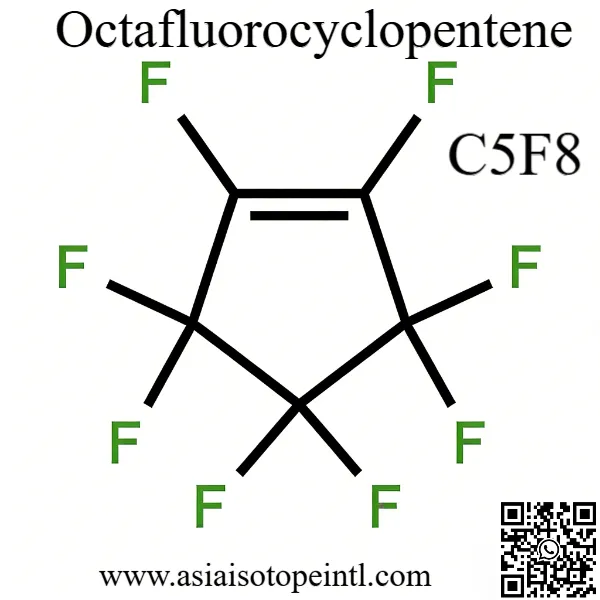
C₅F₈, with its molecular formula indicating five carbon atoms and eight fluorine atoms arranged in a cyclic structure with one double bond, might appear similar to other fluorocarbons at first glance. However, its environmental behavior differs dramatically due to several key factors:
Atmospheric Lifetime: While CF₄ persists for millennia, C₅F₈ has a significantly shorter atmospheric lifetime. The carbon-carbon double bond and cyclic structure make it more susceptible to atmospheric degradation processes, including photochemical breakdown and reaction with hydroxyl radicals—the atmosphere’s natural “detergent” molecules.
Global Warming Potential: C₅F₈ has a 100-year GWP of approximately 90. Let that sink in for a moment. Compared to CF₄’s GWP of 7,390, we’re looking at a roughly 82-fold improvement. Against C₂F₆’s GWP of 12,200, the advantage exceeds 135-fold. This isn’t an incremental improvement—it’s a fundamental transformation of the environmental equation.
No Ozone Depletion: Unlike some chlorofluorocarbons, C₅F₈ does not contribute to stratospheric ozone depletion. Its atmospheric chemistry doesn’t produce chlorine or bromine radicals that catalytically destroy ozone molecules.
Real-World Emission Reductions: The Numbers That Matter
Environmental claims mean little without quantifiable impact. Based on comprehensive process data from leading-edge fabs that have implemented C₅F₈-based etching, the emission reductions are substantial and verifiable.
Per-Wafer Emission Intensity: Substituting C₅F₈ for traditional CF₄/C₂F₆ mixtures in critical etching steps reduces PFC emissions by approximately 67% per wafer processed. This calculation accounts for differences in process time, gas flow rates, and utilization efficiency.
Fab-Level Impact: A high-volume 300mm fab processing 50,000 wafers per month can avoid emissions equivalent to approximately 15,000-20,000 metric tons of CO₂ annually by transitioning to C₅F₈ chemistries. To put this in everyday terms, this is roughly equivalent to:
- Removing 3,000-4,000 passenger vehicles from the road for a year
- The annual carbon sequestration of approximately 20,000-25,000 tree seedlings grown for ten years
- The electricity consumed by 2,500 average American homes annually
Industry-Wide Potential: If the global semiconductor industry fully adopted C₅F₈ where technically feasible, the cumulative emission reductions could exceed several million metric tons of CO₂-equivalent annually—a climate benefit comparable to significant renewable energy deployments.
The Performance Paradox: Better for the Environment AND Better for Chip-Making
Here’s where the C₅F₈ story becomes truly compelling: these environmental benefits come not at the expense of process performance, but alongside significant technical improvements. This defies the conventional assumption that “green” alternatives require performance compromises.
Superior Etch Selectivity: Precision Meets Sustainability
In semiconductor etching, “selectivity” refers to how discriminatingly a chemistry attacks different materials. High selectivity means you can etch through your target material (say, silicon dioxide) while barely touching your mask material (typically photoresist). This is crucial because modern chip features are so small that even minor mask erosion compromises pattern fidelity.
C₅F₈ delivers exceptional selectivity—routinely achieving silicon-to-photoresist ratios exceeding 15:1 in optimized processes. This outperforms traditional CF₄-based chemistries, which typically achieve ratios of 8:1 to 12:1 under comparable conditions.
The mechanism involves C₅F₈’s plasma fragmentation pattern. When energized in the plasma chamber, C₅F₈ produces both etchant species (primarily fluorine radicals) and polymer-forming fragments. These polymer fragments preferentially deposit on photoresist surfaces, forming a protective layer that inhibits etching. Meanwhile, ion bombardment on horizontal silicon surfaces prevents polymer accumulation, allowing etching to proceed.
This self-limiting behavior—protection where you want it, etching where you need it—provides process engineers with unprecedented control. Thinner photoresist layers become viable, enabling finer lithographic resolution. Deeper etches become possible without mask breakthrough. Both outcomes directly support continued device scaling and performance improvement.
Anisotropic Profile Control: Vertical Precision
Modern semiconductor devices require structures with extremely steep, vertical sidewalls. Tapered or bowed profiles cause electrical shorts, performance degradation, and yield loss. C₅F₈ excels at producing highly anisotropic etch profiles—meaning material removal occurs predominantly in the vertical direction.
Field data from production fabs consistently demonstrates sidewall angles of 88-90 degrees using C₅F₈ processes. This near-perfect verticality stems from the interplay between ion-enhanced etching (directional, occurring where ions strike) and sidewall passivation (polymer deposition protecting vertical surfaces).
For advanced nodes—14nm, 10nm, 7nm, and below—this profile control is non-negotiable. Feature dimensions have shrunk to the point where even a 2-3 degree deviation from vertical can compromise device functionality. C₅F₈’s consistent delivery of vertical profiles has made it indispensable for leading-edge production.
Line Width Control: Nanometer-Scale Accuracy
Critical Dimension (CD) control—maintaining target feature dimensions throughout processing—directly impacts chip performance and yield. Variations of just a few nanometers can alter transistor switching speeds, drive currents, and leakage characteristics.
C₅F₈ processes demonstrate exceptional CD uniformity, with 3-sigma (three standard deviations) variation of less than 2nm across 300mm wafers. This uniformity reflects:
Consistent plasma chemistry: C₅F₈’s thermal stability ensures reproducible fragmentation patterns from wafer to wafer.
Reduced micro-trenching: The polymer deposition characteristics minimize the “trenching” effect at feature bottoms, a common defect with more aggressive chemistries.
Lower ion energy requirements: C₅F₈ etches effectively at lower bias powers, reducing physical sputtering effects that can distort features.
The practical outcome? Higher yields, tighter performance distributions, and ultimately more chips per wafer—economic benefits that compound the environmental advantages.
The Business Case: Sustainability as Competitive Advantage
For semiconductor manufacturers navigating an intensely competitive global marketplace, C₅F₈ adoption delivers compelling business value that extends well beyond “doing the right thing environmentally.”
Regulatory Compliance and Risk Mitigation
Environmental regulations surrounding fluorinated greenhouse gases are tightening globally:
European F-Gas Regulations: The EU’s regulatory framework places increasingly strict limits on high-GWP substances, with potential phase-downs that could restrict availability of traditional PFC gases.
California Air Resources Board (CARB): California’s semiconductor facilities face stringent greenhouse gas reporting requirements and reduction targets. C₅F₈’s lower GWP directly facilitates compliance.
International Climate Commitments: As nations implement Paris Agreement commitments, carbon pricing mechanisms and emissions caps may increasingly affect high-GWP industrial gases.
Proactive adoption of low-GWP alternatives like C₅F₈ provides regulatory certainty and reduces exposure to potential carbon pricing or restricted substance lists. In strategic planning terms, this is classic risk mitigation—making today’s voluntary improvements before they become tomorrow’s mandatory requirements.
Corporate Sustainability Goals and Stakeholder Expectations
Leading semiconductor companies have announced ambitious carbon neutrality targets—TSMC by 2050, Samsung by 2050, Intel by 2040. Achieving these commitments requires addressing process gas emissions, which represent significant portions of scope 1 (direct) emissions.
Beyond regulatory drivers, stakeholder expectations are evolving:
Investor Pressure: ESG (Environmental, Social, Governance) considerations increasingly influence investment decisions. Major institutional investors now actively screen for climate risks and emission reduction commitments.
Customer Requirements: Major tech companies like Apple, Google, and Microsoft demand supply chain transparency regarding carbon footprints. Semiconductor suppliers with lower emission profiles gain competitive advantages in customer selection processes.
Employee Recruitment and Retention: Particularly for younger technical talent, employer environmental commitments influence career decisions. Companies demonstrating genuine sustainability leadership find recruiting advantages in competitive labor markets.
Process Economics: The Total Cost of Ownership
While environmental and performance benefits are clear, process economics ultimately drive manufacturing decisions. Here too, C₅F₈ demonstrates advantages:
Reduced Chamber Cleaning Frequency: The polymer characteristics of C₅F₈ processes typically result in less aggressive chamber wall deposition compared to some traditional chemistries, extending intervals between time-consuming chamber cleans.
Higher Throughput: Superior selectivity enables thinner photoresist layers, which require less time to coat, expose, and develop. These time savings accumulate across thousands of wafers.
Improved Yield: Better CD control and profile uniformity translate directly to fewer defects and higher first-pass yields—the single largest driver of per-chip costs in semiconductor manufacturing.
Supply Chain Resilience: As a relative newcomer compared to decades-old CF₄ and C₂F₆, C₅F₈ production infrastructure is more modern and geographically diverse, potentially offering supply security advantages.
Real-World Implementation: Case Studies from Leading Manufacturers
Theory and laboratory results matter, but production validation provides the ultimate proof. C₅F₈ has been successfully deployed in some of the world’s most demanding semiconductor manufacturing environments.
Advanced Logic Production
Taiwan Semiconductor Manufacturing Company (TSMC), the world’s largest dedicated semiconductor foundry, has integrated C₅F₈ into production processes for 7nm and more advanced nodes. Published conference presentations from TSMC process engineers cite consumption figures of approximately 1.2 metric tons per production line annually, indicating significant-scale deployment.
Samsung Electronics, another leading-edge manufacturer, has similarly incorporated C₅F₈ chemistries into its advanced logic fabrication. Industry conference proceedings describe optimization work achieving the high selectivity and profile control necessary for gate patterning and shallow trench isolation—two of the most critical and challenging etching steps in modern chip-making.
The validation from these industry leaders carries enormous weight. These companies operate at the absolute cutting edge of semiconductor technology, where process margins are razor-thin and yield is paramount. Their adoption of C₅F₈ signals that it meets the most demanding performance standards while delivering environmental benefits.
Memory Manufacturing Applications
Beyond logic devices, C₅F₈ has found applications in memory production, where environmental benefits combine with specific technical advantages:
DRAM Capacitor Etching: Dynamic RAM requires deep, high-aspect-ratio capacitor structures. C₅F₈’s ability to maintain vertical profiles in deep etches—aspect ratios exceeding 40:1—proves invaluable. The environmental benefits are particularly significant here, as DRAM production volumes are enormous, with tens of billions of units manufactured quarterly worldwide.
3D NAND Flash: The newest generation 3D NAND structures exceed 100 layers stacked vertically, with channel holes etched through the entire stack. These holes represent some of the most extreme aspect ratios in semiconductor manufacturing—depths exceeding 5 micrometers with diameters below 100 nanometers. C₅F₈’s combination of vertical etch characteristics and controlled polymer formation enables these structures while reducing the PFC emissions that would otherwise accompany such complex processing.
Equipment Cleaning Applications
Beyond direct wafer etching, C₅F₈ serves in chamber cleaning applications—removing unwanted deposits that accumulate on reactor walls during production. Traditional chamber cleaning often employs NF₃ (nitrogen trifluoride), which, as mentioned earlier, has an astronomical GWP of 17,200.
C₅F₈-based remote plasma cleaning, sometimes enhanced with oxygen addition, provides effective cleaning with dramatically lower climate impact. While this represents a smaller fraction of total gas consumption compared to wafer processing, every emission reduction contributes to overall sustainability goals.
Handling and Safety: Responsible Implementation
No discussion of specialty gases would be complete without addressing safety considerations. C₅F₈, like all semiconductor process gases, requires proper handling protocols and safety systems.
Toxicological Profile
Octafluorocyclopentene exhibits high acute inhalation toxicity, with laboratory animal studies indicating LC₅₀ values (the concentration lethal to 50% of test subjects) of approximately 459 ppm for 4-hour exposures in rats. This places C₅F₈ in a similar toxicity range as many traditional semiconductor gases—significant, but manageable with appropriate engineering controls.
Essential Safety Measures
Facilities using C₅F₈ implement multi-layered safety systems:
Primary Containment: Sealed gas delivery systems with welded or high-integrity connections minimize leak potential. Gas cabinets provide secondary containment with dedicated exhaust systems.
Continuous Monitoring: Toxic gas monitors in gas cabinets, process tools, and facility spaces provide early leak detection. Modern monitors can detect concentrations well below hazardous levels, triggering alarms and automatic system responses.
Ventilation and Exhaust: Process tool exhaust systems, often incorporating point-of-use abatement (scrubbing) equipment, ensure that any unreacted gas is safely treated before atmospheric release. Facility ventilation systems provide multiple air changes per hour, preventing accumulation.
Personal Protective Equipment: Maintenance personnel use appropriate respiratory protection during cylinder changes and equipment service. Emergency response teams maintain specialized protective equipment for incident response.
Training and Procedures: Comprehensive training ensures all personnel understand gas properties, recognize warning signs, and know proper emergency procedures.
It’s worth emphasizing that these safety measures are standard practice in semiconductor fabs regardless of specific chemistries. The industry maintains an excellent safety record with specialty gases, reflecting decades of protocol development and continuous improvement in safety culture.
The Path Forward: Future Developments and Emerging Opportunities
As I look toward the next decade of semiconductor manufacturing, several trends will likely amplify C₅F₈’s importance and drive continued innovation around this chemistry.
Next-Generation Device Architectures
The transition from planar transistors to FinFETs (fin field-effect transistors) and now to Gate-All-Around (GAA) nanosheet or nanowire structures creates new etching challenges. These three-dimensional device architectures require simultaneous control of multiple surfaces and interfaces—precisely where C₅F₈’s tunable chemistry excels.
Emerging device concepts—from vertical transport field-effect transistors (VTFETs) to monolithic 3D integration—will push etching requirements even further. The same properties that make C₅F₈ valuable today—selectivity, anisotropy, profile control—will become even more critical as device complexity increases.
Compound Semiconductor Integration
The semiconductor industry is increasingly incorporating compound semiconductors—gallium nitride (GaN), silicon carbide (SiC), gallium arsenide (GaAs)—for specialized applications like power electronics and RF communications. These materials present unique etching challenges due to their strong chemical bonds and resistance to conventional wet chemical processing.
Preliminary research suggests C₅F₈-based plasma chemistries can effectively etch these materials with good profile control. As compound semiconductors become more mainstream—driven by electric vehicle adoption, 5G infrastructure, and renewable energy systems—C₅F₈’s application scope will likely expand beyond traditional silicon processing.
Process Optimization and Mixture Exploration
Current C₅F₈ processes represent early-stage optimization. Significant opportunities exist for refinement through:
Gas Mixture Engineering: Combining C₅F₈ with controlled additions of oxygen, argon, nitrogen, or other gases can fine-tune polymer formation rates and etchant concentrations for specific applications.
Plasma Parameter Optimization: Advanced plasma sources (inductively coupled plasma, capacitively coupled plasma with multiple RF frequencies, pulsed plasmas) enable new ways of activating C₅F₈, potentially unlocking performance improvements not yet realized.
Pressure and Temperature Exploration: Most current processes operate within relatively narrow parameter windows. Systematic exploration of extended parameter spaces may reveal “sweet spots” with enhanced performance or efficiency.
Supply Chain Development
As C₅F₈ adoption expands, supply chain infrastructure will evolve. Current production is concentrated among a handful of specialty chemical suppliers, but growing demand will likely attract new entrants and stimulate capacity expansions.
Geographic diversification of production—establishing synthesis facilities in multiple regions—will improve supply security and potentially reduce transportation-related emissions. Quality standards and purity specifications will continue tightening to meet ever-more-demanding semiconductor process requirements.
A Call to Action: Leadership Through Implementation
Standing at this critical juncture—where technological advancement and environmental responsibility intersect—the semiconductor industry faces a choice. We can continue with business-as-usual approaches, accepting high-GWP emissions as an unavoidable cost of progress. Or we can embrace solutions like Octafluorocyclopentene that prove the false dichotomy between performance and sustainability.
Throughout my career, I’ve learned that true innovation doesn’t accept artificial constraints. The best solutions don’t compromise between competing objectives—they transcend the apparent trade-offs and deliver across multiple dimensions simultaneously.
C₅F₈ represents exactly this type of breakthrough innovation. It demonstrates that environmental responsibility and technological excellence aren’t competing priorities requiring balance—they’re complementary goals that, with the right chemistry (quite literally), can be achieved together.
For process engineers, the message is clear: evaluate C₅F₈ for your critical etching applications. The technical performance alone justifies adoption, and the environmental benefits provide additional compelling reasons.
For fab managers and manufacturing executives, C₅F₈ offers a rare opportunity: improve process metrics, enhance regulatory compliance, advance corporate sustainability goals, and potentially reduce costs—all through a single process change.
For industry leaders and policy makers, the broader lesson is profound: green chemistry isn’t a constraint on innovation—it’s a catalyst for it. By demanding better environmental performance, we drive technical creativity that yields solutions superior to what we would have developed under pure performance optimization.
Conclusion: The Future is Green—and High-Performance
Octafluorocyclopentene (C₅F₈) represents more than just an alternative etching gas. It symbolizes a fundamental shift in how we approach semiconductor manufacturing—a shift that recognizes environmental stewardship not as an unfortunate cost but as a design requirement that drives better solutions.
With its low Global Warming Potential of 90 (versus 7,000-12,000 for traditional alternatives), its proven ability to deliver superior etch selectivity exceeding 15:1, its exceptional anisotropic profile control, and its track record in leading-edge production at facilities like TSMC and Samsung, C₅F₈ has earned its place as a cornerstone technology for sustainable semiconductor manufacturing.
The transition to C₅F₈ and similar low-GWP process gases isn’t merely about reducing emissions—though that alone would justify adoption. It’s about proving that our industry can continue its remarkable trajectory of innovation while dramatically improving environmental performance. It’s about demonstrating leadership on climate issues while simultaneously advancing technological frontiers.
As we collectively work toward a more sustainable future—one where advanced microelectronics power the innovations we need while treading more lightly on our planet—chemistries like Octafluorocyclopentene show the way forward. The revolution in semiconductor etching isn’t coming—it’s already here, one molecule at a time.
Would you like a deeper dive into any specific technical parameters or applications?
As an industry leader focused in Specialty Gases products, our goal is to support our customers by keeping them at the forefront of their industries. We’re here to help with any questions you might have so you can transform your ideas into reality, and tackle those big science challenges.
Get free consultant, our experts are ready to serve.
(Follow up our update articles on www.asiaisotopeintl.com or send your comments to tao.hu@asiaisotope.com for further communications)