Ultra High Purity Nitrogen Supply for Semiconductor Factories: Core Requirements and something you need to know
BY Tao, Published Dec 7, 2025
Ultra High Purity Nitrogen (N₂), as the most widely used “electronic specialty gas” in semiconductor manufacturing, is widely applied throughout the entire process, including wafer cleaning, photolithography, etching, deposition, packaging, and testing, due to its chemical inertness, non-conductivity, and ease of availability.
1. Core Requirements for Nitrogen in Semiconductor Manufacturing
| Requirement Dimensions | Semiconductor Manufacturing (High-end) | General Industrial Fields |
|---|---|---|
| Purity (N₂) | ≥99.999% (5N Grade) or higher | Usually 99.9%-99.99% |
| Dew Point (Moisture Content) | ≤-70℃ or lower | Usually ≤-40℃ |
| Pressure Stability | Extremely high, fluctuation within ±0.01MPa | Relatively loose requirements |
| Particle Control | Extremely strict, usually <0.01μm (or specific particle count) | Has requirements, but lower level |
| Core Application Scenarios | Chip packaging protection, lithography, CVD, cleaning, etc. | Welding, food packaging, chemical coating, etc. |
Purity: The more advanced the process, the higher the requirements.
Basic Requirements: Industrial-grade nitrogen purity ≥ 99.99% (4N), but semiconductor manufacturing requires “electronic-grade high-purity nitrogen,” with mainstream standards ranging from 99.9999% to 99.9999999%;
Mature processes (28nm and above): Primarily use 6N~7N nitrogen, mainly for auxiliary processes such as wafer handling, chamber purging, and drying;
Advanced processes (14nm and below, such as 7nm and 3nm): Require 8N~9N ultra-high purity nitrogen for core processes such as photoresist coating, atomic layer deposition (ALD), and etching. Impurity content (such as O₂, H₂O, CO₂, and particles) must be controlled at ppb (10⁻⁹) level or even ppt (10⁻¹²) level; otherwise, it will lead to wafer surface contamination, film defects, and short circuits.
Key impurity control: O₂ ≤ 0.1ppb, H₂O ≤ 0.1ppb, CO₂ ≤ 0.1ppb, particles (≥0.1μm) ≤ 1 particle/L.
Flow and Pressure Stability: Matching Dynamic Process Requirements
Flow range: Single unit requirements range from tens of L/min to hundreds of m³/h, with total plant flow reaching thousands to tens of thousands of m³/h (depending on plant capacity).
Stability Requirements: Flow fluctuation ≤ ±1%, pressure fluctuation ≤ ±0.05MPa
Pressure Rating: Standard supply pressure is 0.4~0.8MPa (adjustable according to equipment requirements); some high-end equipment requires precise pressure stabilization to ±0.01MPa.
Other Key Indicators
Dew Point: ≤ -70℃ (corresponding to H₂O content ≤ 0.1ppb), preventing water vapor condensation on wafer surfaces or inside equipment;
Oil-Free and Water-Free: Oil must be thoroughly removed during nitrogen preparation and delivery, typically requiring an oil content ≤ 0.01ppm;
Particle Control: Delivery pipelines must be made of stainless steel (316L EP grade), with polished inner walls (Ra ≤ 0.2μm), and equipped with high-precision filters (0.01μm level) to prevent pipeline corrosion or particle shedding.
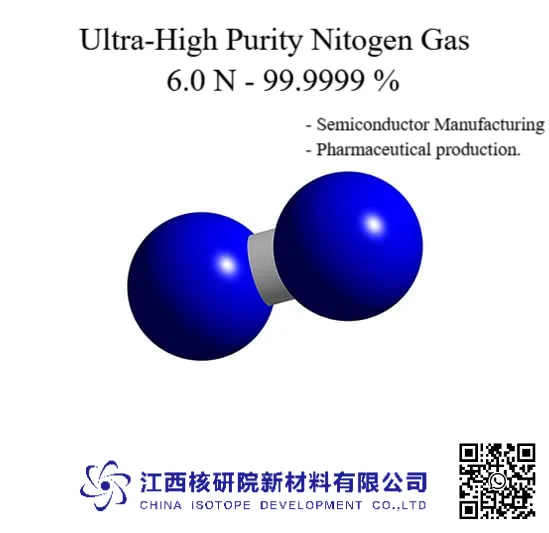
Ultra High Purity Nitrogen N2 Gas
2. Nitrogen Supply System for Semiconductor Factories
The nitrogen supply system for semiconductor factories adopts a “centralized preparation + distributed distribution” model. Its core consists of a nitrogen generation unit, a purification unit, a storage and buffer unit, a delivery and distribution unit, and a monitoring and emergency unit, ensuring a continuous, stable, and high-purity supply.
Nitrogen Source Generation Unit: This is the “heart” of the system. Currently, the mainstream technologies are PSA (Pressure Swing Adsorption) and cryogenic separation, as well as membrane separation.
Storage Tank: Used to balance gas consumption fluctuations, ensure stable supply pressure, and provide a short-term buffer during equipment maintenance.
Pressure Boosting System: Pressurizes nitrogen to the required process pressure (e.g., 0.6-0.8 MPa) and ensures minimal pressure fluctuations.
Distribution Piping: Uses stainless steel (e.g., 316L) EP-grade pipes with electrolytic polishing (EP) of the inner wall and double-sided orbital welding to minimize the generation of particulate matter and precipitated contaminants in the pipeline.
Monitoring and Control Unit: Modern systems come standard with an industrial-grade PLC and touchscreen to monitor key parameters such as purity, pressure, dew point, and flow rate in real time. Data can be recorded and traced, and multi-level alarms can be set for intelligent management.
3. Ultra High Purity Nitrogen Supply in Cylinders
Ultra High Purity Nitrogen , typically contains between 99.9999% to 99.99999% nitrogen, with impurities typically in the parts per billion (ppb) range. This grade of nitrogen is used in applications such as semiconductor manufacturing or pharmaceutical production.
| Component | Unit | Specification |
| N2 | % | ≥99.9999% |
| Ar | ppm | ≤ 2.0 |
| O2 | ppm | ≤ 0.1 |
| CO2 | ppm | ≤ 0.1 |
| H2O | ppm | ≤ 0.5 |
| CH4 | ppm | ≤ 0.1 |
| H2 | ppm | ≤ 0.1 |
China Isotope Development Co.,Ltd is profressional to supply Ultra High Purity Nitrogen N2 Gas to clients over the past years to be qualified supplier of multinational companies, gaining their trust ranging from its quality / price / delivery. We know each parameters of product, to solve their questions on site , and pursuit to continue serving clients better.
Would you like a deeper dive into any Ultra High Purity gases like Argon, Helium, Oxygen , Hydrogen , Methane, Ammonia, Silane ….. etc ?
As an industry leader & reputable manufacturer focused in specialty gases, our goal is to support our customers by keeping them at the forefront of their industries. We’re here to help with any questions you might have so you can transform your ideas into reality, and tackle those big science challenges.
Get free consultant, our experts are ready to serve.
(Follow up our update articles on www.asiaisotopeintl.com or send your comments to tao.hu@asiaisotope.com for further communications)