CH4 as a Strategic Propellant: How Methane is Redefining Aerospace Engineering and Mars ISRU Architectures
BY Tao, Published Jan 27, 2026
Introduction: The Paradigm Shift in Propulsion Chemistry
In the specialized world of industrial gas research, we often view molecules through the lens of their thermal stability, purity, and reactivity. For decades, the aerospace industry operated within a rigid dichotomy: you either chose Refined Petroleum-1 (RP-1 Kerosene) for raw power and density, or Liquid Hydrogen (LH2) for efficiency. It was a trade-off between the “muscle” of kerosene and the “finesse” of hydrogen.
However, as we stand on the precipice of a new era in interplanetary exploration, a third contender has risen from the background to the forefront: Methane (CH4).
As China Isotope Development Co Ltd was starting to supply Ultra High Purity Methane (UHP CH4) to China domestic clients, I can tell you that the shift toward Methalox (a mixture of liquid methane and liquid oxygen) is not merely a trend; it is an engineering inevitability. This shift is driven by the requirements of the next generation of launch vehicles—specifically, the need for full reusability and the audacity of the Mars architecture.
In this deep dive, we will explore why the simplest hydrocarbon is becoming the most strategic molecule in aerospace, analyzing its impact on engine thermodynamics, vehicle reusability, and the holy grail of space exploration: In-Situ Resource Utilization (ISRU).
1. The “Goldilocks” Propellant: Balancing Density and Efficiency
To understand why methane is winning the space race (powering SpaceX’s Starship, Blue Origin’s New Glenn, and LandSpace’s Zhuque-2), we must look at the physics of rocket propulsion.
The Specific Impulse (Isp) Equation
In rocketry, efficiency is measured by Specific Impulse (Isp)—essentially, how many seconds one pound of propellant can generate one pound of thrust.
- Kerosene (RP-1): Low Isp, but high density. Good for getting off the ground, but inefficient in vacuum.
- Hydrogen (LH2): Incredible Isp (high efficiency), but terrible density. Hydrogen is so light that it requires massive fuel tanks, adding structural weight and drag.
- Methane (CH4): The middle ground.
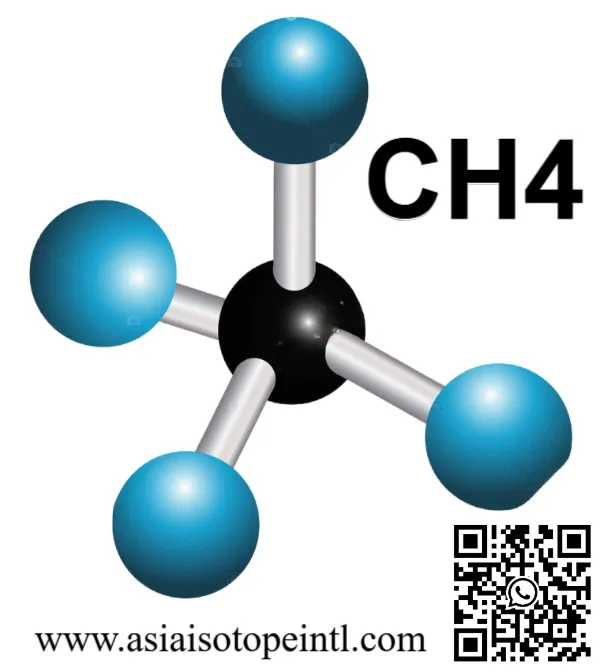
Methane offers a specific impulse closer to hydrogen but with a density closer to kerosene. In my lab analysis, we refer to this as the “Goldilocks” zone. It provides high enough thrust to lift heavy payloads while maintaining a fuel tank size that is structurally manageable.
The Problem of “Coking”
From a chemical perspective, one of kerosene’s biggest drawbacks is polymerization. When RP-1 burns, it leaves behind carbon deposits—soot and resin—known as “coking.” For a disposable rocket, this is fine. But for a reusable engine that needs to fly 10, 50, or 100 times, coking is a disaster. It clogs injectors and degrades turbine blades.
Methane, being a simple single-carbon molecule, burns remarkably clean. There are no long carbon chains to break down into soot. This cleanliness is the silent hero of reusability, allowing engines like the Raptor to operate repeatedly with minimal refurbishment.
2. Cryogenics and the “Soft Cryo” Advantage
As a gas specialist, I spend a lot of time dealing with boiling points. This is where methane offers a subtle but profound engineering advantage over hydrogen.
Liquid Hydrogen must be stored at near-absolute zero (approx. -253°C or 20 Kelvin). This requires immense insulation and poses severe material challenges, such as hydrogen embrittlement (where hydrogen atoms weaken metals).
Liquid Methane, however, boils at -161.5°C (111.6 K). While still cryogenic, this temperature is chemically compatible with Liquid Oxygen (LOX), which boils at -183°C (90 K).
The Common Bulkhead Solution
Because the temperature ranges of liquid methane and liquid oxygen are similar, engineers can design rocket stages with a common bulkhead—a single thin wall separating the fuel from the oxidizer. With hydrogen and oxygen, the temperature difference is so vast that a shared wall would cause the oxygen to freeze solid or the hydrogen to boil instantly.
By using methane, we reduce the structural mass of the rocket, improving the “mass fraction”—the ratio of propellant to vehicle structure. In aerospace, losing weight is the only way to gain capability.
3. High-Purity Requirements: It’s Not Just Natural Gas
A common misconception I encounter is the idea that aerospace companies are just pumping “natural gas” into rockets. As a purity expert, I must clarify: Rocket Grade Methane is not the same as the LNG (Liquefied Natural Gas) used for heating homes.
Standard LNG contains impurities like sulfur compounds, nitrogen, and heavier hydrocarbons (ethane, propane). In the extreme environment of a rocket engine turbopump spinning at 100,000 RPM, even trace amounts of sulfur can cause corrosion, and varying hydrocarbon ratios can lead to combustion instability (engine chugging).
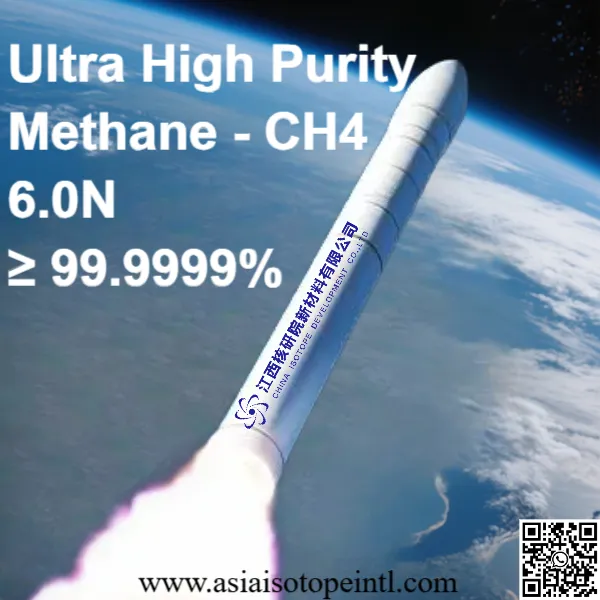
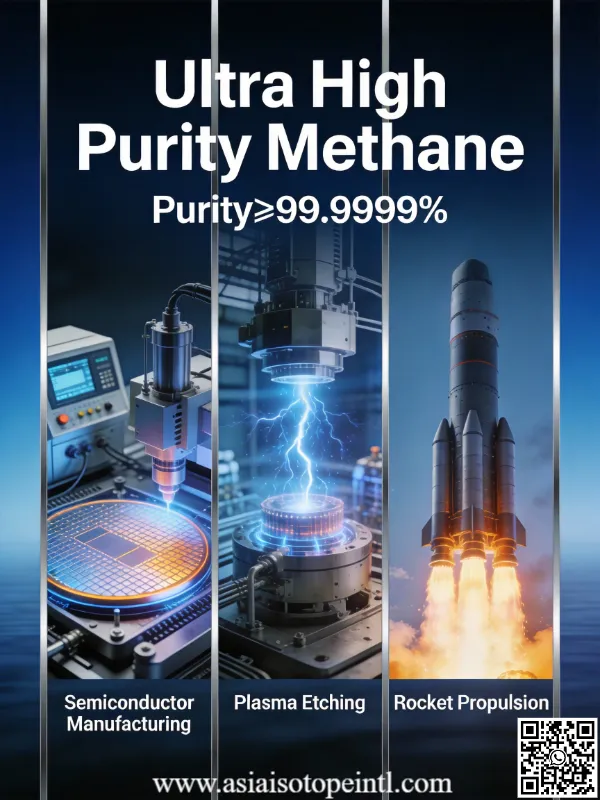
We are seeing a surging demand for ultra-high purity methane (99.99% or higher). Processing methane to this level involves rigorous distillation and filtration to remove trace moisture and sulfur. The reliability of a billion-dollar mission often hangs on the purity of the gas in the tank.
4. Mars ISRU: The Strategic Pivot
If we were only going to the Moon, hydrogen might still be the king. But the target is Mars, and that dictates the chemistry. This is where the Sabatier Reaction makes methane the undisputed choice for interplanetary colonization.
The Tyranny of the Rocket Equation
The Tsiolkovsky rocket equation dictates that for every kilogram of payload you want to bring back from Mars, you need to bring massive amounts of fuel to get it there first. It is currently impossible to launch a rocket from Earth carrying enough fuel to fly to Mars, land, and fly back.
Therefore, you must make your fuel on Mars.
The Chemistry of Mars
The Martian atmosphere is 95% Carbon Dioxide (CO2). Water ice (H2O) is abundant in the Martian regolith (soil). Through a process called electrolysis, we can split water into Hydrogen and Oxygen. Then, using the Sabatier process (discovered by French chemist Paul Sabatier in the 1910s), we combine that Hydrogen with Martian CO2:
𝐶𝑂2+4𝐻2→𝐶𝐻4+2𝐻2𝑂
The Result: Methane (Fuel) and Water. The water is recycled back into the system to make more hydrogen.
This is the keystone of the SpaceX Starship architecture. You cannot do this efficiently with kerosene (too complex to synthesize) or hydrogen (too difficult to store liquid hydrogen on Mars for years without it boiling off). Methane is the only propellant that is manufacturable on Mars and stable enough to be stored for the return journey.
5. The Engineering Revolution: Full-Flow Staged Combustion
The adoption of methane has enabled a leap in engine cycles, specifically the Full-Flow Staged Combustion (FFSC) cycle, used in the Raptor engine.
In traditional engines, a small amount of fuel is burned to spin the pumps, and the exhaust is dumped overboard (wasted). In staged combustion, that exhaust is fed back into the main chamber.
However, doing this with oxygen-rich gas is incredibly dangerous because hot oxygen eats metal. Doing it with kerosene is difficult because of the soot (coking).
Methane allows for a “clean” burn on both the fuel side and the oxidizer side of the turbopumps. This allows the engine to run at chamber pressures previously thought impossible (300+ bar). Higher pressure means more thrust from a smaller engine. It is the chemical stability of methane that makes this thermodynamic wizardry possible.
6. Economic and Environmental Implications
The Cost Per Kilogram
From an economic standpoint, methane is abundant and cheap. While Rocket Grade Methane is processed, the feedstock is widely available compared to the energy-intensive process of liquefying hydrogen. When you combine cheap fuel with reusable rockets (enabled by clean-burning methane), the cost to orbit drops from $10,000/kg to potentially under $100/kg in the coming decade.
The Environmental Question
Is methane “green”? Methane is a potent greenhouse gas if leaked. However, when burned efficiently in a rocket, the byproduct is mostly CO2 and water vapor. While rockets do emit CO2, the soot (black carbon) from kerosene rockets is actually more concerning for the upper atmosphere because it absorbs sunlight and warms the stratosphere. Methane burns relatively cleanly, producing negligible soot. As launch cadences increase from annually to daily, the clean-burning nature of methane will become a regulatory necessity.
Conclusion: The Molecule of the Future
In summary, the aerospace industry’s transition to methane is not a fad; it is a calculation of physics, chemistry, and strategy.
- Performance: It balances the high efficiency of hydrogen with the manageable density of kerosene.
- Reusability: It burns clean, eliminating coking and enabling rapid engine turnaround.
- Storability: Its “soft cryo” temperatures allow for lighter tanks and common bulkheads.
- Mars Architecture: It is the only viable fuel for In-Situ Resource Utilization, serving as the literal ticket home from the Red Planet.
As we look toward a future where humanity becomes a multi-planetary species, the humble methane molecule—refined to extreme purity and compressed into the hearts of giant machines—will be the workhorse that carries us there. It is a triumph of chemical engineering meeting aerospace ambition.
For those of us in the gas industry, ensuring the supply, purity, and handling technologies for this strategic propellant is our contribution to the next great leap for mankind.
Would you like a deeper dive into any specific technical parameters or applications?
As an industry leader focused in Specialty Gases products, our goal is to support our customers by keeping them at the forefront of their industries. We’re here to help with any questions you might have so you can transform your ideas into reality, and tackle those big science challenges.
Get free consultant, our experts are ready to serve.
(Follow up our update articles on www.asiaisotopeintl.com or send your comments to tao.hu@asiaisotope.com for further communications)