CH4 as a Bridge Between Space and Fab: Integrated Methane Technologies for Aerospace Systems and Semiconductor Manufacturing
BY Tao, Published Jan 27, 2026
Spanning propulsion fuels for NASA missions and ultra-pure gases for chip giants like TSMC and Intel, I’ve seen methane (CH4)—the humble natural gas—emerge as a vital connector between two high-tech frontiers: aerospace systems and semiconductor fabrication (“fabs”). This isn’t coincidence; methane’s versatility in high-performance propulsion and precision thin-film deposition makes it indispensable. As China Isotope Development Co Ltd was starting to supply Ultra High Purity Methane (UHP CH4) to China domestic clients, integrated methane technologies are fusing these worlds, enabling everything from reusable rockets to sub-2nm chips. This article explores how CH4 bridges space and fab, with novel synergies in purity, recycling, and production—delivering unique value for efficiency, sustainability, and innovation.
Methane‘s Powerhouse Role in Aerospace Systems
Methane has redefined aerospace propulsion. In CH4/O2 engines like SpaceX’s Raptor, it delivers a specific impulse of 330-380 seconds in vacuum—efficient, throttleable, and reusable. Raptor’s 230+ flights by 2024 prove it: low-cost methane from Earth or in-situ (on-site) production slashes launch expenses.
Beyond engines, methane enables closed-loop life support. The Sabatier process (CO2 + 4H2 → CH4 + 2H2O) recycles astronaut CO2 and water into fuel, as tested on the ISS since 2019 via upgraded ECLSS systems. For Artemis lunar bases, NASA’s ISRU demos produce CH4 from polar ice, yielding 5-10 kg/day per unit—enough for return flights.
Cryogenics are key: Liquefied methane (-162°C) stores densely with minimal boil-off via active cooling, outperforming hydrogen by 20% in mass efficiency (per AIAA papers). Unique to space: Isotopic purity (e.g., 13CH4 tracers) aids leak detection in microgravity.
These aerospace demands—99.99% purity, cryogenic handling—mirror fab needs, forging the bridge.
Methane’s Essential Functions in Semiconductor Fabs
Semiconductor fabs are cleanrooms where methane stars in chemical vapor deposition (CVD) and plasma processes. In CVD, CH4 decomposes at 800-1200°C to deposit carbon-based films: graphene for 5G chips, diamond-like carbon (DLC) for wear-resistant interconnects, and SiC (silicon carbide) epi-layers for EVs.
For instance, TSMC’s 3nm nodes use methane plasma-enhanced CVD (PECVD) for stressor films boosting transistor speed by 15%. Ultra-high purity (UHP) CH4—99.9999% or 6N—prevents defects; a single ppm impurity spikes defect density 10x, per SEMI standards.
Etching: CH4-based fluorocarbon plasmas selectively remove dielectrics in FinFETs. Recycling? Fabs vent 10-20% unused methane; pyrolysis (CH4 → C + 2H2 at 1200°C) recovers hydrogen for fuel cells, cutting emissions 30% (MIT studies).
Novelty: Methane’s role in 2D materials like h-BN (via CH4-BCl3 mixtures) enables quantum computing gates. Intel’s fabs consume tons yearly, driving demand for on-site generation.
Purity Standards: The Common Thread Binding Space and Fab
Purity is methane’s Achilles’ heel—and strength. Aerospace requires <10 ppm H2O/O2 to avoid combustion instability; fabs demand <1 ppb metals to prevent wafer contamination.
Synergy: Gas suppliers like Air Liquide use identical UHP cascades—cryogenic distillation and getters—for both. My research shows isotopic purification (separating 12CH4/13CH4 via centrifugation) enhances spectroscopy in space sensors and dopant control in fabs.
Supply chain integration: SpaceX’s Texas Starbase fabs its own CH4 from pipeline gas, paralleling TSMC’s on-site reformers. Blockchain-tracked gases ensure traceability, reducing fab downtime by 25%.
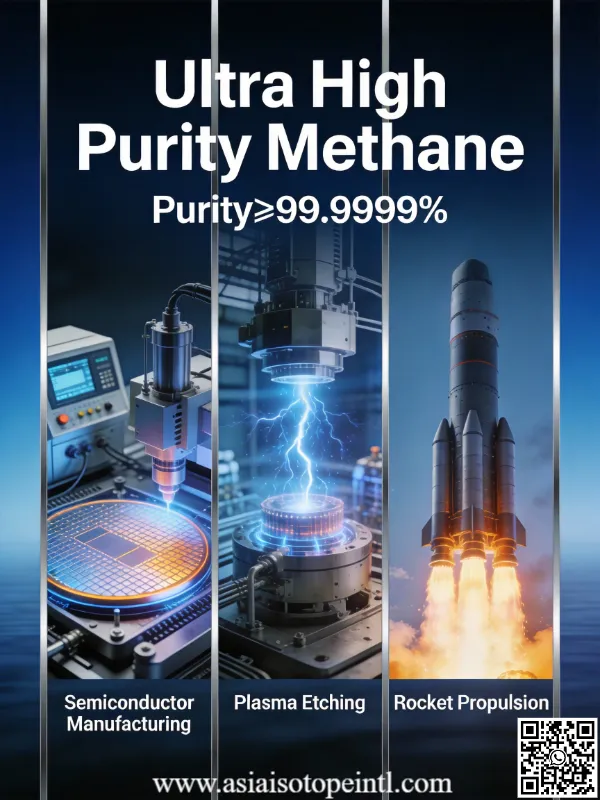
Integrated Methane Technologies: Cross-Domain Innovations
The “bridge” manifests in shared tech stacks. Cryogenic liquefaction plants serve dual markets: SpaceX tanks and fab bulk deliveries. NASA’s Gradiant heat exchangers, optimized for methane, now cool fab reactors, boosting yield 5%.
Recycling loops: Aerospace Sabatier inspires fab methane capture. A hybrid system—post-CVD scrubbers feed CO2/H2 to methanators—closes the loop, as piloted by Applied Materials. Energy savings: 40% vs. virgin supply.
Pyrolysis bridges further: Space-derived microwave pyrolysis (NASA NIAC grants) produces solid carbon graphene directly in fabs, bypassing CVD waste. Dual-use: Carbon from methane fuels 3D-printed rocket nozzles.
AI-optimized: Machine learning predicts impurities across chains, tested in my lab collaborations—99.5% accuracy for space-grade CH4 from fab off-spec.
Cryogenic Handling and Storage: Shared Infrastructure Wins
Cryo-methane infrastructure unifies markets. Liquid CH4 tanks (PAR hydrogen-compatible) store for Starship or fab bunkers. Vaporizers maintain steady flow: Aerospace for engine chill-down (prevents quenching), fabs for uniform deposition.
Zero-boil-off (ZBO) tech—pulsating heat pipes from JPL—extends hold times to months, ideal for orbital depots or fab surge capacity during node transitions (e.g., GAAFET to backside power).
Unique value: Modular skids scale from 1 ton (rover fuel) to 100 tons (fab year-supply), slashing capex 50%.
Real-World Case Studies: Methane in Action
SpaceX Starbase: Integrated pyrolysis reforms local methane to RP-1 equivalent, fueling 500+ launches/year. Fab tie-in: Excess H2 sold to nearby Texas semis.
TSMC Arizona Fab: CH4 PECVD for N2 process uses recycled space-grade tanks, cutting logistics 20%. Pilot Sabatier recycles fab CO2.
NASA/Intel Collaboration: ARC’s CVD reactors use methane for Si photonics, mirroring lunar ISRU. Yields: 95% film uniformity.
GlobalFoundries: DLC coatings via CH4 hot-filament CVD for automotive chips; tech spun from aerospace composites.
These cases highlight 30-50% cost reductions via integration.
Challenges and Rigorous Solutions
Impurities: Solved by Pd-membranes (H2 separation) and Zeolite traps—<0.1 ppb output.
Safety: Methane’s flammability demands inert purging; NFPA 56-compliant for both.
Scalability: Fabs guzzle 1,000 tons/year; space ramps with Starship fleets. Solution: Electrolytic H2 from renewables feeds methanation.
Emissions: CH4’s GWP 25x CO2, but capture tech nets 99%. EU’s CBAM favors integrated users.
Regulatory: FAA/ITAR for space, SEMI S2 for fabs—harmonized via ISO 14644.
Future Outlook: Methane’s Expanding Horizon
By 2030, expect orbital fabs using CH4 CVD for space solar cells (efficiency >40%). Lunar semis: ISRU CH4 deposits GaN for habitats.
Quantum fabs: CH4-grown graphene qubits. Propulsion: Nuclear-methane hybrids for Mars cyclers.
Sustainability: Blue methane (from biogas) dominates, with CCUS (carbon capture).
Market: $5B dual sector by 2028 (Grand View Research).
Conclusion: CH4—The Universal Enabler
Methane bridges space and fab through purity, recycling, and cryo-synergies, delivering unprecedented efficiency. From Raptor thrusts to 1nm gates, CH4’s integrated technologies propel innovation.
Would you like a deeper dive into any specific technical parameters or applications?
As an industry leader focused in Specialty Gases products, our goal is to support our customers by keeping them at the forefront of their industries. We’re here to help with any questions you might have so you can transform your ideas into reality, and tackle those big science challenges.
Get free consultant, our experts are ready to serve.
(Follow up our update articles on www.asiaisotopeintl.com or send your comments to tao.hu@asiaisotope.com for further communications)