Description
Product Name: Superconducting Quantum Computer
Main use: Quantum simulation, optimization, and algorithm research.
Availability : In Stock
What is a Superconducting Quantum Computer?
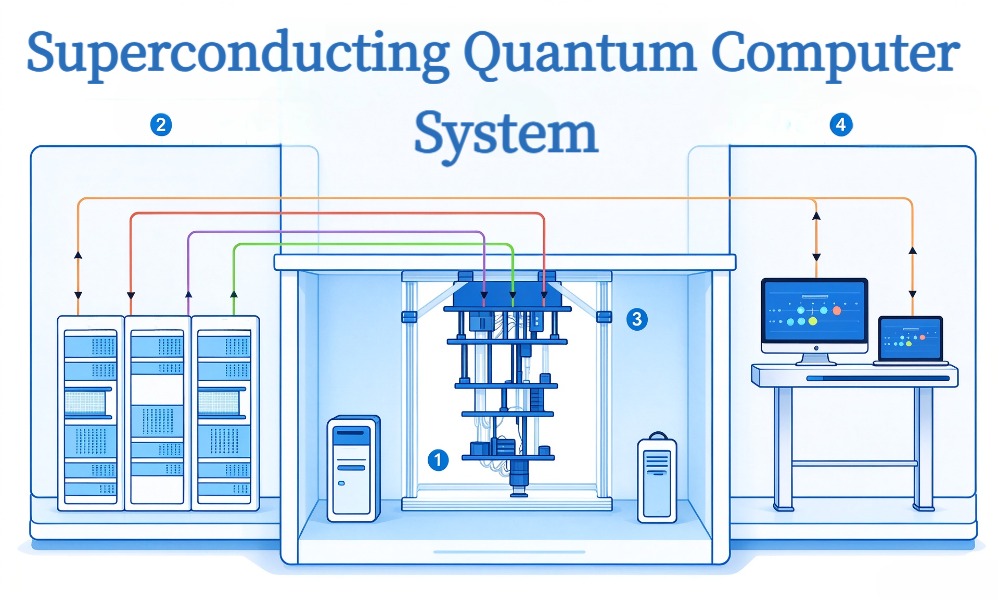
The superconducting quantum computer is the core product of Origin Quantum. This quantum computer contains the superconducting quantum chip system, the quantum computing measurement and control system, the quantum computer operation software system and the quantum computing environment support system.
Certificate of Performance
| Product Model | CID72-400 | CID135-400 | CID180-400 |
|---|---|---|---|
| Number of superconducting qubits | 72 | 135 | 180 |
| Average relaxation time T1 (typical) | ≥60 μs | ≥60 μs | ≥60 μs |
| Average dephasing/coherence time T2 (typical) | ≥40 μs | ≥40 μs | ≥40 μs |
| Average single-qubit gate fidelity (typical) | ≥99.9% | ≥99.9% | ≥99.9% |
| Average two-qubit gate fidelity (typical) | ≥99.0% | ≥99.0% | ≥99.0% |
| Average readout fidelity (typical) | ≥98.0% | ≥98.0% | ≥98.0% |
🌌 The future demands a new paradigm of computing—one that empowers us to explore the world at a deeper level.
🚀 We are dedicated to making this capability accessible to more people, enabling them to do groundbreaking work.
⚛️ Superconducting quantum computers are already here, shaping our lives today.
💡 Contact us and share your vision with us! 👇
tao.hu@asiaisotope.com
What are applications of a Superconducting Quantum Computer?
The superconducting quantum computer is the core product of Origin Quantum. This quantum computer contains the superconducting quantum chip system, the quantum computing measurement and control system, the quantum computer operation software system and the quantum computing environment support system.
1. Quantum Simulation: Materials and Molecular Systems
Quantum simulation is widely regarded as the application closest to practical relevance. Classical computers struggle to represent the exponentially large state spaces of interacting quantum systems; a superconducting quantum processor can, in principle, simulate these systems natively. Current work includes Fermi–Hubbard model dynamics on systems exceeding 100 qubits, variational quantum eigensolvers for materials science benchmarks, and quantum chemistry calculations relevant to drug discovery and catalyst design. By 2026, quantum simulation is moving from proof-of-principle demonstrations toward workflows that can inform real molecular and materials questions.
2. Combinatorial Optimization
Many industrial problems—logistics routing, portfolio optimization, energy scheduling, network design—are combinatorial optimization problems whose classical solution costs grow rapidly with problem size. Superconducting quantum computers can implement quantum optimization heuristics and sampling algorithms that explore solution landscapes differently from classical solvers. Distributed quantum sampling across partitions of a superconducting processor has been demonstrated at the thousand-qubit scale in research settings, with best reported hardware results using 50-qubit partitions. Optimization remains an active research area: the question is not whether a quantum computer “solves” optimization, but for which problem families and at what scale quantum resources offer a genuine advantage.
3. Quantum Algorithm Research and Quantum-Classical Hybrid Computing
Superconducting hardware is the most industrially mature quantum computing platform and serves as a primary testbed for algorithm development. This includes variational algorithms, quantum machine learning primitives, and quantum-classical hybrid loops in which a classical optimizer works alongside a quantum processor. Quantum-assisted AI—using quantum sampling or optimization as a component of a classical machine-learning pipeline—is an emerging direction, though claims of broad near-term AI acceleration should be treated with caution.
4. Foundational Physics and Benchmarking
Superconducting processors are used to study quantum chaos, thermalization, and decoherence in controlled settings. The 78-qubit “Chuang-tzu 2.0” processor, for example, has been used to directly observe and manipulate prethermalisation—a transitional state in quantum systems—and to tune the speed of quantum decoherence. These experiments inform both fundamental physics and the engineering limits of future error-corrected systems.
Important boundary condition: A superconducting quantum computer is not a general-purpose replacement for classical computing infrastructure. For cryptography at cryptographically relevant scales, millions of physical qubits may be required; current systems operate in the NISQ (noisy intermediate-scale quantum) regime, where error rates, connectivity, and coherence remain limiting factors. The system should be evaluated against specific algorithmic targets, not against general computing benchmarks.
Why Choose Our Superconducting Quantum Computer ?
A Complete Turnkey Solution: Origin Quantum Full-Machine Services
Choosing a superconducting quantum computer is not just about purchasing a piece of hardware; it is about building a reliable, long-term research infrastructure. We stand out by offering a comprehensive, end-to-end “Turnkey” service package that covers the entire lifecycle of your quantum system:
Secure Supply & Delivery
We provide direct-from-manufacturer supply with fully validated logistics. A superconducting system requires extreme care during transit. We utilize specialized anti-vibration packaging and strict environmental controls to ensure the delicate cryogenic components and wiring arrive at your facility in perfect condition.
Professional Equipment Installation
Our team conducts thorough on-site assessments and handles the physical setup of the entire system. This includes assembling the complex dilution refrigerator, integrating the control electronics, and seamlessly connecting the system to your facility’s power, cooling water, and network infrastructure, saving your team valuable time and effort.
Precise Equipment Commissioning
Installation is followed by rigorous expert commissioning. We manage the complex process of system evacuation, cool-down, and wiring verification. Our engineers perform precise qubit calibration to ensure the system meets the agreed performance specifications, transitioning it from a physical assembly into a fully functional quantum computer.
Comprehensive Trial Operation Support
We do not just hand over the keys; we ensure you can actually drive it. Our technical experts provide dedicated on-site support to help your researchers run their first quantum algorithms and benchmarks. We assist in system optimization and provide hands-on training, ensuring a smooth transition from installation to actual scientific research.
Long-Term Operation & Maintenance
Quantum systems demand continuous expert care. We provide comprehensive O&M services, including preventive maintenance, cryogenic consumable management (such as helium-3 circulation), regular hardware/software updates, and rapid-response troubleshooting. We guarantee maximum system uptime and extend the lifespan of your investment, allowing your team to focus entirely on scientific breakthroughs.
Frequently Asked Questions (FAQs)
Q1. What is a superconducting quantum computer in simple terms?
A: It is a special type of computer that uses tiny superconducting circuits as its basic working units. Unlike a normal computer that uses 0 or 1, these units can behave in more than one state at the same time. This may help solve certain very hard problems.
Q2. How is it different from a normal computer?
A: A normal computer handles everyday tasks step by step. A superconducting quantum computer is not faster for everyday work. It is designed for special research and computing problems where its different way of working may be useful.
Q3. What can it be used for?
A: It can already be used for quantum computation and quantum communication.
Q4. Why does it need very cold temperatures?
A: The tiny circuits only show their special behavior when kept extremely cold. Without cold conditions, they lose that behavior and cannot work as needed. So cooling is a core part of the system, not an accessory.
Q5. Can it replace my normal computer?
A: No. It is not a replacement for normal computers. It is a specialized machine for certain research and computing tasks, and it usually works alongside normal computers.
Q6. Is it easy to buy and use?
A: No. It is a large, complex system that needs special facilities and trained people. It is not a home or office device. Organizations usually access it through specialized providers or research facilities.
Q7. Is it safe to be around?
A: The main safety concerns are very cold equipment and electrical systems, not radiation. Trained staff follow safety rules. In normal operation, it does not produce dangerous radiation.
Q8. What kind of place does it need?
A: It needs a dedicated room with stable power, cooling, protection from vibration, and careful control of its surroundings. It is not something you can put on a desk.
Q9. Why use superconducting technology?
A: Superconducting circuits are one of the more developed approaches to building quantum computers. They can perform operations quickly and have a growing research and industry base. But they are not the only approach.
***** Ready to Order Superconducting Quantum Computer? *****
- Get competitive pricing
- Fast response within 24 hours
- Technical consultation available
Contact Us tao.hu@asiaisotope.com