Description
Product Name: Perfluorobutanesulfonyl Fluoride | PBSF | CAS: 375-72-4
CAS: 375-72-4
Purity: ≥98.0%
Product specifications: 250 g, 1 kg, 25 kg.
Main use: mainly used as a sulfonylation reagent and chemical intermediate to make nonaflates, fluorinated surfactants, and specialty fluorinated compounds.
Availability: In Stock
What is Perfluorobutanesulfonyl fluoride (PBSF)?
Perfluorobutanesulfonyl fluoride (PBSF, C₄F₉SO₂F) is a perfluorinated sulfonyl fluoride in which a perfluorobutyl chain is directly attached to a highly reactive sulfonyl fluoride group. It is a colorless, transparent liquid at room temperature, with a molecular weight of approximately 302.09 g/mol, a density of about 1.68–1.72 g/mL, and a boiling point of about 64–66 °C. Its low surface energy, chemical inertness of the perfluorobutyl chain, and high electrophilicity of the –SO₂F group make PBSF a useful non-isotopic fluorinating and perfluoroalkylating building block for introducing the perfluorobutylsulfonyl group into target molecules.
Certificate of Analysis
| Test Item | Specification |
|---|---|
| Appearance | Colorless transparent liquid |
| Purity (GC) | ≥98.0% |
| Water Content | ≤0.20% |
| Free Fluoride (F⁻) | ≤20 ppm |
| APHA Color | ≤30 |
| Heavy Metal (Pb) | ≤5 ppm |
| Boiling Range | 52–56 ℃ |
| Density (25℃) | 1.69–1.72 g/mL |
| Refractive Index n20D | 1.302–1.310 |
| Residue on ignition | ≤0.10% |
China Isotope Development Co.,Ltd , with its own plant in the middle of china, is professionally supplying Fluorides products (such as Perfluorobutanesulfonyl Fluoride (PBSF)) to the market over the past years as per client’s particular packages. We are a qualified supplier of many Fine chemicals and pharmaceutical companies , gaining their trust ranging from quality, price, to delivery. We know each parameter of the product, to solve their questions on site, and pursue to continue serving clients better.
For more information, Visit us at www.asiaisotopeintl.com
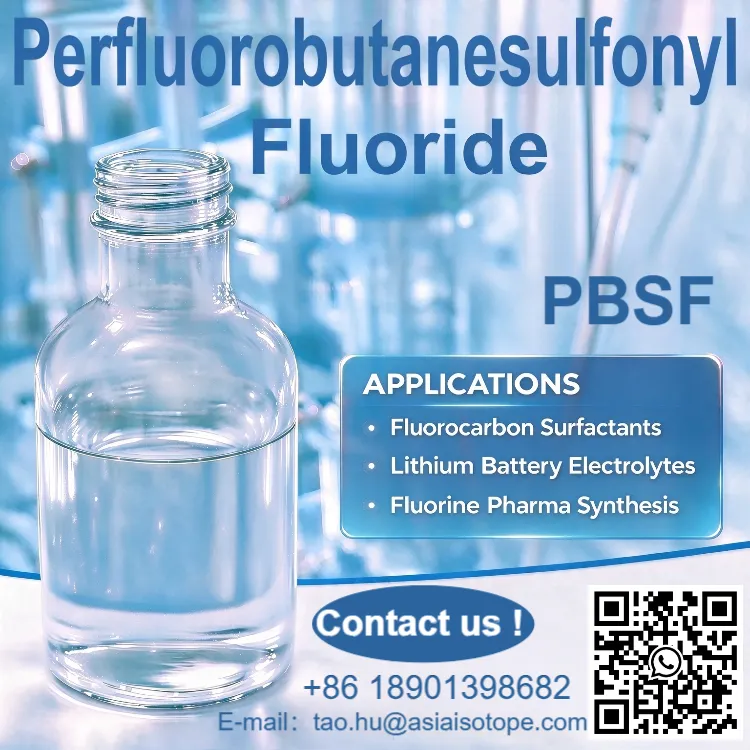
Perfluorobutanesulfonyl Fluoride | PBSF | CAS: 375-72-4
What are applications of Perfluorobutanesulfonyl fluoride (PBSF)?
Perfluorobutanesulfonyl fluoride (PBSF) is a reactive perfluorinated sulfonyl fluoride. Its –SO₂F group reacts with alcohols, phenols, and amines, while the perfluorobutyl chain provides low surface energy and chemical stability. It is used across specialty chemicals, materials, energy, pharmaceutical, and agrochemical fields.
1. High-End Fluorocarbon Surfactants
-
Surfactant Precursor: PBSF is a building block for anionic, cationic, non-ionic, and zwitterionic fluorinated surfactants.
-
Low Surface Tension: PBSF-derived surfactants lower surface tension at low concentrations; the C4 chain reduces bioaccumulation potential relative to long-chain homologs.
-
End Uses: Paints, inks, coatings, fire-fighting agents, and aqueous cleaning formulations.
2. Transparent Flame-Retardant Polycarbonate Materials
-
PFBS Additive: PBSF-derived potassium perfluorobutanesulfonate (PFBS) provides UL94 V-0 flame retardancy in polycarbonate at low loadings.
-
Transparency Retention: Unlike many phosphorus-based flame retardants, PFBS preserves PC transparency.
-
Formulation Note: Above about 0.1% PFBS, transparency can degrade; thin-gauge V-0 often requires a siloxane co-additive.
3. Lithium-Ion Battery Electrolytes
-
Dual-Function Additive: The PBSF-derived PBS⁻ anion forms a LiF-rich SEI, while K⁺ helps homogenize lithium deposition.
-
Dendrite Suppression: This suppresses lithium dendrite growth and electrolyte consumption.
-
Cycling Performance: Reported stable cycling in Li–Cu and Li–LiFePO₄ cells under lean-electrolyte conditions.
4. Synthesis of Novel Fluorinated Pharmaceuticals
-
Deoxyfluorination Reagent: PBSF converts hydroxy groups to fluorine in pharmaceutical intermediates.
-
Nonaflate Cross-Coupling: PBSF-derived nonaflates serve as electrophiles in palladium-catalyzed coupling.
-
Industrial Routes: Used in fluorinated drug intermediate synthesis, including florfenicol and oxazolidinone routes.
5. High-End Fluorinated Pesticides
-
Agrochemical Intermediate: PBSF is used to synthesize fluorinated pesticide intermediates.
-
Property Enhancement: The perfluorobutylsulfonyl group can increase lipophilicity and stability of active ingredients.
-
Building Blocks: PBSF-derived sulfonamide intermediates are useful in agrochemical discovery.
6. Specialty Functional Fluorinated Dyes
-
Compound Distinction: In dye-related contexts, “PBSF” often refers to pentafluorobenzenesulfonyl fluorescein (CAS 728912-45-6), a H₂O₂-selective fluorescent probe—not perfluorobutanesulfonyl fluoride (CAS 375-72-4).
-
Dye Precursor: Perfluorobutanesulfonyl fluoride itself is listed as a precursor for fluorine-containing dyes.
-
Verification: Confirm the CAS number when specifying “PBSF” for dye applications.
Why Choose Our Perfluorobutanesulfonyl fluoride (PBSF)?
High Purity & Stability:
Consistent high chemical purity grades (≥98.0%) and low water content protect your fluorination, sulfonylation, and coupling reactions from hydrolysis-related failures.
Reliable & Stable Supply
We offer better supply security and scalability compared to traders and middlemen who depend on others for stock.
Lower Total Cost of Ownership
Direct supply = competitive price + fewer rejections + less downtime + higher yield. You save money where it matters most—not just on the product price.
Full Traceability & Compliance
Complete production traceability and documentation that meet the demanding requirements of research, pharmaceutical, and specialty chemical industries.
Technical Expertise
In-depth manufacturer expertise to support your specific application—not just selling chemicals, but helping you use it optimally and safely.
Packaging & Delivery Options
Standard Package: 250 g, 1 kg, 25 kg.
Customized packages available.
Frequently Asked Questions (FAQs)
Q1. What is Perfluorobutanesulfonyl fluoride (PBSF)?
A: It is a special type of perfluorinated sulfonyl fluoride liquid. The carbon chain is fully fluorinated, and the sulfonyl fluoride group can be easily detected and reacted by standard laboratory methods. This makes it very useful for synthesis and tracking.
Q2. What is it mainly used for?
A: It is used in organic synthesis, pharmaceutical research, battery material studies, and specialty chemical development. Researchers use it to introduce the perfluorobutylsulfonyl group or to convert alcohols and phenols into reactive fluorinated intermediates.
Q3. Is it natural or radioactive?
A: It is a synthetic fluorochemical and is not radioactive at all. It is handled as a specialty chemical under normal laboratory precautions.
Q4. How should it be stored?
A: It must be kept in a securely sealed container. You should store it in a cool, dry, and well-ventilated place, away from moisture, acids, and direct sunlight. Inert atmosphere storage is recommended for long-term use.
Q5. Is it safe to handle?
A: It is generally considered safe to handle with normal laboratory precautions. It is not classified as a highly toxic material. However, avoid breathing in vapor or dust and wear basic protective equipment such as gloves and a mask, as with any reactive fluorochemical.
Q6. Is it bad for the environment?
A: It is a PFAS-class fluorochemical and should not be released into the environment. It should be handled carefully to avoid unnecessary release, and waste should be disposed of according to local regulations.
Q7. Are there special rules for shipping it?
A: It is classified as a dangerous good for transport. It is shipped as a corrosive chemical product (UN 3265, Class 8, Packing Group II) in sealed containers with moisture-proof protection. It requires hazardous materials logistics.
Q8. How long does delivery usually take?
A: If the product is in stock, we can usually arrange shipment within a few business days. The exact delivery time depends on your location and customs clearance for international orders.
Q9. Why is it useful for research?
A: It acts like a reactive “building block.” Because standard machines can easily detect fluorinated products, scientists can follow exactly where the perfluorobutylsulfonyl group goes during tests without disturbing the process.
Q10. Why choose this instead of a longer-chain sulfonyl fluoride?
A: You only choose this if you need a C4 perfluorobutyl sulfonyl fluoride building block or a deoxyfluorination/nonaflate reagent. It is not safer or more dangerous than longer-chain sulfonyl fluorides—it is a shorter-chain alternative. If you do not need the perfluorobutyl group or sulfonyl fluoride reactivity, another reagent may be enough.
***** Ready to Order Perfluorobutanesulfonyl fluoride (PBSF)? *****
- Get competitive pricing
- Fast response within 24 hours
- Technical consultation available
Contact Us tao.hu@asiaisotope.com