Zinc-68 Isotope: The High-Abundance Stable Target Material Leading the Revolution in Next-Generation Medical Radionuclide Production
BY Tao, Published Dec 14, 2025
With more enquiries on Zinc-68 Isotope from web, I would like to share my production experience and operation these year to more end users who are interested. As a nuclear staff with more than 5 years of hands-on experience in stable and radioactive isotope research and production, I have witnessed the entire evolution of medical radionuclide supply chains. Few developments have excited me as much as the rapid rise of enriched zinc-68 (⁶⁸Zn) as the cornerstone target material for gallium-68 (⁶⁸Ga) production. Today, ⁶⁸Zn is no longer just one option among many — it is the enabling technology that is finally breaking the bottleneck of ⁶⁸Ga supply and making truly decentralized, high-volume production of next-generation PET tracers a reality.
Zn 68
1. Basic Nuclear Properties of Zinc-68 — Why Nature Chose It
Zinc has five stable isotopes. ⁶⁸Zn has the second-highest natural abundance at 18.50–18.80 % (the highest is ⁶⁴Zn at ~49 %). This apparently modest number becomes a huge practical advantage when we need to produce ⁶⁸Ga via the ⁶⁸Zn(p,n)⁶⁸Ga reaction.
Key nuclear data that matter in daily production:
- Natural abundance: 18.50 % (IAEA 2022 update)
- Recommended enrichment level for modern solid targets: ≥99.0 %, typically 99.2–99.8 %
- Nuclear reaction: ⁶⁸Zn(p,n)⁶⁸Ga
- Optimum proton energy window: 13–14 MeV incident → 8–10 MeV on target (after degraders)
- Theoretical thick-target yield (13.5 MeV): ~280 MBq/µAh with natural Zn, >1,500 MBq/µAh with >99 % ⁶⁸Zn
- Half-life of daughter ⁶⁸Ga: 67.83 minutes
- Decay mode: 89 % positron emission (Eβ⁺max = 1.92 MeV), perfect for PET
These numbers explain why every major supplier — Eckert & Ziegler, ITG, IRE ELiT, and now Asian manufacturers — has moved to highly enriched ⁶⁸Zn solid targets in the past five years.
2. The Historical Bottleneck: Generator-Dependent ⁶⁸Ga Supply
Until ~2018, >95 % of the world’s clinical ⁶⁸Ga came from ⁶⁸Ge/⁶⁸Ga generators. These generators rely on ⁶⁸Ge (T½ = 270.95 d) produced by high-energy proton spallation of molybdenum or rubidium, followed by elaborate chemical separation. The process is expensive, centralized, and limited to a few facilities worldwide (Brookhaven, Los Alamos, iThemba, ARRONAX).
Consequences for clinics:
- Generator cost: 35,000–55,000 USD per unit
- Maximum elution activity: ~1.85 GBq at calibration
- Only 2–8 patients per day possible in most centers
- Cold-chain logistics and customs delays common outside Europe/North America
The breakthrough came when cyclotron groups demonstrated that low-energy medical cyclotrons (16–19 MeV) could produce clinically relevant amounts of ⁶⁸Ga directly using enriched ⁶⁸Zn pressed or electroplated solid targets. A single 60–90 minute irradiation at 30–50 µA now routinely yields 40–90 GBq of ⁶⁸Ga — enough for 50–100 patient doses.
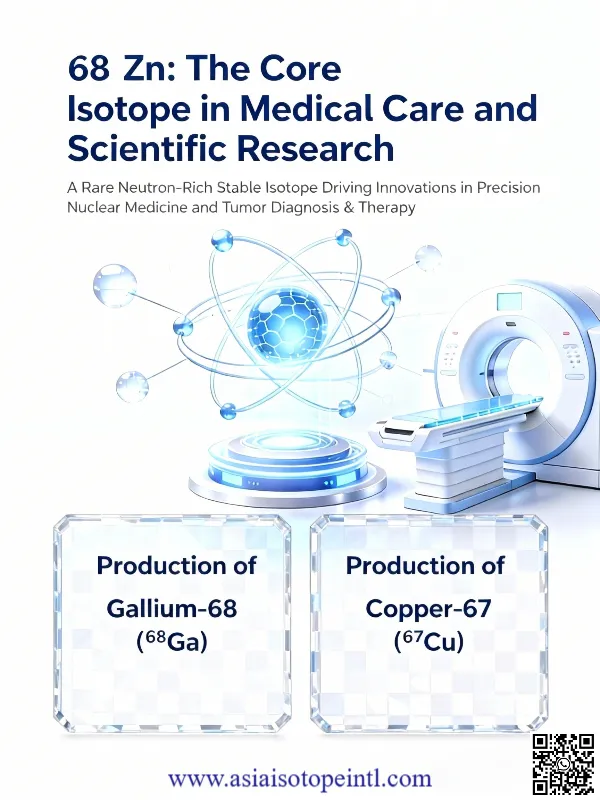
Zn 68 Isotope applications
3. Modern Solid-Target Production Technology Using ⁶⁸Zn
The current gold-standard target is the “coin” or “plate” design:
- Target material: 99.8 % ⁶⁸Zn metal (typical mass 300–800 mg)
- Backing: niobium or molybdenum body with helium cooling
- Plating method: molten-salt electrodeposition (Asia Isotope patented process) or cold pressing + vacuum sintering
- Beam parameters: 14.5 MeV incident, 40–60 µA, 90–120 min irradiation
- Typical end-of-bombardment activity: 70–110 GBq
- Dissolution: 7–10 M HCl at 90–110 °C, 15–20 min
- Purification: single-column hydroxamate or ZR resin process (recovery >95 %, processing time <25 min)
Result: GMP-grade [⁶⁸Ga]GaCl₃ ready for labeling in <45 minutes after EOB, with molar activity routinely exceeding 500 GBq/µmol.
4. Quantitative Comparison: Generator vs. Enriched ⁶⁸Zn Cyclotron Route
| Parameter | ⁶⁸Ge/⁶⁸Ga Generator (50 mCi) | Enriched ⁶⁸Zn Solid Target (90 min, 50 µA) |
|---|---|---|
| Initial activity available | 1.85 GBq | 80–110 GBq |
| Patients per day (3 GBq/dose) | 2–8 | 25–35 |
| Cost per GBq (approx.) | 8,000–12,000 USD | 300–600 USD |
| Geographic availability | Limited | Any hospital with 16–19 MeV cyclotron |
| Radionuclidic purity at EOS | >99.9 % | >99.9 % |
| Long-lived waste (⁶⁸Ge) | Yes | Negligible |
The economic and logistical superiority is overwhelming.
5. Global Supply Chain of Enriched Zinc-68 (Current Situation 2025)
Major certified suppliers of ≥99.0 % ⁶⁸Zn:
- China Isotope Development (China) – currently the largest volume supplier globally
- Eckert & Ziegler Eurotope (Germany)
- Isoflex (Russia/USA)
- Trace Sciences International (Canada)
China Isotope Development achieved >98 % enrichment routinely at multi-hundred-gram scale , driving the price from ~2,500 USD/g (2019) down to ~700–780 USD/g (2025 contract price for >100 g orders). This price collapse is the single most important enabler of widespread adoption.
6. Emerging Trends: Liquid Targets and Automated Solid Target Systems
Although pressed solid targets dominate today, two innovations are gaining traction:
- Liquid zinc nitrate targets (70Zn/68Zn blend in nitric acid)
Advantages: no target recovery, very high current (>100 µA) possible
Status: clinical batches already performed at University of Alabama and Rigshospitalet Copenhagen. - Fully automated solid-target transfer and dissolution systems
IBA Synthera, Trasis AllinOne, and Asia Isotope’s own Generation-III module now allow push-button production with <15 mSv exposure to staff.
7. Future Outlook: From ⁶⁸Ga to Theranostic Pairs Using Zinc Isotopes
The same enriched ⁶⁸Zn targets can produce copper-64 via ⁶⁸Zn(p,αn)⁶⁴Cu at slightly higher energy (30–40 MeV), though dedicated ⁶⁴Ni targets remain preferred. More interestingly, enriched ⁷⁰Zn is emerging as the optimal target for no-carrier-added ⁶⁷Ga production for SPECT — completing the zinc isotope family contribution to nuclear medicine.
8. Conclusion
Enriched zinc-68 has single-handedly transformed gallium-68 from a niche, generator-constrained radionuclide into the most widely used positron emitter after fluorine-18. The combination of high natural abundance, straightforward enrichment, excellent nuclear reaction cross-section, and mature solid-target technology has created what I confidently call the “third pillar” of modern PET — alongside ¹⁸F-FDG and ¹¹C tracers.
Any nuclear medicine department with a modern low-energy cyclotron can now produce its own ⁶⁸Ga in quantities that were unimaginable five years ago. This is not evolution; this is revolution — and zinc-68 is the material that made it possible.
Would you like a deeper dive into any specific technical parameters or applications?
As an industry leader focused in isotope products, our goal is to support our customers by keeping them at the forefront of their industries. We’re here to help with any questions you might have so you can transform your ideas into reality, and tackle those big science challenges.
Get free consultant, our experts are ready to serve.
(Follow up our update articles on www.asiaisotopeintl.com or send your comments to tao.hu@asiaisotope.com for further communications)