The Strategic Role of Gd-160 in Manufacturing Terbium-161 for Precision Cancer Treatment
BY Tao, Published Dec 28, 2025
The landscape of targeted radionuclide therapy is undergoing a transformative shift. After more than two decades immersed in isotope research and production, Terbium-161 (Tb-161) represents something genuinely exceptional—a therapeutic radionuclide that may fundamentally enhance how we approach cancer treatment at the cellular level. At the heart of this breakthrough lies an unassuming precursor: Gadolinium-160 (Gd-160), a stable isotope whose strategic importance in nuclear medicine cannot be overstated.
China Isotope Development Co.,Ltd ,as a emerging Isotope supplier, was supplying Gadolinium-160 (Gd-160) to serve Researches & Institues step by step , gaining their trust ranging from its quality / price / delivery. This article will delve into the intricate and crucial relationship between Gd-160 and Tb-161, exploring the scientific underpinnings, production challenges, and the immense therapeutic promise that Tb-161 holds for patients worldwide. We stand at the cusp of a new era in targeted radionuclide therapy, and understanding the role of Gd-160 is fundamental to appreciating the magnitude of this advancement.
The Genesis of a Therapeutic Powerhouse: From Gd-160 to Tb-161
The creation of a therapeutic radioisotope is a process of nuclear alchemy, transforming a stable, non-radioactive element into a precisely engineered weapon against disease. The production of Terbium-161 is a prime example of this elegant physics. It begins with a highly enriched, stable isotope, Gadolinium-160.
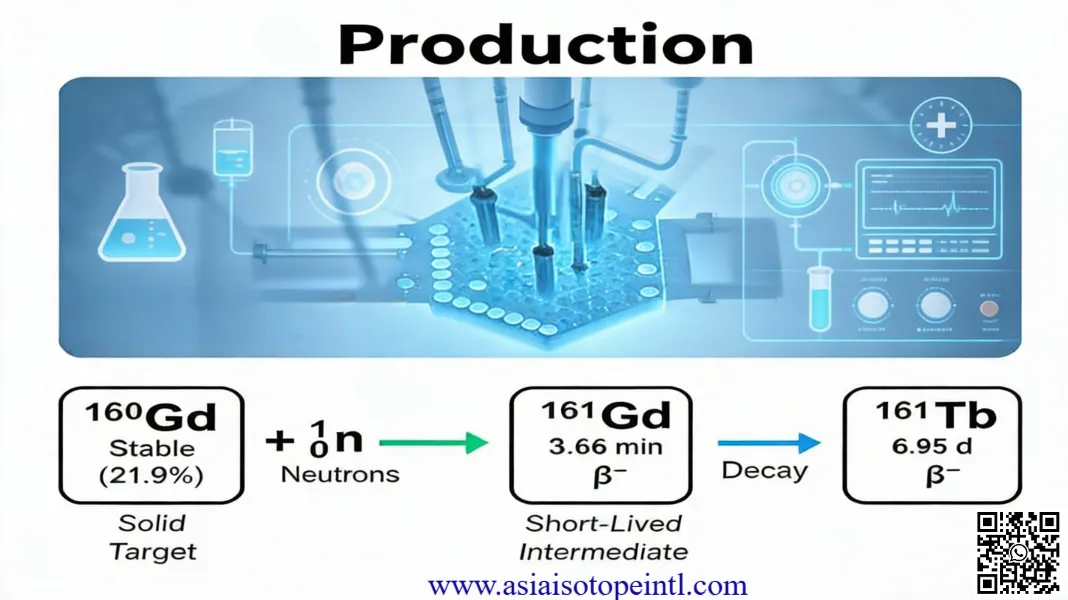
The process, known as neutron capture, takes place within the core of a nuclear reactor. Here is a step-by-step breakdown of this transformation:
- Target Irradiation: A target material, composed of highly enriched Gadolinium-160, is placed into a nuclear reactor where it is bombarded with a high flux of neutrons.
- Neutron Absorption: An atom of Gd-160 absorbs a neutron, momentarily becoming Gadolinium-161 (Gd-161). This is represented by the nuclear reaction:
160Gd(n,γ)161Gd. - Beta Decay: The newly formed Gd-161 is unstable and has a very short half-life of just 3.66 minutes. It rapidly undergoes beta (β⁻) decay, where a neutron in its nucleus is converted into a proton, releasing an electron (the beta particle) and an antineutrino. This decay transforms it into a new element: Terbium-161 (Tb-161).
This indirect production route is exceptionally advantageous because it results in a different element (Terbium) from the starting target material (Gadolinium). This elemental difference is the key to achieving the high purity and specific activity required for medical applications, as it allows for chemical separation of the desired Tb-161 from the bulk Gd-160 target material.
Gd 160 Production
The “Swiss Army Knife” of Radionuclides: Why Terbium is Special
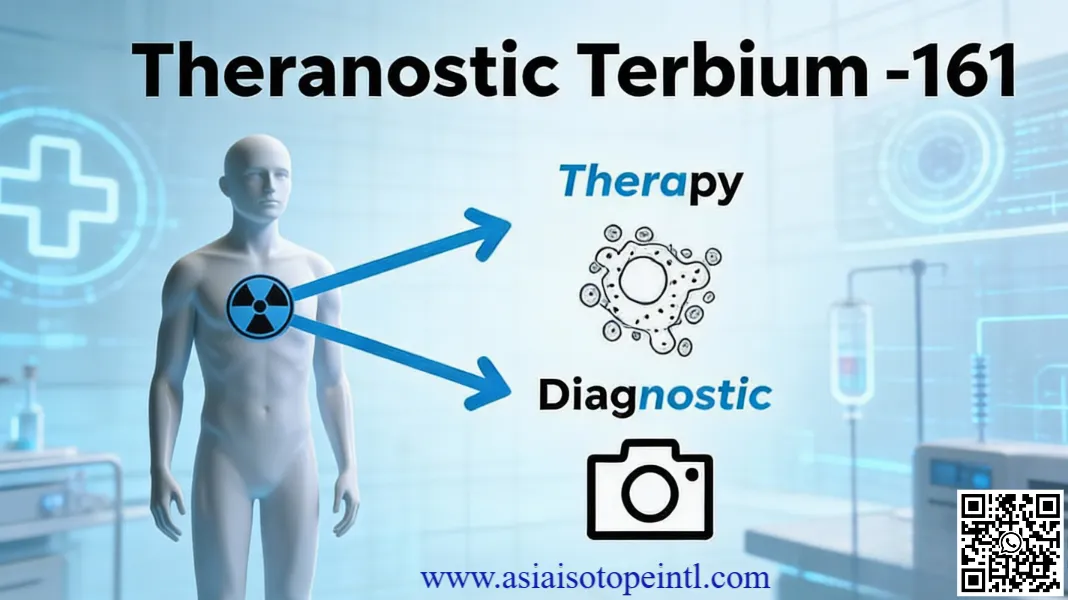
The terbium family of isotopes has been aptly nicknamed the “Swiss Army knife” of nuclear medicine. This is because different isotopes of this single element offer a complete toolkit for both diagnosing and treating cancer, a concept known as “theranostics”. The four key medical isotopes of terbium are:
- Terbium-152 (Tb-152) and Terbium-155 (Tb-155): These are diagnostic isotopes used for PET (Positron Emission Tomography) and SPECT (Single Photon Emission Computed Tomography) imaging, respectively, allowing clinicians to visualize tumors and plan treatments.
- Terbium-149 (Tb-149): An alpha-emitter used for Targeted Alpha Therapy (TAT), which delivers highly potent, short-range radiation.
- Terbium-161 (Tb-161): A therapeutic isotope that is the focus of our discussion.
Because all these isotopes are of the same element, they share identical chemical properties. This allows researchers to develop a single targeting molecule that can be paired with any of these four isotopes. A physician could first use a Tb-152 or Tb-155 labeled molecule to image a patient’s cancer and confirm the drug reaches the tumor, and then, with high confidence, administer the same molecule labeled with therapeutic Tb-161 or Tb-149 to treat the disease. This “matched-pair” approach is the essence of personalized medicine in oncology.
The Unique Therapeutic Signature of Terbium-161
The excitement surrounding Tb-161 stems from its unique decay characteristics, which set it apart from other therapeutic radionuclides, most notably the current clinical workhorse, Lutetium-177 (Lu-177). While Tb-161 and Lu-177 have very similar half-lives (around 6.9 days and 6.7 days, respectively) and both emit therapeutic beta (β⁻) particles, Tb-161 offers a significant additional benefit.
Upon decay, Tb-161 releases a cascade of low-energy conversion and Auger electrons in addition to its primary beta particle. This is the critical distinction.
- Beta (β⁻) Particles: These electrons travel a few millimeters in tissue, making them effective for treating larger tumor masses.
- Auger and Conversion Electrons: These electrons have a very short range, on the scale of nanometers to micrometers (from the size of a cell down to the width of a DNA strand). This short-range, high-energy deposition is intensely damaging to the cells from which they are emitted.
This dual-radiation profile makes Tb-161 exceptionally potent, particularly against the most insidious aspects of cancer: micrometastases, or tiny clusters of cancer cells, and even single circulating tumor cells that are often the cause of disease recurrence. While the beta particles attack the bulk of the tumor, the Auger electrons deliver a highly localized, cytotoxic punch, ideal for eradicating these microscopic, often undetectable, disease sites. Preclinical studies and simulations have shown that Tb-161 can deliver a significantly higher radiation dose to tumor cells compared to Lu-177 for the same amount of radioactivity, potentially leading to a more profound therapeutic effect.
The Art and Science of Radiopharmaceuticals
Simply producing Tb-161 is not enough; it must be delivered specifically to cancer cells while sparing healthy tissue. This is the role of a radiopharmaceutical. These sophisticated drugs consist of three components:
- The Radionuclide: The radioactive isotope that provides the therapeutic radiation (in this case, Tb-161).
- The Targeting Molecule: A biological molecule (like a peptide or antibody) that acts like a heat-seeking missile, designed to bind to specific receptors or antigens found on the surface of cancer cells. Examples include PSMA-targeting molecules for prostate cancer and somatostatin analogues for neuroendocrine tumors.
- The Linker (or Chelator): A chemical cage that securely holds the radionuclide and connects it to the targeting molecule.
Once assembled, the radiopharmaceutical is administered to the patient, typically via injection. It travels through the bloodstream, and the targeting molecule seeks out and binds to the cancer cells, delivering the attached Tb-161 directly to the tumor site. This targeted approach maximizes the radiation dose to the cancer while minimizing exposure and damage to healthy organs, leading to fewer side effects compared to traditional chemotherapy.
The Critical Bottleneck: Securing the Gd-160 Supply Chain
For all its promise, the widespread clinical adoption of Tb-161 faces a significant logistical hurdle: the supply of its precursor, Gadolinium-160. To produce Tb-161 with the high specific activity needed for therapy (meaning a high ratio of radioactive Tb-161 atoms to non-radioactive atoms), the starting material must be highly enriched Gd-160. Natural gadolinium contains only about 21.86% of the Gd-160 isotope, which is insufficient. The enrichment process, which separates the desired Gd-160 from other gadolinium isotopes, is complex and requires specialized technology.
For years, the limited availability of enriched Gd-160 has been a major bottleneck, restricting the production of Tb-161 to largely research quantities. However, the growing recognition of Tb-161’s potential has spurred significant investment and strategic partnerships within the isotope industry. China Isotope Development Co.,Ltd ,as a emerging Isotope supplier, was supplying Gadolinium-160 (Gd-160) to serve Researches & Institues , expect to increas supplying in 2026. At the same time, several companies have recently announced major agreements to scale up the enrichment and supply of Gd-160, a crucial step toward ensuring a reliable and robust supply chain for Tb-161-based therapies. These developments are essential for moving Tb-161 from promising research into mainstream clinical practice.
The Final Step: Purification and Preparation
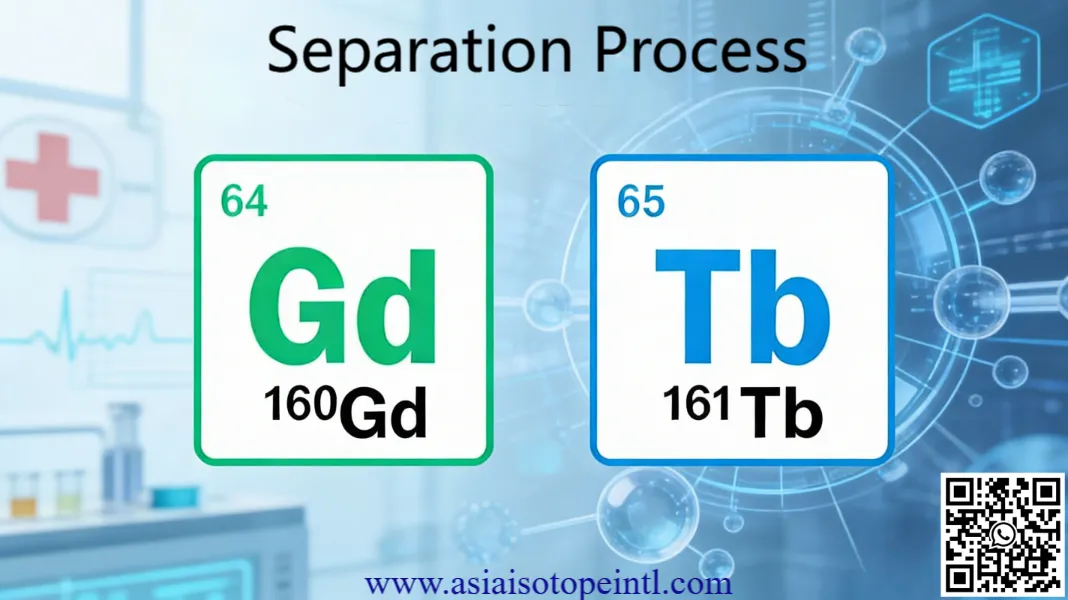
After the Gd-160 target is irradiated in a reactor, the newly created Tb-161 must be meticulously separated from the remaining Gd-160 and any other potential impurities. This is a critical radiochemical process that ensures the final product is of the highest purity and specific activity, a designation known as “no-carrier-added” (NCA).
The chemical similarity of adjacent lanthanide elements like gadolinium and terbium makes this separation challenging. Scientists employ advanced techniques such as high-performance ion chromatography (HPIC) and extraction chromatography. In these methods, the irradiated target material is dissolved, and the solution is passed through columns containing specialized resins. By carefully controlling the chemical conditions (e.g., the type and concentration of eluting agents), chemists can selectively wash away the gadolinium while retaining the terbium, or vice-versa, ultimately isolating the pure Tb-161. The result is a purified solution of [161Tb]TbCl3 (Terbium-161 chloride), ready to be chelated to targeting molecules for the final preparation of the radiopharmaceutical.
Clinical Horizons: Tb-161 in Action
The transition from preclinical promise to clinical reality is well underway for Tb-161. Several clinical trials have been initiated to evaluate the safety and efficacy of Tb-161-labeled radiopharmaceuticals. These trials are primarily focused on cancers where targeted radionuclide therapies have already shown success, such as:
- Metastatic Castration-Resistant Prostate Cancer (mCRPC): Using molecules that target the Prostate-Specific Membrane Antigen (PSMA), trials are assessing whether [161Tb]Tb-PSMA can offer a more potent treatment than its lutetium-177 counterpart.
- Neuroendocrine Tumors (NETs): Building on the success of [177Lu]Lu-DOTATATE, researchers are investigating [161Tb]Tb-DOTATATE and other somatostatin receptor antagonists, hoping the unique properties of Tb-161 will lead to improved patient outcomes.
Early results and ongoing studies are highly encouraging, suggesting that Tb-161 is not only effective but also well-tolerated by patients, with toxicity profiles that appear manageable and comparable to existing therapies. The VIOLET trial, for instance, has provided the first major clinical validation of Tb-161’s potential in treating prostate cancer. As more data from these and future trials become available, the clinical role of Tb-161 will be more clearly defined, potentially establishing it as a new standard of care for several cancer types.
A Look to the Future: The Dawn of the Terbium Era
As a worker who has spent a career studying the fundamental properties of isotopes, it is profoundly gratifying to see this knowledge translate into therapies that have the potential to save and extend lives. The strategic use of stable Gd-160 to produce therapeutic Tb-161 is a testament to the ingenuity of the nuclear science community. It represents a convergence of physics, chemistry, and medicine.
The path forward is clear. With the Gd-160 supply chain being actively secured and clinical trials demonstrating its therapeutic advantages, Tb-161 is poised to become a cornerstone of the next generation of targeted cancer treatments. Its ability to effectively eliminate microscopic disease addresses a critical unmet need in oncology—the prevention of relapse and the treatment of widespread metastatic disease. The journey from a stable gadolinium atom to a precision cancer therapy embodies the very essence of scientific progress, offering new hope to patients and new tools for clinicians in the fight against cancer.
Would you like a deeper dive into any specific technical parameters or applications?
As an industry leader focused in isotope products, our goal is to support our customers by keeping them at the forefront of their industries. We’re here to help with any questions you might have so you can transform your ideas into reality, and tackle those big science challenges.
Get free consultant, our experts are ready to serve.
(Follow up our update articles on www.asiaisotopeintl.com or send your comments to tao.hu@asiaisotope.com for further communications)