Enriched Gd-160 Target Materials: Pioneering Dual-Purpose Cancer Imaging and Treatment
BY Tao, Published Dec 28, 2025
Enriched Gadolinium‑160 (Gd‑160) is not administered to patients—it is a stable “target material” placed in a reactor to manufacture Terbium‑161 (Tb‑161), one of the most compelling next-generation radionuclides for precision cancer theranostics (therapy + imaging in one platform). The strategic value of enriched Gd‑160 comes from three hard realities:
- Tb‑161’s biology-facing advantage—it delivers tumor-killing beta radiation plus short-range conversion/Auger electrons that are especially effective against micrometastases and small tumor cell clusters.
- Tb‑161’s production-facing advantage—it is produced via an indirect reactor route (Gd‑160(n,γ)→Gd‑161→Tb‑161) that enables chemical separation and thus high specific activity product.
- The supply chain bottleneck—to scale Tb‑161, you must scale high-enrichment, high-purity Gd‑160 targets, plus target fabrication know-how and recycling.
What follows is a practical, technically grounded guide—written from the perspective of an isotope production specialist—on why enriched Gd‑160 target materials are becoming a cornerstone resource for dual-purpose cancer imaging and treatment.
1. Why “Enriched Gd‑160 Target Material” Matters More Than the Radioisotope Headlines
In nuclear medicine, the public conversation often centers on the “headline isotope” (here: Tb‑161). In real-world manufacturing, however, the decisive factor is frequently the target material—its isotopic enrichment, chemical purity, physical form, and recyclability.
Enriched Gd‑160 target material is the upstream enabler that determines whether Tb‑161 can be produced with:
- High yield (enough activity per batch),
- High radionuclidic purity (low contaminants),
- High apparent molar activity (essential for labeling small-molecule vectors),
- Repeatable GMP workflows and robust supply.
If you want Tb‑161 to be more than “promising,” you must treat Gd‑160 as a strategic manufacturing asset, not a commodity powder.
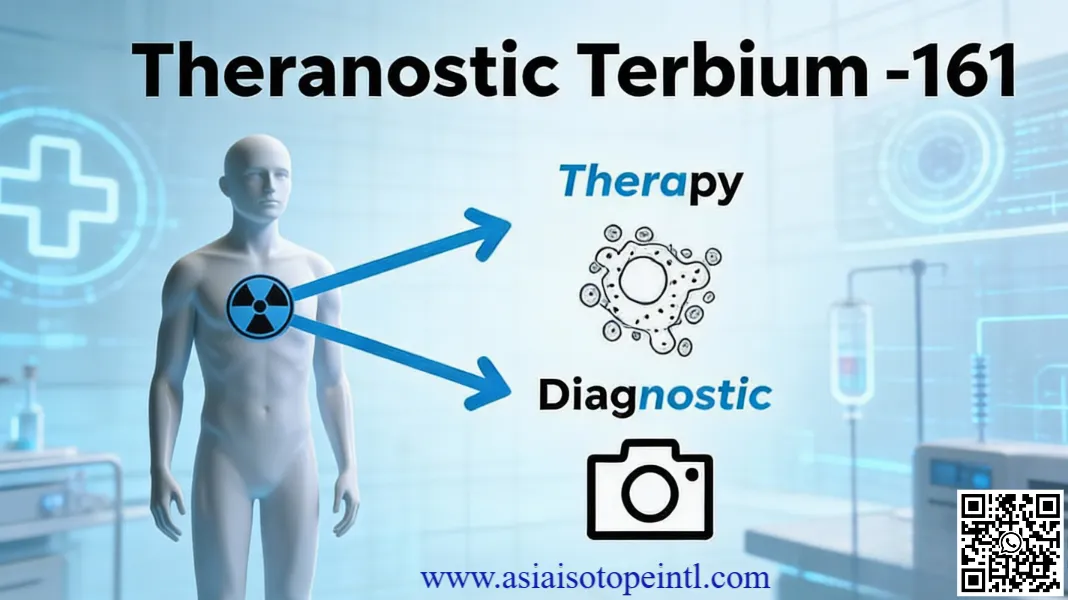
2. The Dual-Purpose Promise: How Tb‑161 Supports Both Treatment and Imaging
2.1 What “Theranostics” Actually Means (in plain language)
Theranostics combines therapy and diagnostics—either by:
- using the same radionuclide that emits both therapeutic particles and imageable photons, or
- using element-matched pairs (same chemistry, different emissions) to image first and treat second with nearly identical biological behavior.
Tb‑161 is particularly interesting because it supports both approaches:
- It emits beta particles (therapy) and also photons usable for SPECT imaging (tracking and dosimetry).
- It belongs to the “terbium family,” where other Tb isotopes (e.g., Tb‑155 for SPECT, Tb‑152 for PET, Tb‑149 for alpha therapy) can form an element-matched toolbox sometimes called a theranostic quartet.
2.2 Why Tb‑161 Can Outperform Lu‑177 in Small Disease (Micrometastases)
Lu‑177 has proven clinical value, but it is not perfectly optimized for very small tumor deposits. Tb‑161 is similar in half-life and beta energy profile, yet it emits a substantial additional component of low-energy electrons (conversion and Auger electrons).
Those extra electrons deposit energy over very short distances, which modeling studies show can increase absorbed dose in single tumor cells and micrometastases compared with Lu‑177.
A key practical takeaway:
- Beta particles help treat larger lesions through crossfire.
- Conversion/Auger electrons can intensify killing in small clusters where crossfire is limited.
2.3 Imaging Value: Not Just “Nice to Have”
SPECT imaging with Tb‑161 is not a marketing add-on—it supports:
- Patient-specific dosimetry (how much dose goes where),
- Verification of targeting (did the drug reach the tumor?),
- Therapy monitoring (response + toxicity management).
Clinical imaging protocol development for Tb‑161 SPECT/CT has been explicitly studied, highlighting that Tb‑161 can yield clinically usable SPECT images and dosimetry workflows.
3. The Core Nuclear Reaction: How Gd‑160 Becomes Tb‑161
3.1 The Indirect Reactor Route (and why it’s strategically “clean”)
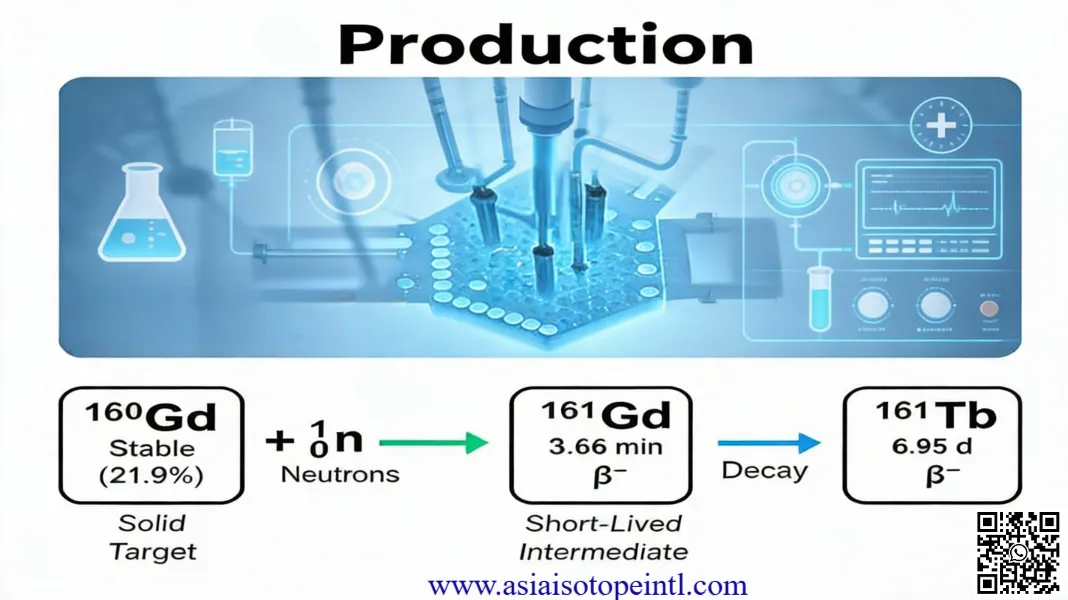
The established high-quality production route is reactor-based:
Gd‑160 (n,γ) → Gd‑161 → Tb‑161 (via β⁻ decay)
A crucial feature: the intermediate Gd‑161 has a very short half-life (~3.7 minutes), so it quickly decays to Tb‑161 during/after irradiation, enabling practical recovery.
3.2 Why This Route Enables High Specific Activity
In isotope manufacturing, specific activity (or in radiopharmacy terms, molar activity) is a decisive quality parameter. “High” means you can label your targeting molecule without flooding it with non-radioactive metal that competes for binding.
This Gd→Tb route produces a different element (Tb) than the target (Gd), which makes chemical separation possible—and that is the pathway to no-carrier-added / high-specific-activity Tb‑161 suitable for radiolabeling.
3.3 Alternative accelerator routes: why target purity becomes harder
There is ongoing research into non-reactor production routes, but practical limitations remain. For example, deuteron-based production on Gd‑160 can generate undesired Tb‑160 contamination at significant levels, making it unattractive for high-purity medical supply.
This is why, today, enriched Gd‑160 reactor targets remain the most credible path to scalable, medically acceptable Tb‑161.
4. Why Enrichment Is Non-Negotiable: The “Self‑Shielding” Trap in Natural Gadolinium
Natural gadolinium contains multiple stable isotopes. Two of them—Gd‑157 and Gd‑155—have extraordinarily high thermal neutron capture cross sections (about 254,000 barns and ~60,700 barns, respectively).
By contrast, Gd‑160 has a much smaller capture cross section (on the order of ~1–2 barns in commonly cited tables).
What this means in real reactor targets
If you irradiate natural gadolinium, the “neutron-hungry” isotopes (Gd‑157, Gd‑155) absorb a large fraction of neutrons near the target surface. This creates a severe self‑shielding effect (neutrons don’t penetrate evenly), reducing effective activation of Gd‑160 deeper in the target.
So enrichment is not merely “more Gd‑160 per gram.” It also:
- reduces neutron theft by other isotopes,
- improves irradiation efficiency and predictability,
- reduces the complexity of downstream radiochemistry.
In short: high-enriched Gd‑160 is a yield technology and a purity technology at the same time.
5. What “Target Material Engineering” Really Involves (Beyond a Certificate of Analysis)
A target is a designed object—not just a chemical.
For Tb‑161 manufacturing, the target must survive:
- reactor irradiation (neutron flux + heating),
- cooling, transport, hot-cell handling,
- dissolution and chemical separation,
- and ideally, recovery and recycling.
5.1 Chemical form: why Gd‑160 oxide dominates
Many production workflows use enriched Gd‑160 as Gd₂O₃ because it is:
- chemically stable,
- relatively straightforward to press into pellets,
- compatible with dissolution chemistry used before chromatography.
5.2 Physical form: powder vs pellet vs sintered body
From a manufacturing standpoint, physical form changes everything:
- Loose powder is easy to prepare but harder to handle in hot cells and may have density/geometry issues.
- Pressed pellets offer better handling and more controlled geometry.
- Sintered targets can offer higher density and mechanical robustness, but require additional materials processing steps (and quality control).
These choices affect:
- neutron penetration profile,
- thermal conductivity and hot spots,
- dissolution time (which impacts how much Tb‑161 decays before recovery).
5.3 Irradiation performance: real data from low‑flux production
A University of Utah team demonstrated that even a low-power research reactor can produce Tb‑161 from enriched Gd‑160 targets, reporting production metrics and separation workflows suitable for research-scale supply.
Notably, they reported a production rate example of ~1.5 ± 0.3 μCi Tb‑161 per mg Gd‑160 per hour (under their described reactor conditions), which is extremely useful as a reality check for planning target mass and irradiation time.
6. The Separation Challenge: Turning an Irradiated Target into Radiopharmaceutical‑Grade Tb‑161
Making Tb‑161 is not only a nuclear problem—it is a lanthanide separation problem.
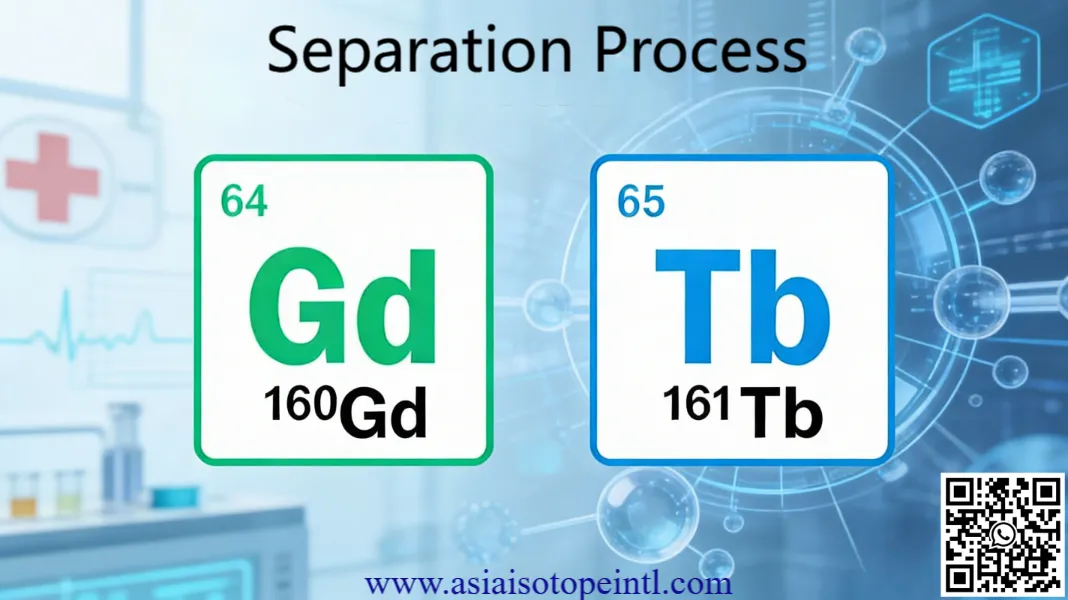
Gd and Tb sit next to each other in the periodic table. Chemically, they are both typically 3+ ions in solution, and their behavior is famously similar. Separating them efficiently—at high purity, quickly—is the heart of the process.
6.1 A practical, well-documented separation architecture
A credible modern approach combines:
- cation exchange chromatography (often with α‑hydroxyisobutyric acid / 2‑hydroxyisobutyric acid as complexing eluent), and
- extraction chromatography (LN/LN2 resin, DGA resin) to polish and concentrate product.
For example, Holiski et al. describe using AG 50W‑X8 with 70 mM 2‑hydroxyisobutyric acid (pH 4.75) followed by LN resin steps, achieving Tb‑161 in a form suitable for radiolabeling and reporting apparent molar activity results for [Tb‑161]Tb‑DOTA.
Independent work has also demonstrated two-step extraction chromatography routes (e.g., LN2 then DGA), and explicitly frames the goal as producing [Tb‑161]TbCl₃ suitable for radiolabeling after irradiation of enriched Gd‑160.
6.2 Why speed matters: the “hidden carrier” problem
Tb‑161 decays to stable dysprosium‑161 (Dy‑161).
Every hour of delay between EOB (end of bombardment) and final purification slightly increases the fraction that has already turned into non-radioactive Dy, which can reduce the apparent molar activity if not managed carefully.
This is one reason production teams obsess over:
- streamlined hot-cell workflows,
- fast dissolution,
- high-throughput columns,
- and low hold-up volumes.
6.3 Emerging separation materials: innovation is happening at the resin level
Beyond classic resins, newer approaches (including solvent-impregnated resins designed for lanthanide selectivity) are being evaluated to shorten separation time and improve resolution between Gd/Tb/Dy.
For a supply chain builder, this matters because separation throughput can be as constraining as reactor access.
7. From “Interesting Isotope” to “Reliable Product”: The Business Physics of Gd‑160 Target Supply
7.1 The global constraint is not only reactors—it’s enriched stable isotopes
Even if you have reactor time, you still need a reliable stream of enriched Gd‑160. Public announcements in 2025 highlight multi‑year supply agreements aimed at securing Gd‑160 feedstock to scale Tb‑161 production (with contracts commencing in 2026 in at least one cited agreement).
This is a signal of a broader truth: Gd‑160 is becoming a strategic input material.
7.2 Why recycling is the quiet hero of Tb‑161 economics
Enriched Gd‑160 is expensive relative to natural gadolinium. Therefore, an industrially rational Tb‑161 program will usually plan for:
- recovery of gadolinium from spent solution,
- re-conversion to target form (often oxide),
- repeated irradiation cycles.
U.S. DOE-supported work explicitly frames “effective target design” and “target material recycling” as a key area for establishing reliable Tb isotope supply chains.
A helpful mental model:
- Reactor irradiation converts only a small fraction of target atoms each run.
- Most Gd‑160 remains Gd‑160 after irradiation.
- Therefore, recycling is not optional if you want cost control at scale.
8. Dual‑Purpose in Practice: Two Ways Enriched Gd‑160 Enables Imaging + Therapy
Pathway A: One radionuclide that can be imaged while treating (Tb‑161)
Tb‑161 emits low-energy photons usable for imaging and emits electrons that treat cancer. This is the simplest dual-purpose route—one isotope, one drug.
Pathway B: Element‑matched pairs (Tb‑155 imaging + Tb‑161 therapy)
While Gd‑160 is the precursor for Tb‑161 specifically, the broader terbium ecosystem is moving toward element-matched imaging/therapy pairs, because identical chemistry makes dosimetry and translation cleaner.
Peer-reviewed literature describes Tb radionuclides (149/152/155/161) as covering all four medically relevant decay modalities and supporting matched theranostic development.
Large research infrastructures (e.g., CERN MEDICIS/ISOLDE) have also highlighted terbium isotope matched-pair concepts and logistics challenges, reinforcing the view that terbium is a long-game platform rather than a single product.
From an industry strategy viewpoint, enriched Gd‑160 targets are a logical first “industrial foothold” because reactor production of Tb‑161 is comparatively direct and scalable relative to some other exotic nuclides.
9. Clinical Momentum: Tb‑161 Is No Longer Only Preclinical
A pivotal proof point is the VIOLET first-in-human clinical program evaluating [Tb‑161]Tb‑PSMA‑I&T in men with metastatic castration-resistant prostate cancer (mCRPC).
In an interim/first-in-human report published in 2025, the trial reported:
- enrollment between October 14, 2022 and February 15, 2024,
- no dose-limiting toxicities,
- and a recommended phase II dose at 7.4 GBq, with recruitment reopened to evaluate 9.5 GBq.
This kind of clinical signal changes procurement behavior: once clinicians and sponsors see tolerability and feasibility, the conversation rapidly shifts from “Can we make it?” to “Can we supply it reliably and repeatedly?”
10. A Procurement-Grade Checklist: What to Specify When Sourcing Enriched Gd‑160 Targets
If your objective is medical-isotope manufacturing (not academic demonstration), you want target material specifications that protect yield, purity, and repeatability.
Below is a practical checklist you can adapt into a purchasing spec.
10.1 Isotopic specification
- Gd‑160 enrichment level (atom %), with measurement method and uncertainty.
- Limits for neutron-absorbing isotopes Gd‑155 and Gd‑157 (these matter disproportionately due to their enormous capture cross sections).
10.2 Chemical specification (trace metals)
For Tb radiopharmaceutical labeling, trace metals are not “minor.” They can directly reduce labeling efficiency and molar activity.
- Fe, Zn, Cu, Al, Ca, Pb (typical problem metals)
- Rare earth contaminants (La, Ce, Eu, Dy), because lanthanides compete chemically
10.3 Physical specification
- Chemical form: typically Gd₂O₃ for many reactor workflows
- Particle size distribution (powder handling vs pellet pressing consistency)
- Tap density / pressed density
- Moisture/LOI (loss on ignition)
- Packaging to control hydration and contamination
10.4 Documentation and compliance readiness
- Chain-of-custody documentation (especially for cross-border shipments)
- Batch-to-batch consistency controls
- Change-notification commitments (critical for GMP processes)
10.5 Recycling compatibility
If you plan to recycle recovered gadolinium:
- Require impurity limits compatible with multi-cycle reuse
- Require documentation of any stabilizers/binders used in pelletization that could complicate dissolution and reprocessing
11. Strategic Outlook (2026 and beyond): Why Gd‑160 Is Becoming a “Platform Material”
From a 20–30 year isotope-industry perspective, here is the underlying logic:
- Targeted radionuclide therapy is expanding into earlier disease stages and minimal residual disease settings—exactly where Tb‑161’s short-range electron component can matter most.
- The field is moving toward quantitative imaging + dosimetry-driven therapy, raising the value of radionuclides and pairs that simplify imaging/therapy translation.
- Supply chains will reward producers who control:
- enriched target materials,
- robust separation chemistry,
- and closed-loop recycling.
In that future, enriched Gd‑160 is not merely “feedstock.” It is the cornerstone material that enables Tb‑161 to shift from a promising isotope to an industrially dependable medical tool.
Would you like a deeper dive into any specific technical parameters or applications?
As an industry leader focused in isotope products, our goal is to support our customers by keeping them at the forefront of their industries. We’re here to help with any questions you might have so you can transform your ideas into reality, and tackle those big science challenges.
Get free consultant, our experts are ready to serve.
(Follow up our update articles on www.asiaisotopeintl.com or send your comments to tao.hu@asiaisotope.com for further communications)