How Carbon Dioxide(CO2)Is Powering a New Era of Green Energy
BY Tao, Published Jan 1, 2026
For two centuries, carbon dioxide (CO2) has been unequivocally cast as the public enemy in the unfolding climate crisis. The very mention of its chemical formula conjures stark images of industrial smokestacks, choking exhaust fumes, and the high-stakes negotiations of global climate accords. However, a transformative shift in this narrative is underway. On December 20, 2024, The world’s first commercial supercritical CO2 (sCO2) power generation unit, dubbed “HyperCarbon One,” was successfully connected to the grid. This event marked a pivotal moment, transforming what was once considered “waste gas” into the efficient, flexible, and green “lifeblood of future energy.”
This groundbreaking project replaces traditional steam with high-pressure CO2 to convert the intense waste heat from steelmaking into electricity. The two 15-megawatt units are not just a proof of concept; they represent a paradigm shift in power generation, promising to be roughly 50% more efficient than existing steam-based systems for waste heat recovery.
The “Chosen One”: Unveiling the Power of Supercritical Carbon Dioxide (CO2)
So, what exactly is this “supercritical” state that holds such promise? It is a unique phase of matter, a fourth state beyond solid, liquid, and gas, achieved when CO2 is subjected to temperatures above 31.1°C and pressures exceeding 7.38 MPa (approximately 73 times the atmospheric pressure at sea level). In this state, CO2 exhibits a fascinating duality: it behaves neither as a gas nor a liquid but as a fluid that possesses the high density of a liquid, making it excellent for heat storage, and the low viscosity of a gas, which allows for minimal flow resistance.
This unique combination of properties is what makes sCO2 a highly efficient medium for generating power. Small changes in temperature or pressure can cause significant shifts in its density, allowing for a powerful and rapid expansion. Crucially, the system operates in a single, supercritical phase, meaning no energy is wasted on phase changes, such as boiling water into steam. This allows for millisecond-level response times to heat application. Furthermore, CO2 is chemically inert, non-toxic, non-flammable, and readily available at a low cost. It operates within a closed-loop system, ensuring zero emissions during power generation. These remarkable, almost paradoxical qualities led researchers to select CO2 from over 20 candidate working fluids, earning it the nickname “The Chosen One.”
Breaking Free from a Century of “Boiling Water”
Since the advent of London’s first coal-fired power plant in 1882, humanity’s primary method for generating electricity has been tethered to the principles of the Rankine cycle: boil water to create steam, and use that steam to spin a turbine. While this method has powered the world for over a century, it is burdened by inherent inefficiencies. Steam is “slow” and cumbersome, requiring massive boilers, extensive water treatment facilities, deaerators, and large cooling towers. A significant portion of energy, over 30%, is lost as latent heat during the condensation phase. Moreover, steam plants are notoriously slow to start and stop and operate inefficiently at partial loads, making them ill-suited for capturing the fluctuating and intermittent waste heat generated by many industrial processes.
The “HyperCarbon One” project rewrites this century-old script by employing a supercritical carbon dioxide (CO2) Brayton cycle, a more efficient and compact alternative. Here’s how it works:
- Compression: The cycle begins with liquid CO2 being compressed to approximately 200 atmospheres. Because of the high density of CO2 near its critical point, this step requires significantly less energy—roughly one-third—compared to compressing a gas like steam.
- Heating: The high-pressure sCO2 is then heated. In the case of the Shougang plant, it utilizes waste heat from the steel sintering process, which can reach temperatures over 700°C. This heat is transferred via heat exchangers, rapidly raising the sCO2 temperature to around 550°C.
- Expansion: This super-hot, high-pressure fluid expands with immense force as it passes through a turbine, spinning it at high speed to generate electricity. The single-unit efficiency of this process can exceed 50%, a notable increase over the roughly 40% efficiency limit of comparable steam turbines.
- Cooling & Recuperation: After expanding through the turbine, the sCO2 is still hot. This remaining heat is “recuperated” and used to preheat the CO2 returning to the primary heat source, which significantly boosts cycle efficiency. Finally, the CO2 is cooled, returning it to a liquid state to complete the closed loop.
The results of this innovative cycle are striking. The “HyperCarbon One” system has demonstrated an 85% increase in thermal-to-electric efficiency and a 50% boost in net electricity output compared to traditional waste-heat steam systems. Furthermore, the physical footprint of the sCO2 power plant is dramatically smaller—components can be up to 10 times smaller than their steam-based counterparts—leading to lower capital costs and a reduced environmental impact. The U.S. Department of Energy estimates that a desk-sized sCO2 turbine could potentially power 10,000 homes. The economic benefits are equally compelling, with a projected payback period of just three years for the Shougang installation.
The Green “Carbon-Negative” Triple Play
The implications of this technology extend far beyond a single steel plant, offering a versatile solution to some of the most pressing energy and environmental challenges.
1. Maximizing Industrial Waste Heat: Heavy industries such as steel, cement, and glass are prodigious producers of medium-to-low-temperature waste heat. In China alone, this untapped resource is equivalent to an estimated 200 million tons of standard coal annually. Traditional waste heat recovery technologies are often inefficient, capturing less than 30% of this available energy. Supercritical carbon dioxide (CO2) cycles, however, are exceptionally well-suited for this task, capable of efficiently harnessing heat from sources ranging from 200°C to over 700°C. If the approximately 300 sintering machines in China were retrofitted with “HyperCarbon” style systems, they could generate an additional 21 billion kWh of clean electricity per year. This is equivalent to a quarter of the annual output of the massive Three Gorges Dam and would directly prevent 18 million tons of CO2 emissions.
2. Zero-Water-Consumption Power Generation: Many of the world’s energy resources, including coal and abundant solar potential, are located in arid and semi-arid regions where water is a scarce and precious commodity. Traditional steam-cycle power plants are water-intensive, a significant drawback in these areas. Supercritical carbon dioxide (CO2) power cycles offer a revolutionary “waterless” solution. Because the CO2 remains in a closed loop and is cooled without being condensed in the same way as steam, the system can be designed for dry cooling, drastically reducing or even eliminating water consumption. A single 2×15 MW sCO2 power station, like the one in Guizhou, can save an estimated 1.2 million tons of water annually—enough to supply a town of 30,000 people. This makes sCO2 technology a critical enabler for developing energy bases in deserts and other water-stressed environments.
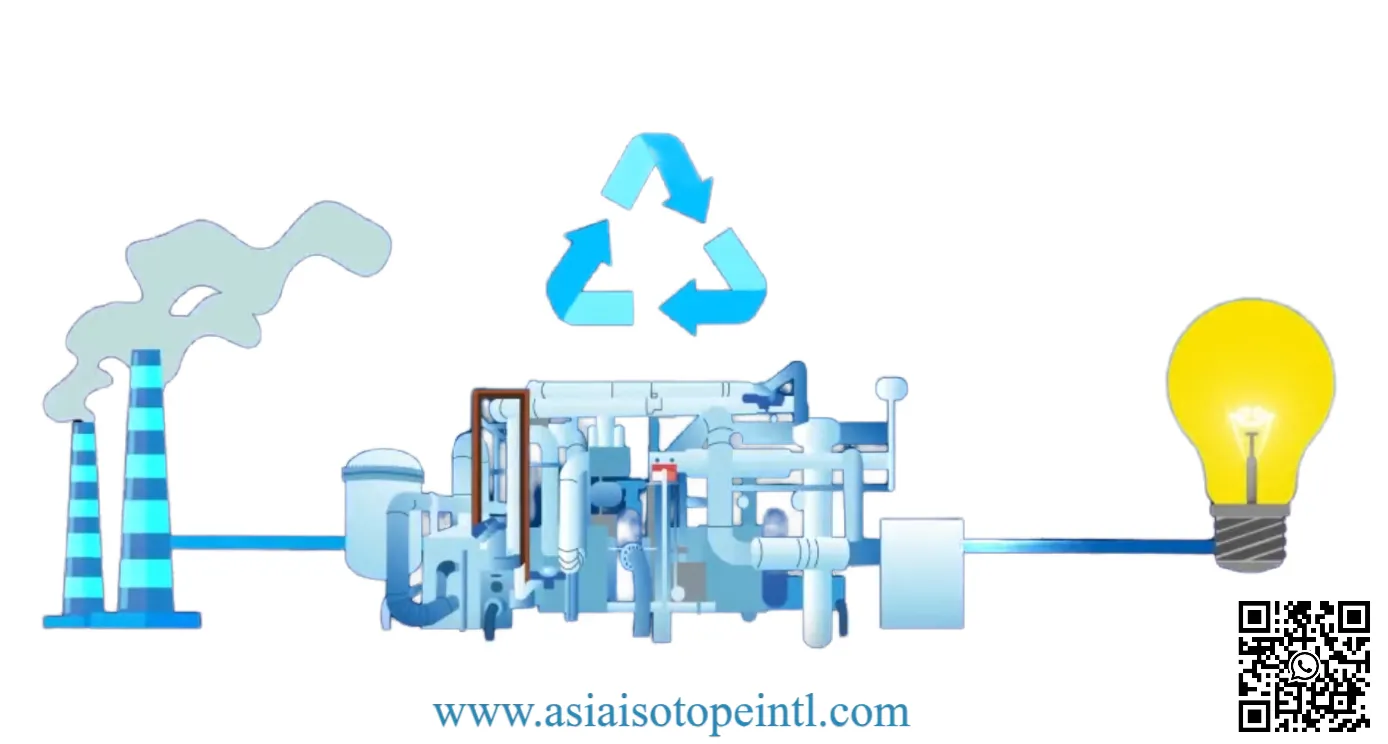
3. A Powerful Synergy with Carbon Capture: Perhaps one of the most elegant aspects of the sCO2 power cycle is its inherent synergy with carbon capture, utilization, and storage (CCUS) technologies. The system itself requires a supply of high-pressure CO2 to function. This creates a perfect opportunity for integration with carbon capture units installed at industrial facilities like cement kilns, chemical plants, or even fossil fuel power stations. The captured CO2, instead of being a liability requiring costly sequestration, becomes a valuable asset. It can first be used as the working fluid to generate electricity from waste heat. Afterward, this same CO2 can be sold for various commercial uses, including in the food and beverage industry, for producing dry ice, or for enhanced oil recovery. This creates a virtuous, integrated “Carbon-to-Energy-to-Materials” value chain, transforming the concept of “carbon negativity” from an environmental goal into a profitable and self-sustaining industry.
The Road Ahead: Challenges and a Reimagined Future
While the successful launch of “HyperCarbon One” is a landmark achievement, the path to widespread adoption is not without its challenges. The extreme pressures and temperatures inside these systems push the limits of modern materials science, requiring specialized alloys that can resist corrosion and weakening over long-term operation. Further research and development are needed to optimize component design, ensure durability, and reduce costs to make the technology competitive across a wider range of applications.
Nonetheless, the promise of sCO₂ is undeniable. Similar demonstration projects are underway globally, including the Supercritical Transformational Electric Power (STEP) pilot plant in Texas, supported by the U.S. Department of Energy, which is progressing toward its 10-MWe goal. Researchers also see clear potential for sCO₂ cycles in next-generation nuclear reactors, concentrated solar power, and even mobile power sources for spacecraft.
Carbon Dioxide CO2 Prospective
The whistle of “HyperCarbon One” has sounded, signaling a profound shift in our relationship with carbon dioxide. It challenges us to look beyond the narrative of a climate villain and see the potential for a powerful energy carrier. Tomorrow’s children, when they hear the words “carbon dioxide,” might not first think of melting glaciers or rising sea levels. Instead, they might imagine the clean, efficient energy that powers their cities at night, the silent electricity powering vessels on the high seas, or the life-support systems humming away on a future Martian base.
From a polluting exhaust gas to a high-performance energy fluid, from a greenhouse villain to a green engine, supercritical Carbon Dioxide CO2 power generation technology delivers a masterclass in industrial and environmental rebranding. It teaches us a vital lesson for the 21st century: carbon itself is not the enemy. The true challenge—and the greatest opportunity—lies in human innovation and our ability to ingeniously integrate every molecule into a virtuous cycle, allowing energy and matter to flow gracefully and sustainably between our industries, our planet, and the sky. The journey toward a zero-carbon future, powered by CO2 itself, is now decisively underway.
Would you like a deeper dive into any specific technical parameters or applications?
As an industry leader focused in Specialty Gases products, our goal is to support our customers by keeping them at the forefront of their industries. We’re here to help with any questions you might have so you can transform your ideas into reality, and tackle those big science challenges.
Get free consultant, our experts are ready to serve.
(Follow up our update articles on www.asiaisotopeintl.com or send your comments to tao.hu@asiaisotope.com for further communications)