Gadolinium-160 Target Material: A Game-Changer for Next-Generation Beta Therapy in Oncology
BY Tao, Published Dec 28, 2025
Gadolinium-160 (Gd-160) is not a “therapy isotope” itself—it is a strategic stable target material that enables reliable reactor production of Terbium-161 (Tb-161), one of the most compelling next-generation radionuclides for targeted beta therapy and theranostics (therapy + imaging) in oncology. What makes this pathway special is that neutron irradiation converts Gd → Tb (a different element), which allows robust chemical separation and supports high specific activity / no-carrier-added Tb-161, a major practical advantage for radiopharmaceutical labeling and clinical translation.
1. Why “Target Material” Can Decide the Future of Nuclear Oncology
In nuclear medicine, the public attention naturally goes to the drug name on the vial—PSMA, DOTATATE, antibodies, peptides. But in real-world production, the entire clinical promise can be limited (or unlocked) by something far less visible: the target material used to make the radionuclide.
That is exactly the case for Tb-161. If you want Tb-161 to become a mainstream clinical workhorse—comparable in availability to today’s Lu-177—then enriched Gd-160 must be available in scalable quantities, consistent chemical form, and with impurity profiles suitable for radiochemical processing and GMP-grade release testing.
From an isotope scientist’s perspective, calling Gd-160 a “game-changer” is not marketing—it is a technical statement about yield control, purity control, and separability, which ultimately determine whether hospitals can reliably receive and label Tb-161 radiopharmaceuticals.
2. The Clinical Direction: “Next-Generation Beta Therapy” Means More Than Just Beta Particles
2.1 Beta therapy is evolving toward micro-scale disease control
Modern targeted radionuclide therapy (TRT)—also called radioligand therapy (RLT)—has proven that we can deliver meaningful survival and quality-of-life benefit in metastatic cancers. Yet a persistent challenge remains: micrometastases and minimal residual disease.
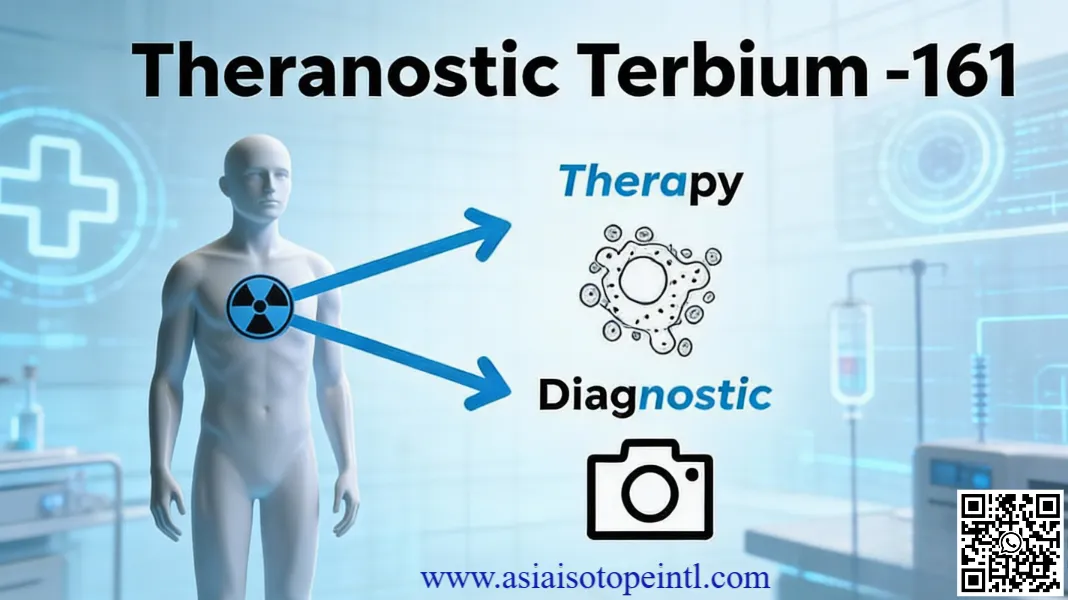
Traditional beta emitters (including Lu-177) are excellent for many tumor sizes, but they may not deposit dose densely enough at cellular/subcellular scale in certain biological contexts. Tb-161 was elevated to “next-generation” status largely because it still behaves like a practical beta emitter and adds a second, micro-scale mechanism of damage through conversion and Auger electrons (very short-range electrons that can deposit energy over distances comparable to cells or even parts of a cell).
2.2 Tb-161 vs Lu-177: similar logistics, potentially stronger microdosimetry
Tb-161 has a half-life commonly listed as 6.89 days and emits beta particles (therapeutic) along with several low-energy gamma lines that can support SPECT imaging.
Importantly, comparative literature continues to emphasize that Tb-161 co-emits short-ranged conversion and Auger electrons, which may improve efficacy—especially for small lesions—while maintaining radiochemistry workflows that are familiar from Lu-177.
A 2021 dosimetric analysis in Cancers (MDPI) quantified this concept in a way that resonates with clinicians: it reports that Tb-161’s advantage is driven by a high emission of electrons below ~40 keV, yielding higher absorbed dose at cellular level and higher dose to very small clusters compared with Lu-177 in simulation frameworks.
3. The Production Logic: Why Gd-160 Is the Essential Starting Point
3.1 The core nuclear pathway (simple to write, hard to industrialize)
The reactor production route is conceptually straightforward:
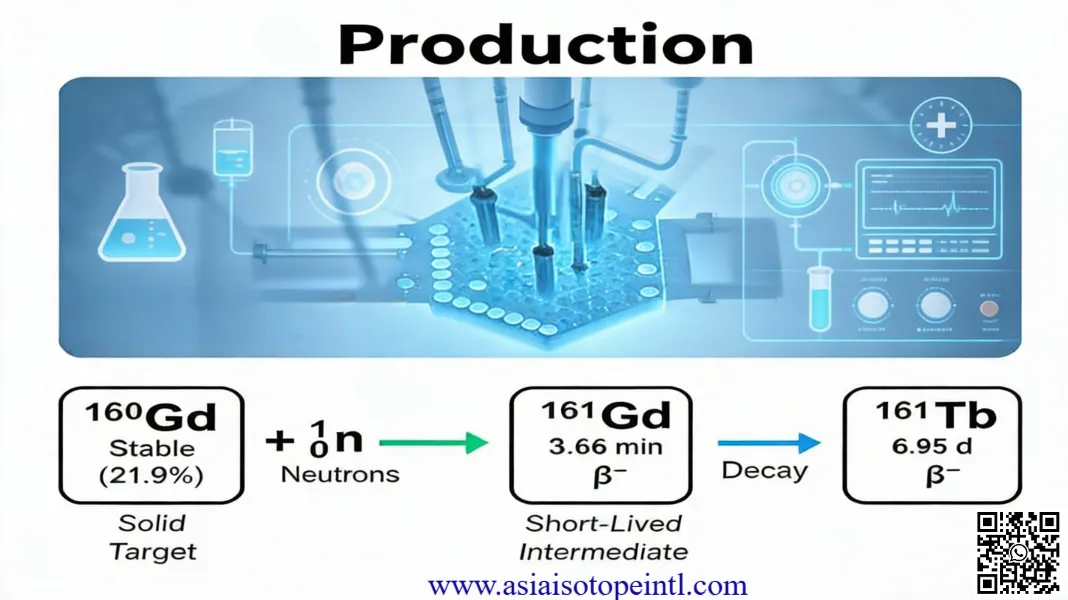
Gd-160 + neutron → Gd-161 → Tb-161
Written in standard notation:
Gd-160(n,γ)Gd-161 → (β⁻ decay) Tb-161
This pathway is highlighted directly in clinical-translation literature, including first-in-human work describing Tb-161 produced from irradiated gadolinium targets and subsequently separated for radiolabeling.
3.2 The strategic advantage: “different element” separation
Here is the production feature that, in practice, separates promising isotopes from scalable isotopes:
- If irradiation produces the same element (target and product chemically identical), separation becomes extremely difficult and specific activity can be limited.
- With Gd-160 → Tb-161, irradiation produces a new element (Tb), allowing a chemically meaningful separation from bulk Gd target material.
This “new element” advantage is emphasized in U.S. DOE communications describing reactor irradiation of Gd-160 and efficient separation to yield high-purity Tb-161 suitable for medical applications.
4. Why Enriched Gd-160 (Not Natural Gadolinium) Is the Real Enabler
4.1 Natural gadolinium contains neutron “black holes”
Natural gadolinium includes several isotopes; two of them—Gd-155 and Gd-157—are famous for extraordinarily high thermal neutron capture cross sections. A peer-reviewed table in Progress of Theoretical and Experimental Physics lists (for natural gadolinium isotopes) Gd-155 ~60,900 barns and provides isotopic abundances alongside capture values.
What does that mean in plain language? If you irradiate natural gadolinium, these isotopes can absorb a large fraction of neutrons that you wanted to deliver to Gd-160—reducing Tb-161 yield efficiency and complicating the activation product mix.
4.2 Procurement reality: Gd-160 must be an engineered material, not a commodity
Modern isotope supply programs list Gd-160 with high enrichment (e.g., >97 atom%) and multiple chemical forms (oxide, nitrate, chloride, metal), reflecting the fact that real producers need target material tailored to irradiation and chemistry workflows.
From an industrial point of view, the “value” of enriched Gd-160 is not simply enrichment percentage—it is the full specification package:
- isotopic composition (including limits on other Gd isotopes),
- chemical purity (trace metals that poison chelation),
- physical properties (pellet pressing, particle size),
- and documentation trail (quality system compatibility).
5. Target Material Engineering: Oxide vs Nitrate Is Not a Small Detail
Scientists often describe the reaction route in a single line, but production engineers know that target chemistry and mechanical stability can decide whether a batch succeeds.
A detailed open-access report on large-scale no-carrier-added Tb-161 production notes that early routes used enriched Gd-160 nitrate targets (prepared from oxide), but lanthanide nitrates are hygroscopic. In-reactor heating can generate water vapor and potentially create overpressure in sealed ampoules—an operational risk that matters when scaling beyond small research batches.
This is one reason many programs emphasize Gd-160 oxide (Gd₂O₃) targets: oxides are generally more stable and can better tolerate irradiation conditions, while still dissolving reliably for downstream chemical separation.
6. Turning Irradiated Targets into Medical Tb-161: Separation Is the Bottleneck (and the Opportunity)
6.1 Tb/Gd separation is hard because they are neighboring lanthanides
Gadolinium and terbium are adjacent rare-earth elements; they share similar chemistry (commonly +3 oxidation state), which makes separation nontrivial. But the field has matured into practical flowsheets that use a combination of:
- cation exchange chromatography, and
- extraction chromatography using lanthanide-selective resins.
A 2024 Applied Radiation and Isotopes study (University of Utah) describes production of no-carrier-added Tb-161 from enriched Gd-160 oxide targets using low-flux research reactors and details separation via cation exchange (AG 50W-X8 with α-HIBA) followed by extraction chromatography (LN resin with nitric acid). It also reports example production and separation performance indicators relevant to radiolabeling quality.
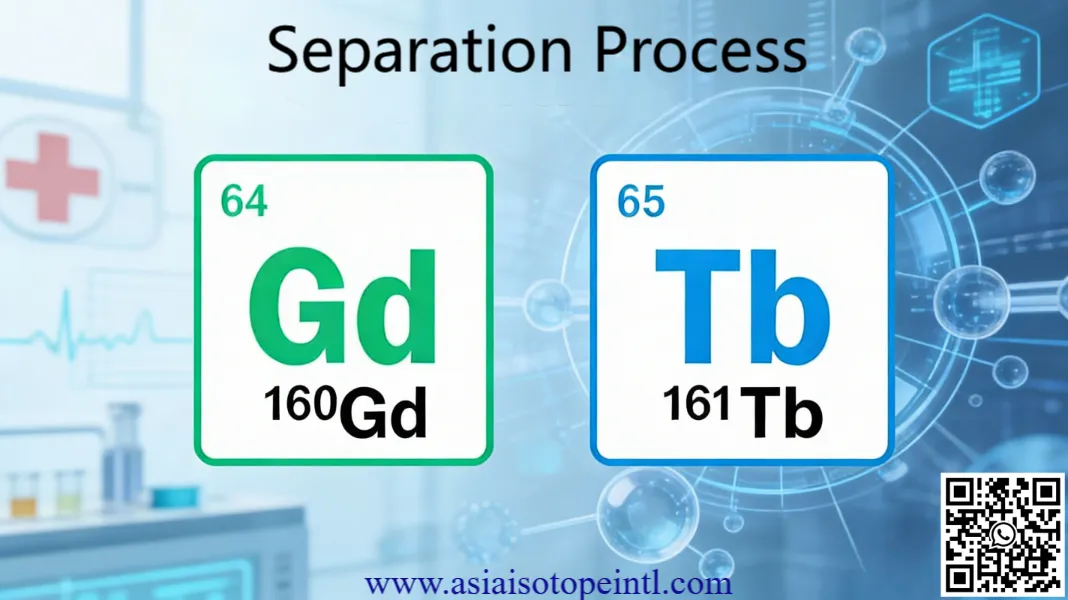
6.2 Why “no-carrier-added” and high molar activity matter clinically
Radiopharmaceutical therapy is not only about delivering activity—it is about delivering activity on a molecule that still behaves like a drug.
If your radionuclide product contains too much stable terbium (carrier) or competing metals, you often need more ligand to achieve labeling yield. That can alter:
- receptor saturation,
- tumor-to-organ ratios,
- and overall therapeutic index.
The first-in-humans feasibility report of Tb-161-DOTATOC shows that Tb-161 can be separated, shipped, and radiolabeled at radiochemical purity suitable for patient application, demonstrating real-world workflow feasibility from production site to clinic.
7. The “Beta Therapy” Claim: Where Tb-161 Is Already Touching Clinical Reality
7.1 Neuroendocrine tumors (NETs): Tb-161-DOTATOC feasibility milestone
The Journal of Nuclear Medicine paper “First-in-Humans Application of Tb-161” is a key translational milestone: it describes shipping Tb-161 from PSI (Switzerland) to a clinic in Germany, radiolabeling DOTATOC, acquiring planar imaging and SPECT/CT, and reporting that the administration was well tolerated in two patients—demonstrating feasibility of clinical imaging and dosimetry workflows with Tb-161-labeled peptides.
While this is not yet a definitive therapeutic efficacy trial, it is the kind of “operational proof” that must exist before large multi-center therapy studies can scale.
7.2 Prostate cancer (PSMA RLT): early clinical trial signals
A major update came with the VIOLET phase 1/2 program in metastatic castration-resistant prostate cancer, reporting first-in-human results for [Tb-161]Tb-PSMA-I&T. The PubMed record summarizes the dose escalation design (4.4, 5.5, 7.4 GBq), notes no dose-limiting toxicities in the interim analysis cohort, and reports 7.4 GBq as the recommended phase 2 dose, with limited Grade 3 treatment-related adverse events in that dataset.
From an isotope-production standpoint, this matters because clinical momentum changes supply-chain economics: once trials expand, Gd-160 target availability becomes a limiting reagent unless upstream capacity is secured.
8. Why Gd-160 Is a “Game-Changer” Specifically for Oncology Beta Therapy
Let me state the mechanism cleanly, because this is the core thesis:
- Enriched Gd-160 enables efficient, controlled neutron capture irradiation for Tb-161 production.
- The pathway creates Tb-161 as a different element, enabling chemical separation from bulk target.
- That separation supports no-carrier-added / high molar activity Tb-161, enabling strong radiolabeling performance.
- Tb-161 delivers conventional therapeutic beta dose plus additional short-range electron dose, which is scientifically linked to improved micro-scale energy deposition.
- Oncology increasingly needs that micro-scale advantage as treatment shifts toward controlling disseminated disease and small-volume metastases.
This framing is strongly aligned with both clinical translation literature (first-in-human Tb-161 use) and modern dosimetry comparisons suggesting a microdosimetric advantage over Lu-177 under certain conditions.
9. What Buyers and R&D Teams Should Demand from Gd-160 Target Material (Practical Checklist)
If your organization is developing Tb-161 radiopharmaceuticals—or planning future clinical supply—treat Gd-160 procurement as a technical program, not a purchase order.
9.1 Isotopic specification (performance starts here)
- Gd-160 enrichment level (commonly high, e.g., >97 atom% in major catalogs)
- Tight limits on Gd-155 and Gd-157 (to avoid neutron capture waste and activation complexity)
Commercial isotope catalogs explicitly list high enrichment levels for Gd-160 and offer multiple chemical forms, which should be selected to match your target fabrication and dissolution strategy.
9.2 Chemical purity (radiolabeling is unforgiving)
Even if your Tb-161 separation is elegant, trace metals (Fe, Zn, Cu, stable lanthanides, etc.) can reduce labeling yields and reproducibility. This is why production papers emphasize characterization and comparison against established commercial Lu-177 products and why GMP alignment is repeatedly discussed in the production literature.
9.3 Physical form and handling (the plant will thank you)
- oxide vs nitrate vs metal form
- pellet press behavior
- hygroscopicity and sealed ampoule risk profile
- dissolution kinetics and filtration behavior
These are not side issues; they become dominant as batch size scales.
10. Scaling and Resilience: The Supply Chain Story Is Changing (2024–2025)
One of the most important (and underappreciated) developments is proof that Tb-161 production is not confined to only the highest-flux flagship reactors.
In 2025, the U.S. Department of Energy highlighted work demonstrating that a low-power university research reactor could produce Tb-161 at high purity from Gd-160 targets, emphasizing efficient separation and medical-application-grade purity, while referencing the associated peer-reviewed publication.
This doesn’t mean “any reactor can do it” at industrial scale. It means something more strategic: the production network can diversify, supporting R&D, preclinical pipelines, and potentially regional supply redundancy.
11. Where This Is Going Next: Tb-161 as a Platform, Not a Single Product
Tb-161 is often described as “Lu-177 plus extra electrons,” but the bigger opportunity is platform-based:
- PSMA ligands (prostate cancer)
- somatostatin receptor ligands (NETs)
- potentially antibodies or other internalizing vectors where short-range electrons may add benefit
The 2025 review literature continues to frame Tb-161 as a strong candidate to follow Lu-177 into broader clinical use, emphasizing similar radiochemistry while highlighting the added short-ranged electron emissions as a differentiator.
And from the “material science” viewpoint, that future rests on one foundational truth: the better your Gd-160 target program, the faster your Tb-161 clinical program can move.
Would you like a deeper dive into any specific technical parameters or applications?
As an industry leader focused in isotope products, our goal is to support our customers by keeping them at the forefront of their industries. We’re here to help with any questions you might have so you can transform your ideas into reality, and tackle those big science challenges.
Get free consultant, our experts are ready to serve.
(Follow up our update articles on www.asiaisotopeintl.com or send your comments to tao.hu@asiaisotope.com for further communications)