Medical-Grade Ultra High Purity Helium: Powering MRI Superconducting Magnets at 4K Temperature
BY Tao, Published Jan 11, 2026
China Isotope Development Co Ltd is premium supplier of Ultra High Purity 6N Helium He Gas over past years immersed in the world of cryogenic gases and their pivotal roles in high-stakes medical technologies, I’ve witnessed firsthand how the simplest elements can enable the most profound medical breakthroughs. Helium, that lightweight, inert gas we associate with party balloons, is far more than a novelty—it’s the lifeblood of modern diagnostic imaging.
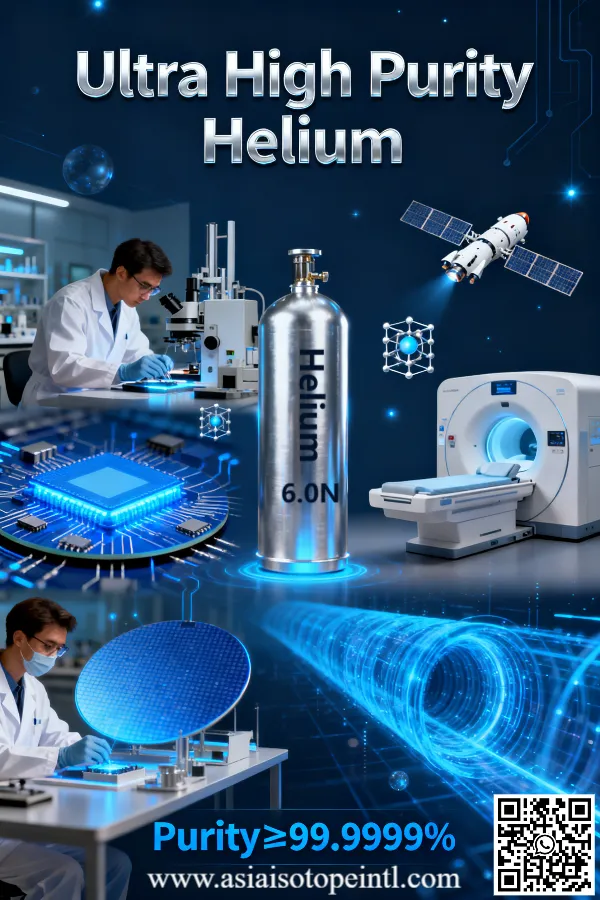
In Magnetic Resonance Imaging (MRI) scanners, Medical-Grade Ultra High Purity (UHP) Helium at 99.9999% purity (6N grade) could be the unsung hero that keeps superconducting magnets humming at an astonishing 4 Kelvin (4K)—that’s a bone-chilling -269°C, just 4 degrees above absolute zero. Without it, the world’s MRI fleet would grind to a halt, leaving millions without access to non-invasive, radiation-free imaging for everything from brain tumors to heart conditions.
As global healthcare demands sharper images and faster scans amid rising chronic disease rates, I’ll unpack why this ultra-pure helium is indispensable, how it works in the cold heart of an MRI, and the cutting-edge challenges we face in supplying it reliably. This isn’t just science; it’s the foundation of lifesaving diagnostics.
1. What Makes Medical-Grade UHP Helium “Medical-Grade”?
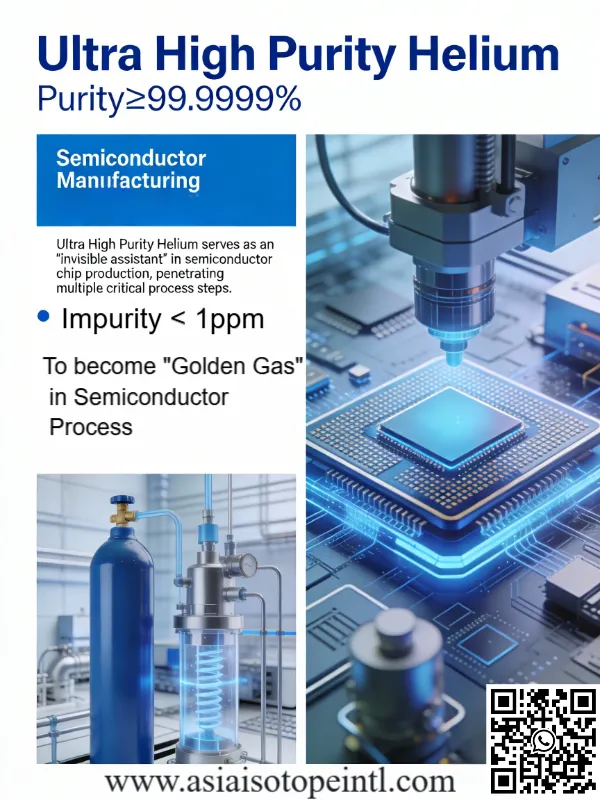
Purity isn’t a buzzword in the gas industry—it’s a non-negotiable lifeline. 6N Helium means impurities total less than 1 part per million (ppm), a level so stringent that if you filled an Olympic-sized swimming pool with it, you’d have fewer than 300 contaminant molecules swimming around.
Standard vs. Medical-Grade: The Purity Spectrum
- Industrial Helium (4N-5N): Fine for welding or balloons, but with 10-100 ppm impurities like oxygen, nitrogen, or moisture.
- UHP Helium (6N): Semiconductor-grade baseline.
- Medical-Grade UHP Helium: Even more rigorously certified. It undergoes additional pharmaceutical-grade testing for biocompatibility, consistent isotopic composition (to avoid magnetic field distortions), and cryogenic stability. Trace metals, hydrocarbons, and even neon (which can cause boil-off issues) are scrubbed to sub-ppb levels.
Why the extra hoops? In an MRI cryostat—the sealed vacuum flask housing the magnet—any impurity acts like sand in an engine. Oxygen freezes into ice crystals that block cooling channels; moisture forms hydrates that expand and crack components; nitrogen dilutes the helium, raising the required cooling power by up to 20%.
Global standards like USP (United States Pharmacopeia) or EP (European Pharmacopoeia) mandate this for medical helium, ensuring patient safety and scanner reliability. In 2024 alone, China consumed over 3.2 million cubic meters of medical helium, accounting for ~85% of total helium use in healthcare worldwide.
2. The Magic of Superconductivity: Why 4K and Helium Go Hand-in-Hand
MRI scanners produce magnetic fields up to 7 Tesla (T)—30,000 times stronger than Earth’s—for crystal-clear images. This power comes from superconducting magnets, coils of niobium-titanium wire that carry massive currents with zero electrical resistance when cooled below their critical temperature (~9K for NbTi).
How Superconductivity Works (Simplified)
At room temperature, electrons in a metal collide, wasting energy as heat (resistance). Below a threshold, they pair up into “Cooper pairs,” gliding frictionlessly. But this magic demands extreme cold—4K for stability, providing a safety margin against field fluctuations.
Enter liquid helium: Helium-4 liquefies at 4.2K under atmospheric pressure, the lowest boiling point of any common substance. Pump it down to lower pressures, and it hits 4K. No other cryogen matches this:
- Liquid Nitrogen (77K): Too warm; quenches (abruptly warms) the magnet.
- Hydrogen: Too reactive and explosive.
A typical 1.5T MRI holds 1,500-2,000 liters of liquid helium in its cryostat. Each scanner guzzles about 12,000 liters annually due to boil-off (natural evaporation). Multiply by ~60,000 global MRIs, and you see why helium shortages make headlines.
3. The Anatomy of an MRI Cryostat: Helium’s Critical Journey
Picture the MRI magnet as a thermos flask on steroids: multi-layered insulation, radiation shields, and a neck tube for helium management.
Key Components Powered by UHP Helium
- Primary Cooling Bath: The magnet coils dunk in liquid helium at 4.2K. UHP purity prevents impurity buildup, which could insulate the coils and cause hotspots.
- Cold Head (Cryocooler): Modern “zero-boil-off” MRIs use pulse-tube refrigerators (PTRs) to re-liquefy evaporating helium. The PTR’s expansion volumes run on gaseous helium loops—must be 6N to avoid compressor failures.
- Helium Circulation Loop: High-purity gas recirculates to intercept boil-off vapors, condensing them back to liquid. Impurities accumulate here first, demanding periodic purity checks via Residual Gas Analyzers (RGAs).
- Thermal Shields: Intermediate stages at 40-80K use evaporated helium to intercept heat leaks.
During operation, the cryostat loses ~0.1-0.5% helium daily. In emergencies—like a quench (magnet warms suddenly, venting helium explosively)—up to 90% can evaporate in seconds, costing $50,000+ to refill.
Medical-grade UHP Helium’s edge: Its superior thermal conductivity (0.15 W/m·K at 4K, 5x better than neon mixtures) ensures even cooling, minimizing quench risks by 30-50% compared to lesser grades.
4. The Perils of Impurities: Real-World Quench Disasters and Prevention
Impurities aren’t abstract—they cause failures. Here’s the science:
Common Culprits and Their Damage
- Oxygen (<0.1 ppm allowed): Freezes at 54K, plugging neck tubes. A 2019 U.S. hospital outage traced to 5 ppm O2 led to a full quench, downtime of 3 weeks.
- Moisture (H2O, <0.1 ppm): Forms clathrates (helium-trapping ice cages) at 5-10K, blocking flow. Expands 1,600x on freezing.
- Nitrogen/Neon: Lower boiling points raise bath pressure, accelerating boil-off by 10-20%.
Quench Physics: A hotspot exceeds Tc, resistance spikes, Joule heating (I²R) vaporizes helium violently. Fields collapse, risking coil damage. Helium purity directly correlates with quench-free uptime—6N systems average 99.99% reliability vs. 98% for 5N.
Prevention? Helium Purity Monitors (HPACs) sample gas continuously, alerting if ppb thresholds breach. Refills use bulk cryogenic trailers with onboard purifiers.
5. Production and Supply Chain: From Earth’s Crust to Hospital Bays
Helium forms in uranium/thorium decay deep underground, trapped in natural gas (0.1-2% concentration). Extraction is energy-intensive:
The Purification Odyssey to 6N Medical-Grade
- Crude Extraction: Membrane separation from natgas.
- Cryogenic Distillation: At -269°C, helium vaporizes first.
- PSA/Getters: Adsorbents strip ppm impurities; hot titanium getters mop up ppb O2/N2.
- Medical Certification: Isotopic purity (He-3 <1 ppm), microbial testing, cylinder passivation (internal electropolishing).
China’s helium self-sufficiency has surged via tech breakthroughs—from natgas/LNG tails to air separation. Firms like China Isotope Development Co.,Ltd—deeply entrenched in helium ops for research, industry, and electronics—now supply 6N medical-grade reliably, slashing import reliance.
Challenges:
- Global Shortages: U.S. Federal Helium Reserve closed 2021; Qatar ramps up, but geopolitics loom.
- Demand Boom: Aging populations + high-field MRIs (3T/7T) spike needs 5-7%/year.
- Logistics: Liquid helium trailers lose 0.5%/day; dewars vent if idle.
Innovations: Helium Recycling recovers 95% from vented gas via cryocoolers. Closed-loop systems in new Siemens/GE scanners cut annual use to <500L.
6. Broader Impacts: From Diagnostics to Healthcare Economics
MRI’s helium dependency touches every scan:
- Clinical Wins: Detects 90% of early strokes, guides 70% of neurosurgeries.
- Economics: A quench downtime costs $10K/day. Reliable 6N helium saves hospitals millions.
- Stats: 50 million U.S. scans/year; China’s MRI fleet grew 15% in 2024.
Emerging Trends:
- High-Temp Superconductors (HTS): YBCO tapes at 77K (LN2-cooled) promise helium-free MRIs by 2030, but fields cap at 1.5T vs. 7T.
- Hybrid Cryostats: Neon-helium mixes for 10K operation—cheaper but less efficient.
- Portable MRIs: Hyperfine’s low-field (0.064T) uses permanent magnets—no helium!
Yet, for precision diagnostics, 4K UHP helium reigns supreme.
7. Future Horizons: Sustainability and Innovation in Medical Helium
As an expert, I foresee a balanced path:
- Recovery Mandates: EU regs target 90% recapture by 2028.
- Domestic Production: China’s 6N breakthroughs reshape supply.
- Alternatives R&D: MgB2 superconductors at 20K; but scale-up lags.
Unique Value: Medical-grade UHP helium isn’t commoditized—its traceability, from mine to MRI, ensures zero-compromise performance.
8. Conclusion: The Cold Guardian of Human Health
In the quest for healthier lives, Medical-Grade Ultra High Purity Helium stands as the cryogenic sentinel, powering MRI superconducting magnets at 4K with unwavering reliability. Its 99.9999% purity isn’t luxury—it’s the barrier against chaos in a system where one impurity molecule can cascade into catastrophe.
From enabling tumor detection in children to mapping stroke-damaged brains, this “golden gas” underpins radiology’s golden era. As demand surges with AI-enhanced imaging and portable tech, mastering its supply chain will define healthcare access.
Would you like a deeper dive into any specific technical parameters or applications?
As an industry leader focused in Specialty Gases products, our goal is to support our customers by keeping them at the forefront of their industries. We’re here to help with any questions you might have so you can transform your ideas into reality, and tackle those big science challenges.
Get free consultant, our experts are ready to serve.
(Follow up our update articles on www.asiaisotopeintl.com or send your comments to tao.hu@asiaisotope.com for further communications)