UHP Helium Gas Solutions: Enabling 5nm Chip Production with 6N-Grade Helium Cooling Systems
BY Tao, Published Jan 11, 2026
The Critical Role of Ultra-High Purity Helium in Advanced Semiconductor Manufacturing
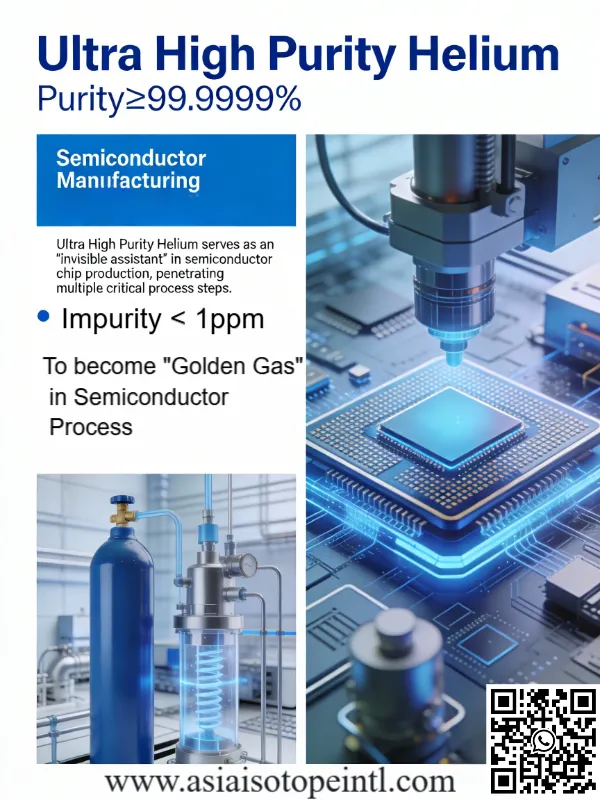
As we push the boundaries of semiconductor technology toward ever-smaller nodes, the manufacturing processes become exponentially more complex and demanding. The transition to 5-nanometer (5nm) chip production represents one of the most significant technological leaps in the semiconductor industry, requiring unprecedented levels of precision, control, and purity in every aspect of the fabrication process. Among the critical enablers of this advanced technology is ultra-high purity (UHP) helium gas, specifically 6N-grade helium (99.9999% purity), which plays an indispensable role in the cooling systems essential for successful 5nm chip production.
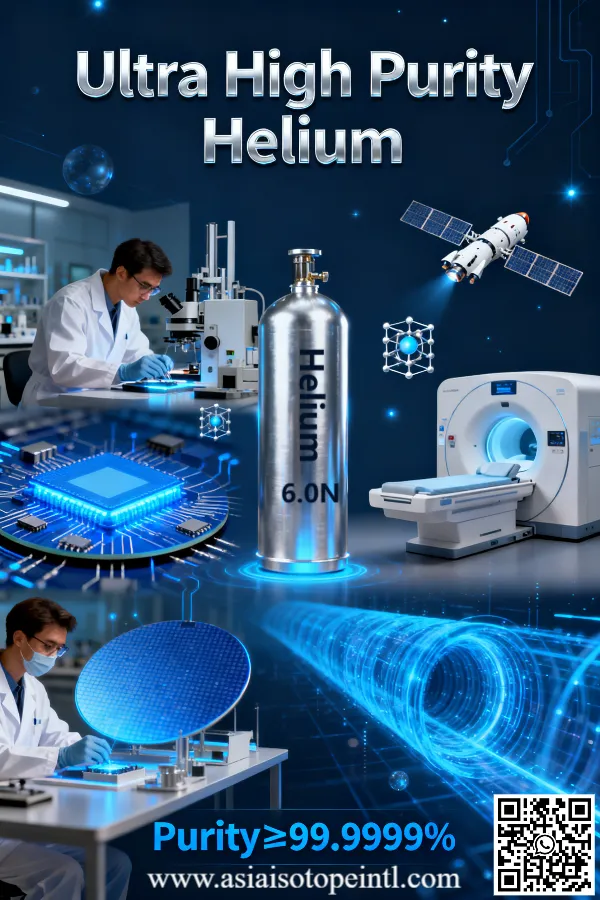
China Isotope Development Co.,Ltd is professionally supplying Helium He Gas Ultra High Purity 6.0N 99.9999% with their own package processing one-stop service to meet client advanced requirements, as a qualified supplier of multinational companies, gaining their trust ranging from its quality / price / delivery.
The semiconductor industry’s evolution from 14nm to 10nm, then 7nm, and now 5nm nodes has introduced thermal management challenges that conventional cooling methods simply cannot address. At these microscopic scales, where transistor features measure just a few dozen atoms across, even minute temperature variations can cause devastating effects on yield rates and chip performance. This is where UHP helium gas solutions emerge as a game-changing technology, providing the exceptional thermal control necessary for producing the world’s most advanced processors.

Understanding 6N-Grade Helium: Purity Standards and Specifications
Defining Ultra-High Purity in the Context of Semiconductor Manufacturing
When we speak of 6N-grade helium, we’re referring to a purity level of 99.9999% – meaning that for every million helium atoms, fewer than one is an impurity. This extraordinary level of purity isn’t just a nice-to-have specification; it’s an absolute necessity for 5nm chip production. To put this in perspective, standard industrial-grade helium typically offers purity levels around 99.995% (4N5), which, while impressive for many applications, falls far short of semiconductor manufacturing requirements.
The impurity profile of 6N-grade helium is meticulously controlled and monitored. Critical contaminants that must be minimized include:
- Moisture (H₂O): Limited to less than 0.5 parts per million (ppm)
- Oxygen (O₂): Restricted to below 0.1 ppm
- Nitrogen (N₂): Maintained under 0.5 ppm
- Total Hydrocarbons (THC): Kept below 0.1 ppm
- Carbon Dioxide (CO₂): Limited to less than 0.1 ppm
- Hydrogen (H₂): Controlled to under 0.1 ppm
Each of these impurities, even at trace levels, can interfere with the delicate processes involved in 5nm chip fabrication. For instance, moisture can cause oxidation of critical metal layers, while hydrocarbons can deposit unwanted carbon residues on wafer surfaces, compromising the electrical properties of transistors.
The Purification Journey: From Raw Helium to 6N-Grade
Achieving 6N purity requires sophisticated purification processes that go far beyond simple filtration. The journey begins with raw helium extracted from natural gas wells, which typically contains various impurities including methane, nitrogen, and water vapor. The purification process involves multiple stages:
Cryogenic Distillation: The helium undergoes fractional distillation at extremely low temperatures, leveraging the different boiling points of various gases to separate helium from heavier contaminants.
Pressure Swing Adsorption (PSA): This technology uses specialized adsorbent materials that selectively capture impurities while allowing pure helium to pass through. The system operates in cycles, with adsorbent beds alternating between adsorption and regeneration phases.
Catalytic Purification: Any remaining hydrogen or carbon-containing compounds are removed through catalytic conversion, where these impurities react on specially designed catalyst surfaces and are subsequently removed.
Final Polishing: The last stage involves passage through ultra-fine filters and getter materials that capture any remaining trace contaminants, achieving the final 6N purity level.
Thermal Challenges in 5nm Chip Production
The Heat Generation Paradox of Advanced Nodes
As semiconductor technology advances to smaller nodes, we encounter a fundamental paradox: while individual transistors consume less power, the dramatic increase in transistor density results in unprecedented heat flux levels. A modern 5nm processor can pack over 15 billion transistors into a space smaller than a fingernail, with power densities exceeding 300 watts per square centimeter in hotspot areas – comparable to the heat flux on the surface of the sun.
This extreme heat generation creates multiple challenges:
Thermal Runaway Risk: At 5nm scales, localized heating can trigger positive feedback loops where increased temperature leads to higher leakage currents, which generate more heat, potentially destroying the chip within microseconds.
Lithographic Precision: The extreme ultraviolet (EUV) lithography used for 5nm patterning requires temperature stability within ±0.01°C. Any thermal drift can cause pattern misalignment, reducing yield rates dramatically.
Material Stress: Rapid temperature changes induce mechanical stress in the various materials used in chip construction, potentially causing delamination, cracking, or warpage that renders chips non-functional.
Why Conventional Cooling Falls Short
Traditional cooling methods, including water cooling and standard gas cooling systems, face fundamental limitations when applied to 5nm production:
Insufficient Heat Transfer Rates: Water and conventional coolants simply cannot remove heat quickly enough from the microscopic hotspots that develop during processing.
Contamination Risk: Many traditional coolants introduce contamination risks, either through direct contact or through outgassing of impurities.
Poor Temperature Uniformity: Achieving the sub-millikelvin temperature uniformity required for 5nm processing is virtually impossible with conventional cooling approaches.
The Unique Properties of Helium for Cooling Applications
Exceptional Thermal Conductivity
Helium possesses the highest thermal conductivity of any gas except hydrogen, approximately six times higher than air and three times higher than hydrogen at room temperature. This exceptional property allows helium to rapidly transport heat away from critical surfaces. At the microscale relevant to semiconductor processing, helium’s thermal conductivity enables heat flux management that would be impossible with other cooling media.
Inertness and Chemical Stability
Unlike many other potential coolants, helium is completely inert – it forms no chemical compounds under normal conditions. This absolute chemical stability is crucial in the semiconductor environment, where even trace chemical reactions can compromise device performance. Helium won’t react with sensitive materials like silicon, germanium, or the various metal interconnects used in modern chips, ensuring that the cooling process introduces no chemical contamination.
Low Viscosity and High Diffusivity
Helium’s extremely low viscosity allows it to flow through the tiniest channels and spaces with minimal pressure drop. This property is essential for cooling systems in 5nm production equipment, where cooling channels may be just micrometers wide. The high diffusivity of helium also means it can quickly penetrate into small spaces and crevices, ensuring uniform cooling even in complex geometries.
Quantum Mechanical Advantages
At the cryogenic temperatures sometimes employed in advanced semiconductor processing, helium exhibits unique quantum mechanical properties. Below 2.17 Kelvin, helium becomes a superfluid with zero viscosity, enabling perfect heat transfer in specialized applications. While most 5nm production doesn’t operate at these extreme temperatures, the quantum properties of helium contribute to its exceptional behavior even at higher temperatures.
Implementation of UHP Helium Cooling Systems in 5nm Fabs
System Architecture and Design
Modern UHP helium cooling systems for 5nm production incorporate sophisticated engineering to maximize cooling efficiency while maintaining absolute purity. The typical system architecture includes:
Primary Circulation Loop: High-capacity pumps circulate 6N-grade helium through the cooling system at precisely controlled flow rates, typically ranging from 100 to 1000 standard liters per minute depending on the specific application.
Heat Exchangers: Advanced micro-channel heat exchangers with surface areas exceeding 1000 square meters per cubic meter extract heat from process chambers with minimal temperature gradient.
Purification Subsystems: Continuous purification modules ensure that the helium maintains its 6N purity even after extended circulation, removing any contaminants that might be picked up during the cooling process.
Recovery and Recycling Systems: Given helium’s scarcity and cost, modern systems incorporate sophisticated recovery mechanisms that capture and re-purify used helium, achieving recovery rates exceeding 95%.
Integration with Process Equipment
The integration of UHP helium cooling into 5nm production equipment requires careful consideration of multiple factors:
EUV Scanner Cooling: EUV lithography scanners, the workhorses of 5nm patterning, generate enormous heat loads from their high-power laser sources. UHP helium cooling maintains the optical elements at stable temperatures, preventing thermal distortion that would blur the nanometer-scale patterns.
Plasma Etch Chambers: During plasma etching processes, substrate temperatures must be controlled within ±1°C while exposed to high-energy ion bombardment. Helium backside cooling, where 6N helium flows behind the wafer, provides the necessary thermal management without contaminating the process.
Ion Implantation Systems: High-energy ion beams used for doping generate significant localized heating. UHP helium cooling prevents thermal damage while maintaining the precise depth profiles required for 5nm transistors.
Process Control and Monitoring
Maintaining optimal performance of UHP helium cooling systems requires sophisticated monitoring and control:
Real-Time Purity Analysis: Continuous gas analyzers monitor helium purity at multiple points in the system, detecting any contamination at parts-per-billion levels before it can affect production.
Flow and Pressure Control: Mass flow controllers maintain helium flow rates with precision better than 0.1%, ensuring consistent cooling performance across all process conditions.
Temperature Mapping: Arrays of high-precision temperature sensors create detailed thermal maps of cooled surfaces, enabling predictive adjustments to prevent thermal excursions.
Economic Considerations and ROI Analysis
The Cost-Benefit Equation
While UHP helium systems represent a significant capital investment, the return on investment for 5nm production is compelling. Consider the following economic factors:
Yield Improvement: By maintaining optimal thermal conditions, UHP helium cooling can improve chip yields by 5-10%, translating to millions of dollars in additional revenue per production line.
Equipment Lifetime: Precise temperature control reduces thermal stress on expensive production equipment, extending operational lifetime by 20-30% and reducing maintenance costs.
Energy Efficiency: Despite the initial energy required for helium purification and circulation, the superior heat transfer properties of helium result in overall energy savings compared to alternative cooling methods.
Product Quality: The enhanced thermal control enables production of higher-performance chips that command premium prices in the market.
Supply Chain Considerations
The global helium supply chain presents both challenges and opportunities for semiconductor manufacturers:
Strategic Sourcing: Long-term supply agreements with helium producers ensure stable pricing and availability, critical for maintaining continuous production.
Geographic Distribution: The concentration of helium sources in specific regions (primarily the United States, Qatar, and Russia) requires careful supply chain management and contingency planning.
Alternative Sources: Development of new helium extraction technologies and sources, including from natural gas fields previously considered uneconomical, is expanding supply options.

Future Developments and Emerging Technologies
Beyond 5nm: The Road to 3nm and 2nm
As the semiconductor industry pushes toward 3nm and eventually 2nm nodes, the demands on cooling systems will become even more stringent. UHP helium cooling systems are evolving to meet these challenges:
Enhanced Purity Levels: Research is underway to achieve 7N (99.99999%) and even 8N purity levels, removing impurities that are currently undetectable but may become significant at smaller scales.
Hybrid Cooling Systems: Combination systems that use UHP helium in conjunction with other cooling technologies, such as thermoelectric cooling or liquid nitrogen pre-cooling, are being developed to achieve even better thermal control.
AI-Optimized Control: Machine learning algorithms are being deployed to predict and prevent thermal excursions before they occur, optimizing helium flow patterns in real-time based on process conditions.
Sustainable Helium Management
The semiconductor industry is actively working to address helium sustainability concerns:
Closed-Loop Systems: Next-generation systems achieve near-100% helium recovery, virtually eliminating consumption except for unavoidable leakage.
Helium Conservation Technologies: Advanced seal designs and leak detection systems minimize helium loss, while new storage technologies enable more efficient helium inventory management.
Alternative Cooling Gases: Research into helium-hydrogen mixtures and other gas combinations seeks to reduce helium consumption while maintaining cooling performance.
Best Practices for UHP Helium System Implementation
System Design Guidelines
For organizations implementing UHP helium cooling for 5nm production, several best practices ensure optimal performance:
Contamination Prevention: Every component in contact with UHP helium must be carefully selected and prepared. Electropolished stainless steel, specialized polymers, and ultra-clean assembly procedures prevent introduction of contaminants.
Redundancy and Reliability: Critical cooling systems require N+1 redundancy, ensuring that production continues even if one cooling unit requires maintenance.
Modular Architecture: Designing systems with modular components facilitates maintenance and upgrades without disrupting production.
Operational Excellence
Maintaining peak performance of UHP helium cooling systems requires disciplined operational practices:
Preventive Maintenance: Regular inspection and replacement of filters, seals, and other wear components prevents unexpected failures.
Staff Training: Operators must understand both the technical aspects of the cooling system and the critical nature of maintaining helium purity.
Documentation and Traceability: Comprehensive records of helium purity, system performance, and maintenance activities support continuous improvement and troubleshooting.
Conclusion: The Indispensable Role of UHP Helium in Advanced Semiconductor Manufacturing
The transition to 5nm chip production represents a watershed moment in semiconductor technology, enabled by innovations across multiple disciplines. Among these enabling technologies, UHP helium cooling systems stand out as absolutely critical infrastructure. The unique combination of properties offered by 6N-grade helium – exceptional thermal conductivity, absolute chemical inertness, and superior flow characteristics – makes it irreplaceable in managing the extreme thermal challenges of 5nm production.
As we look toward an future of even smaller semiconductor nodes and more complex chip architectures, the role of UHP helium will only grow in importance. The semiconductor industry’s continued investment in helium purification technology, recovery systems, and supply chain development reflects the strategic importance of this remarkable element.
The success of 5nm chip production ultimately depends on our ability to control process conditions with unprecedented precision. UHP helium cooling systems provide the thermal management foundation that makes this precision possible, enabling the production of processors that power everything from smartphones to supercomputers. As we continue to push the boundaries of what’s possible in semiconductor manufacturing, ultra-high purity helium will remain an essential enabler of progress.
The ongoing evolution of UHP helium technology – from improved purification methods to more efficient recovery systems to AI-optimized control systems – demonstrates the semiconductor industry’s commitment to advancing this critical technology. For manufacturers embarking on 5nm production or planning for future nodes, investing in state-of-the-art UHP helium cooling systems isn’t just a technical necessity; it’s a strategic imperative that will determine competitiveness in the global semiconductor market.
The marriage of 6N-grade helium purity with sophisticated cooling system design has created a technological capability that seemed impossible just a decade ago. As we stand on the threshold of even more advanced semiconductor nodes, UHP helium cooling systems will continue to evolve, adapt, and enable the next generation of electronic devices that will shape our digital future.
Would you like a deeper dive into any specific technical parameters or applications?
As an industry leader focused in Specialty Gases products, our goal is to support our customers by keeping them at the forefront of their industries. We’re here to help with any questions you might have so you can transform your ideas into reality, and tackle those big science challenges.
Get free consultant, our experts are ready to serve.
(Follow up our update articles on www.asiaisotopeintl.com or send your comments to tao.hu@asiaisotope.com for further communications)