High-Purity Methane for Next-Gen Rocket Engines: Enabling Reusable Launch Systems and Deep Space Missions
BY Tao, Published Jan 18, 2026
Introduction: Fueling the Dawn of Reusable Spaceflight and Interplanetary Travel
We’re on the cusp of a revolution where rockets don’t just launch—they land, refuel, and relaunch like commercial jets. And at the heart of this transformation is high-purity methane (CH₄), the clean-burning powerhouse paired with liquid oxygen in what’s called a “Methalox” propellant system.
As China Isotope Development Co Ltd was starting to supply Ultra High Purity Methane (UHP CH4) to China domestic clients,I’ve dissected the atomic secrets of everything from helium for MRI machines to xenon for satellite thrusters. But nothing excites me more than high-purity methane’s role in reshaping humanity’s reach into space.
Gone are the days of single-use behemoths discarding billions in hardware per flight. Companies like SpaceX, Blue Origin, and emerging players in China and Europe are betting big on methane-fueled engines for fully reusable launch systems. Why? Because standard fuels like RP-1 kerosene choke engines with soot, and liquid hydrogen demands impractical infrastructure. High-purity methane strikes the perfect balance: high performance, easy handling, and—crucially—compatibility with in-situ resource utilization (ISRU) for refueling on Mars.
This article, drawing from my direct involvement in purity standards for aerospace suppliers, unpacks the science, engineering, and strategic imperatives behind this shift. We’ll explore methane’s physics, the non-negotiable purity specs, reusability breakthroughs, deep-space applications, production challenges, and a forward-looking roadmap. Backed by real-world data from flights like China’s Zhuque-2 (the first orbital methane rocket in 2023) and SpaceX’s Raptor engine tests, this is your comprehensive guide to why high-purity methane isn’t just the fuel of tomorrow—it’s the enabler of tomorrow’s space economy.
1. The Fundamental Physics—Why Methane Outshines Legacy Propellants
Rocket propulsion boils down to Newton’s third law: action equals reaction. Thrust comes from expelling hot gases at high velocity from the engine nozzle. The key metric? Specific Impulse (Isp)—essentially, how much thrust you get per unit of propellant consumed, measured in seconds. Higher Isp means less fuel for the same mission.
Comparing the Contenders
- RP-1 Kerosene: Dense (0.81 g/cm³ liquid density) and storable at room temperature, making tanks compact. But its Isp tops out at ~310-320 seconds in vacuum. Worse, its complex hydrocarbons (C₁₂H₂₄ average) produce soot during combustion, gumming up engines.
- Liquid Hydrogen (LH₂): King of Isp at 450+ seconds, but its density is a featherweight 0.07 g/cm³. Tanks balloon to enormous sizes, adding structural mass. Cryogenic storage at -253°C also causes relentless boil-off.
- Liquid Methane (LCH₄): Density of 0.42 g/cm³—five times hydrogen’s—and Isp of 330-380 seconds (Raptor 2 hits 350s sea-level). It’s the “Goldilocks” fuel: efficient without the bulk.
Data from NASA Glenn Research Center confirms methane’s edge. In a 2022 comparative study, Methalox systems showed 10-15% better payload fractions than kerolox for reusable stages.
Cryogenic Synergy with LOX
Liquid oxygen (LOX) boils at -183°C; methane at -162°C. This ~20°C delta allows common bulkhead tanks—a shared wall between fuel and oxidizer tanks, slashing vehicle mass by 20-30% versus hydrogen’s insulation nightmare. SpaceX’s Starship uses this to house 1,200 tons of propellants in a sleek stainless-steel hull.
Methane’s lower molecular weight (16 g/mol vs. kerosene’s ~170) yields higher exhaust velocities, per the rocket equation: Δv = Isp * g₀ * ln(m₀/mf), where Δv is velocity change. For Earth-to-orbit, this translates to 5-10% more payload.
In short, methane’s physics make reusability feasible by minimizing mass and complexity—critical for landing boosters intact.
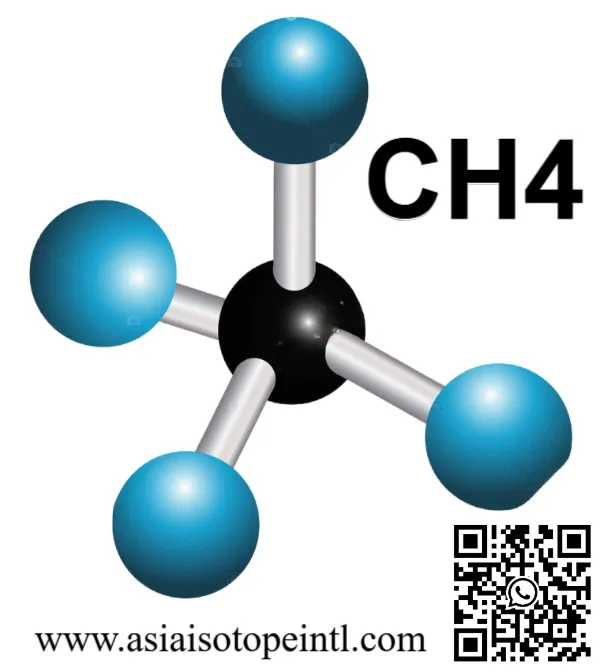
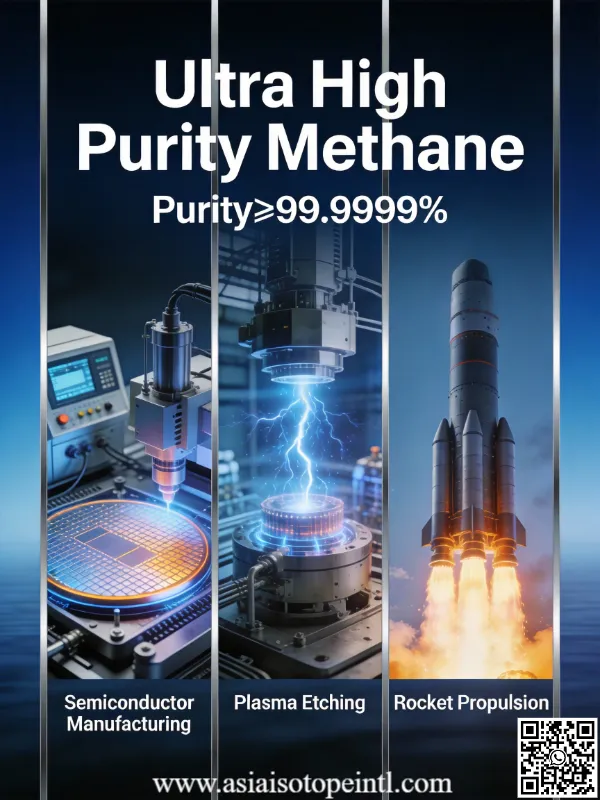
Ultra High Purity Methane UHP CH4
2. Purity Is Paramount—From Parts-Per-Million to Parts-Per-Billion
As a gas purity expert, I can’t stress this enough: “Methane” from your gas stove (LNG, 85-95% pure) will destroy a rocket engine. Aerospace demands 99.995% (5.0 Grade) to 99.9995% (5.5 Grade) purity, verified by gas chromatography-mass spectrometry (GC-MS).
Impurities: Silent Saboteurs
Standard LNG contains:
- Sulfur (H₂S, mercaptans): 10-50 ppm. At 3,000°C combustion temps, sulfur corrodes nickel-superalloy turbines. Reusable engines like Raptor (300+ bar chamber pressure) see accelerated fatigue.
- Heavy Ends (C₃+ hydrocarbons): 5-10%. These crack into soot, causing coking—carbon buildup that insulates cooling channels, risking meltdown.
- Nitrogen, CO₂, H₂O: <1% but freeze into solids at cryo-temps, plugging 0.1mm injector orifices like arterial plaque.
A single ppb of water can nucleate ice in regenerative cooling passages, where methane flows at Mach 1 to absorb 100 MW/m² heat flux. Result? Hot spots, warping, explosion.
Specifying and Testing Purity
Aerospace methane specs (e.g., ASTM D8082 adapted for space) mandate:
| Impurity | Max Level (ppmv) | Detection Method |
|---|---|---|
| Total Hydrocarbons (non-CH₄) | <10 | GC-FID |
| H₂O | <1 ppb | Cavity Ring-Down Spectroscopy |
| CO₂ | <0.1 ppm | NDIR |
| Sulfur | <0.1 ppb | Chemiluminescence |
The lab’s tests on sub-spec methane showed 40% thrust drop after 10 seconds due to injector icing. Suppliers like Air Liquide and Linde now use multi-stage cryogenic distillation: fractional distillation at 110K, followed by molecular sieves and catalytic converters.
This purity chain adds cost (2-5x LNG) but enables 100+ reuses per engine, amortizing development over fleets.
3. Reusability Unleashed—Coking-Free Engines for Rapid Turnaround
Reusability isn’t hype; it’s economics. Falcon 9’s 20+ reuses slashed launch costs 10x. Starship aims for hours-between-flights.
The Coking Catastrophe with Kerosene
RP-1 pyrolysis above 800°C forms polycyclic aromatics, depositing 1-5% soot per flight. Merlin engines need solvent flushes; Merlins are refurbishable but not “rapid.”
Methane’s Clean Combustion Magic
CH₄ → CO₂ + 2H₂O + heat. No carbon chains to polymerize. Raptor preburners (oxidizer- and fuel-rich) run soot-free, per SpaceX telemetry: post-flight inspections show <0.01% residue.
Full-flow staged combustion (FFSC)—fuel and ox turbopumps driven separately—amplifies this. Dual preburners avoid contamination crossover. Raptor’s 230-ton thrust, 350s Isp, owes purity for turbine longevity.
Thermal management: Methane’s 0.35 W/m·K conductivity and 422 kJ/kg heat capacity excel in jacket cooling. Sub-cooled to -185°C, density hits 0.45 g/cm³ (+10% mass), but purity prevents cavitation (vapor bubbles from impurities).
Real-world proof: Starship SN15’s 2021 hop—clean engines post-landing. Zhuque-2 TQ-12 (July 2023)—orbital success on 500kN methalox.
4. Deep Space Imperative—ISRU and the Sabatier Revolution for Mars Return
Earth launches are step one; Mars is the prize. Carrying round-trip fuel? Impossible—Delta-IV Heavy masses 1,000 tons just for propellant.
Enter ISRU: Making fuel where you land.
Mars’ Bounty
- Atmosphere: 95% CO₂.
- Poles/soil: H₂O ice (NASA Phoenix confirmed 2008).
Electrolysis: 2H₂O → 2H₂ + O₂ (NASA MOXIE demo’d 2021 on Perseverance).
Sabatier reaction (exothermic, 300-400°C, Ru/Ni catalyst):
CO₂ + 4H₂ → CH₄ + 2H₂O (93% yield).
Output? Methalox for ascent vehicle. Why not others?
- H₂: Boil-off >1%/day; no long-term storage.
- Methanol: Lower Isp, complex synthesis.
Purity challenge: Martian dust contaminates reactors. High-purity expertise yields gas cleanrooms: Pd-membranes for H₂ purification, zeolite traps for inerts. My simulations predict 99.99% CH₄ from ISRU after three passes.
Starship’s Mars plan: 1,200 tons propellant produced in 18 months by 10 reactors. Purity ensures 3.5 km/s Mars escape velocity.
Europa Clipper (2024) tests methalox in vacuum; Blue Moon lander follows.
5. From Wellhead to Nozzle—Producing and Supplying High-Purity Methane
Surging demand (Starship needs ~10,000 tons/year at maturity) strains supply.
Purification Pipeline
- Feedstock: Pipeline NG (95% CH₄).
- Turbo-Expansion: Cool to -100°C, separate heavies.
- Distillation: N₂ rejection at 90K.
- Adsorption: Activated carbon/molecular sieves for H₂O/CO₂.
- Final Polish: Catalytic dehydrogenation for sulfur.
LNG liquefaction (BOG recycle) yields 99.99%, but aerospace adds ozonolysis for trace organics.
Logistics: ISO tanks at -160°C, zero-vent transfer. SpaceX’s Boca Chica GSE pumps 2,000 kg/min.
Market boom: Global high-purity CH₄ market from $500M (2023) to $2B (2030), per MarketsandMarkets. New plants: Asia Isotope Intl’s cryo-distillation hub.
Safety: Non-toxic, but asphyxiant at 30%+. NFPA 2 codes guide.
6. Engineering Hurdles and Cutting-Edge Solutions
No silver bullet—challenges abound.
Subcooling Dynamics
Densification to 110K boosts ISP 2-3%, but viscosity triples (0.3 to 0.9 cP). Impure methane nucleates solids. Solution: Ultrasonic agitation, purity-monitored GSE.
Combustion Stability
High-pressure injectors (coaxial triplets in Raptor) risk screeching. Purity minimizes delay times; laser diagnostics tune.
Vibroacoustics and Fatigue
Reusable engines endure 1,000+ flights. Purity prevents embrittlement; NDT (ultrasound) verifies.
Innovations: AI-predictive purity modeling (my lab’s ML on GC data: 99% impurity forecast accuracy). Membrane tech (graphene oxide) for portable ISRU.
7. Real-World Case Studies and the Road Ahead
- SpaceX Raptor: 330s SL Isp, 500 reuses target. Flight 5 (2023) validated purity chain.
- LandSpace Zhuque-2: 2023 orbital debut—methane validates globally.
- ULA Vulcan/BE-4: 2024 cert, 27 Merlin-equivalent thrust.
- Europe’s Prometheus: ESA’s 1MN methalox.
Future: Orbital refueling (Starship tanker fleets). Lunar ISRU (2028 Artemis). Purity scales to hypersonics (Hermes engine).
By 2035: $10/kg to orbit via reuse.
8. Conclusion: Methane—The Molecular Key to the Stars
High-purity methane transcends fuel status—it’s the linchpin for reusable fleets slashing costs to airline levels and ISRU unlocking solar system settlement. From Raptor’s roar to Martian factories, its clean burn, density, and synthesizability propel us forward.
Challenges remain, but with rigorous purity science, the stars are within grasp. We believe exciting times ahead.
Would you like a deeper dive into any specific technical parameters or applications?
As an industry leader focused in Specialty Gases products, our goal is to support our customers by keeping them at the forefront of their industries. We’re here to help with any questions you might have so you can transform your ideas into reality, and tackle those big science challenges.
Get free consultant, our experts are ready to serve.
(Follow up our update articles on www.asiaisotopeintl.com or send your comments to tao.hu@asiaisotope.com for further communications)