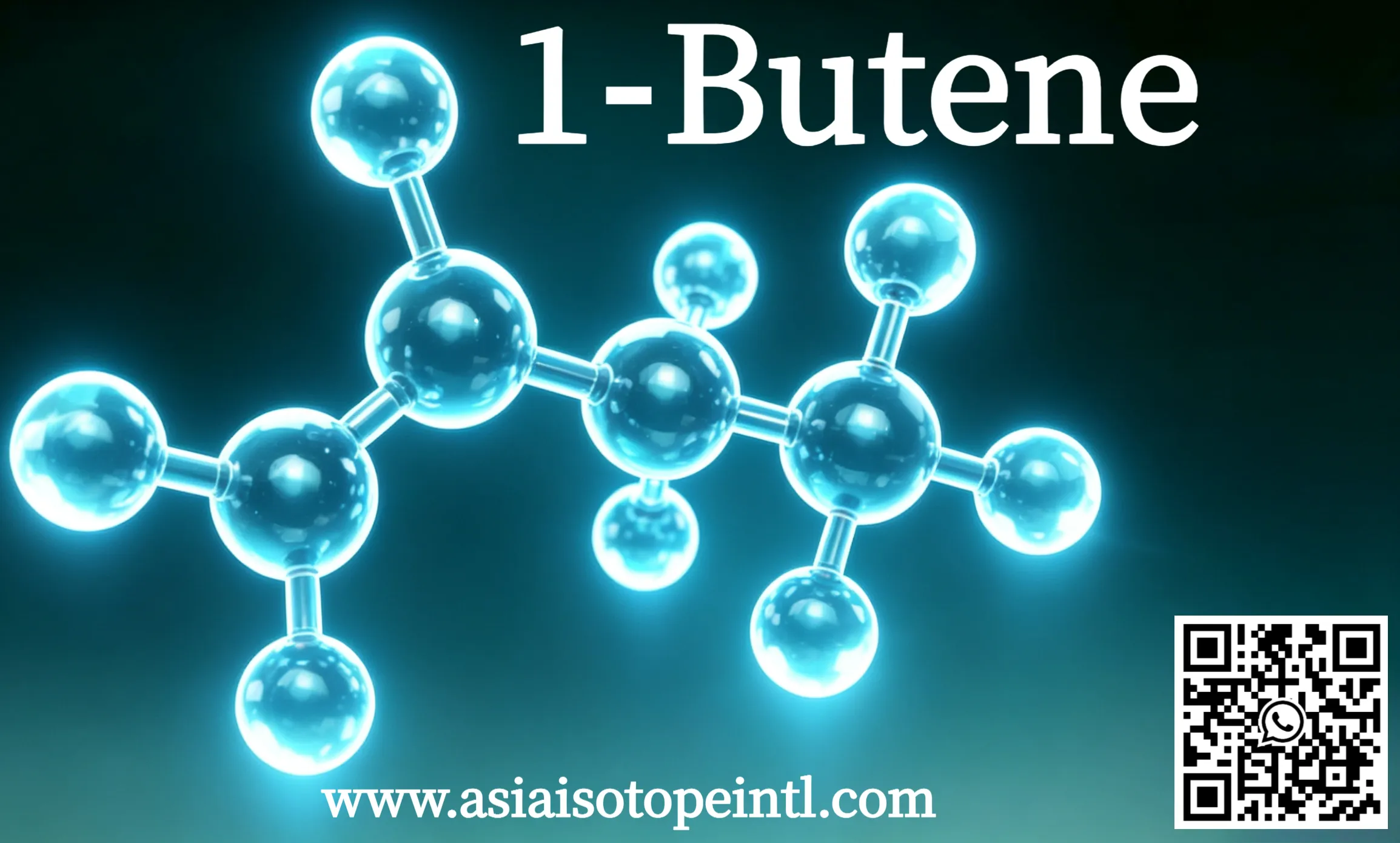
Description
Product number: WT-SG-015
CAS:109-67-1
Purity: 2N
Product specifications: 4L/8L/10L/40L/47L/50L
Product form: 1-Butene
Main use: 1-Butene: Used in the manufacture of high-density polyethylene and other polymers.
What is Pharmaceutical Grade Boric acid-10B (10BH₃O₃)?
1‑Butene, commonly referred to as α‑butylene and sometimes abbreviated as 1‑C₄H₈ or simply n‑butene, is an alkene with the chemical formula C₄H₈ and the linear structure CH₃CH₂CH=CH₂. It is the simplest member of the linear α‑olefins (terminal alkenes) and is one of four isomeric butenes. 1‑Butene is a colourless, flammable gas at room temperature and pressure, with a mild aromatic odour; it liquefies readily under moderate pressure.
As an α‑olefin, 1‑butene possesses a terminal carbon‑carbon double bond, which makes it chemically reactive and amenable to addition, polymerisation, and oxidation reactions. Its boiling point is approximately –6.3 °C and its melting point about –185.3 °C. It is practically insoluble in water but miscible with common organic solvents such as ethanol, diethyl ether, and benzene.
1‑Butene is predominantly used as a comonomer in the production of linear low‑density polyethylene (LLDPE) and high‑density polyethylene (HDPE). Its incorporation into the polyethylene chain significantly improves the toughness, impact resistance, and puncture resistance of the final resin. Beyond polymer applications, it serves as the monomer for polybutene‑1 (a specialty plastic) and as a feedstock for the synthesis of sec‑butanol, butadiene, methyl ethyl ketone (MEK), and butylene oxide. It is also employed in the manufacture of certain agrochemicals, such as the fungicide etaconazole and the insecticide fenobucarb.
In terms of reactivity, 1‑butene behaves like other alkenes: it readily undergoes electrophilic addition (e.g., halogenation, hydrohalogenation, hydration) and oxidation (e.g., epoxidation). Its terminal double bond enables selective functionalisation at the terminal carbon, which is valuable in fine chemical synthesis. Unlike alkyl triflates, 1‑butene is not a leaving group but rather a nucleophilic substrate; however, its gas‑phase handling requires careful exclusion of oxygen and ignition sources.
Commercially, 1‑butene is produced either by separation from C₄ refinery streams (e.g., from steam cracking or fluid catalytic cracking) or by dimerisation of ethylene (the Alphabutol process). It is available in various purity grades, typically as a compressed liquefied gas in cylinders or as a component of mixed C₄ streams.
Safety considerations are paramount: 1‑butene is highly flammable and forms explosive mixtures with air over a concentration range of 1.6 % to 10 % by volume. Its vapour is heavier than air and may accumulate in low‑lying areas, posing an explosion hazard. Inhalation of high concentrations can cause narcotic effects, and its toxicity is roughly 4.5 times that of ethylene. Therefore, 1‑butene must be stored in cool, well‑ventilated areas, away from heat, sparks, and open flames. Appropriate personal protective equipment (e.g., flame‑resistant gloves and goggles) should be worn when handling the material, and all operations should be conducted in an inert atmosphere (nitrogen or argon) when necessary to prevent peroxide formation.
Certificate of Analysis (Pharmaceutical Grade)
| Component | Unit | Specification | |
| Purity | % | ≥99 | |
| N-butane、Isobutane | % | – | |
| Isobutene+2-Butene | % | ≤0.4 | |
| Butadiene+Propylene | mL/m³ | ≤120 | |
| Propargyl | mL/m³ | ≤5 | |
| Total Carbonyl | mg/kg | ≤5 | |
| Water | mg/kg | ≤20 | |
| Methanol | mL/m³ | ≤5 | |
| Methyltert-Butylether | mL/m³ | ≤5 | |
| Sulfur | mg/kg | ≤1 | |
| Carbon Monoxide | mL/m³ | ≤1 | |
| Carbon Dioxide | mL/m³ | ≤5 | |
China Isotope Development Co.,Ltd ,as a emerging fluorinated specialty chemicals supplier, was supplying 1-Buteneto serve clients step by step , gaining their trust ranging from its quality / price / delivery. We know clients need, to solve their questions on site , and pursuit to continue serving clients better.
To conduct our commitment of being a reliable partner to offer solutions when you need special chemicals. Visit www.asiaisotopeintl.com for more information or call us for a in-time communications.
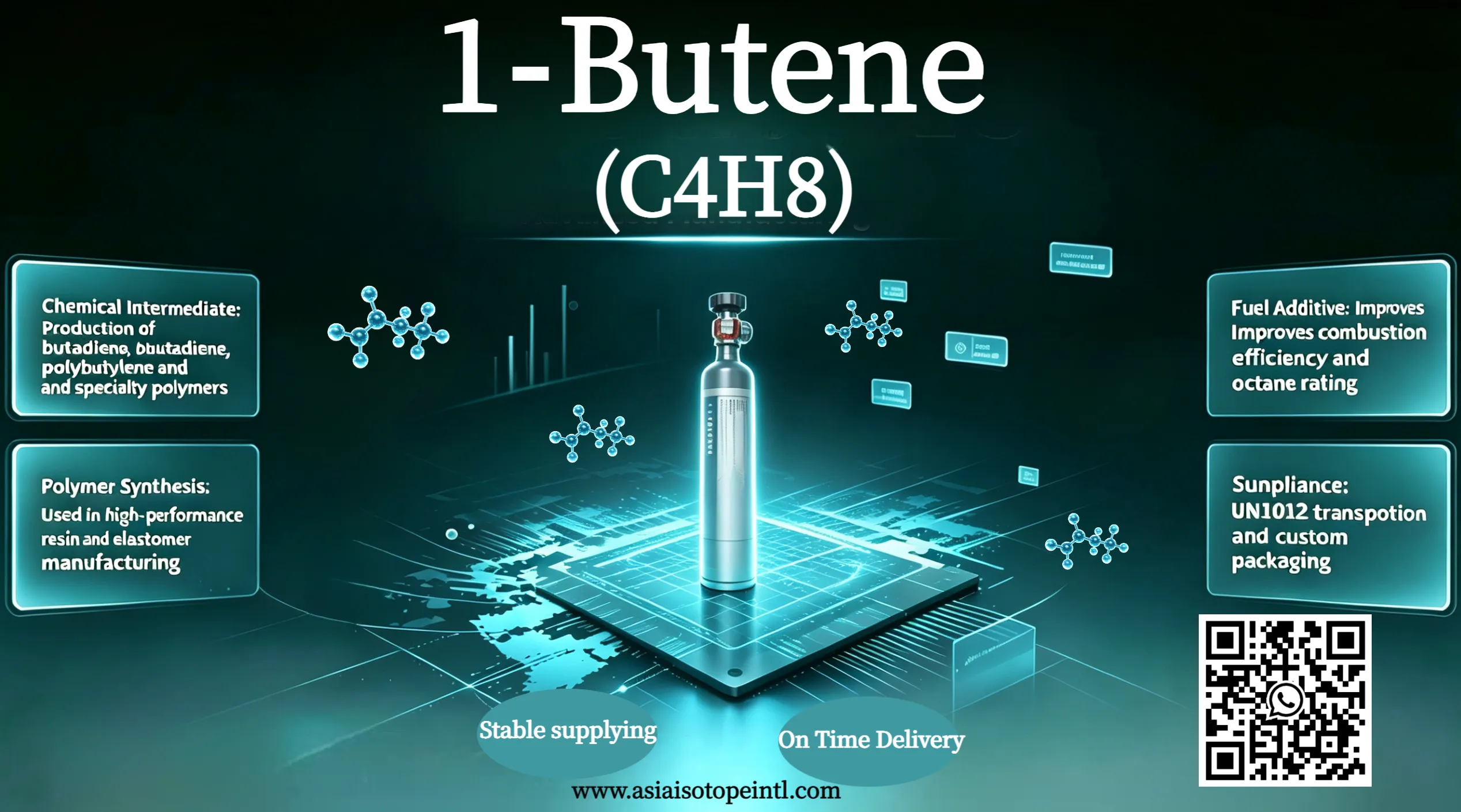
1‑Butene
What are the applications of 1-Butene?
Polymer Production:
1‑Butene is primarily used as a comonomer in the production of linear low‑density polyethylene (LLDPE) and high‑density polyethylene (HDPE). Its incorporation into the polyethylene chain significantly enhances mechanical properties such as toughness, impact resistance, and puncture resistance. In addition, 1‑butene is the monomer for polybutene‑1, a specialty plastic valued for its excellent creep resistance, thermal stability, and flexibility, which finds use in pipe systems, films, and sealants.
Chemical Feedstock:
As a versatile C₄ building block, 1-Butene serves as a key precursor for numerous industrial chemicals. It is hydrated to sec‑butanol, which is further oxidized to methyl ethyl ketone (MEK)—a widely used solvent in coatings, adhesives, and printing inks. Dehydrogenation of 1‑butene yields butadiene, an essential monomer for synthetic rubber (e.g., styrene‑butadiene rubber and polybutadiene). Epoxidation gives butylene oxide, which is converted into glycols, polyether polyols, and other derivatives. It is also used to produce 1-Butene oxide and butene oligomers for lubricant additives and plasticisers.
Agrochemicals:
1‑Butene is employed in the synthesis of certain pesticides. For example, it is used to introduce the butyl or butenyl group into the molecular structure of the fungicide etaconazole and the insecticide fenobucarb, contributing to their biological activity. Its role in agrochemical manufacture, though smaller in volume, highlights its utility in fine chemical synthesis.
Specialty Applications:
Beyond bulk uses, 1‑butene finds limited but noteworthy applications in analytical chemistry as a calibration gas for gas chromatography and environmental monitoring. It also serves as a starting material in the laboratory for preparing other functionalised C₄ compounds via hydroformylation, which produces valeraldehyde (pentanal) for plasticiser alcohol synthesis. Additionally, its terminal double bond enables selective transformations such as metathesis and hydroboration, making it a useful substrate in academic and industrial research.
Safety and Handling Considerations in Use:
Although not an application per se, it is worth noting that 1‑butene’s high flammability and vapour density (heavier than air) demand strict safety protocols during its handling and storage in all its applications. It is typically stored as a liquefied gas under pressure in cylinders or as part of a mixed C₄ stream, and all application processes should be conducted in well‑ventilated areas with explosion‑proof equipment to minimise ignition risks.
Why Choose Our 1-Butene?
High Enrichment & Stability:
Consistent high purity (99%+) and chemical purity (≥99.9%) grades that protect your research, process, and final pharmaceutical products from contamination-related failures.
Reliable & Stable Supply:
As a professional supplier, we offer better supply security and scalability compared to traders and middlemen who depend on others for stock.
Lower Total Cost of Ownership:
Direct supply = competitive price + fewer rejections + less downtime + higher yield. You save money where it matters most—not just on the product price.
Full Traceability & Compliance:
Complete production traceability and quality certifications that meet the demanding requirements of pharmaceutical research and development.
Technical Expertise:
Real manufacturer knowledge to support your specific BNCT or pharmaceutical application—not just selling chemicals, but helping you use them optimally.
Packaging & Delivery Options
Standard Package: 1Kg / 5Kg / 25Kg / 100Kg (Custom packaging available upon request)
Customized package, please contact us for details.
Frequently Asked Questions (FAQs)
Q1. What is 1‑Butene in simple terms?
A1. 1‑Butene is a colourless gas with a slight smell, and its chemical formula is C₄H₈. It belongs to the alkene family (contains a carbon‑carbon double bond) and is commonly used to make plastics and other chemicals.
Q2. Is 1‑Butene the same as butane?
A2. No. Butane is an alkane (no double bond), while 1‑butene is an alkene (has one double bond). This double bond makes 1‑butene much more reactive than butane.
Q3. Is 1‑Butene a gas or a liquid at room temperature?
A3. At normal room temperature and pressure, it is a gas. However, it can be easily liquefied under moderate pressure (e.g., in cylinders) for convenient transport and storage.
Q4. What is 1‑Butene mainly used for?
A4. Its biggest use is as a “comonomer” to produce two common plastics: linear low‑density polyethylene (LLDPE) and high‑density polyethylene (HDPE). Adding 1‑butene makes the plastic tougher and more puncture‑resistant, which is why it is found in cling films, plastic bags, and pipes.
Q5. What else can 1‑Butene be used for?
A5. It can also be used to make solvents (like methyl ethyl ketone), raw materials for synthetic rubber (butadiene), lubricant additives, and intermediates for certain pesticides (fungicides and insecticides).
Q6. Is 1‑Butene flammable?
A6. Yes, it is highly flammable. When mixed with air in a certain concentration range (1.6% – 10% by volume), it can explode if exposed to a spark or flame. So it must be kept away from heat, sparks, and static electricity.
Q7. Does 1‑Butene dissolve in water?
A7. Almost not at all. But it dissolves very well in organic solvents like alcohol, ether, and benzene.
Q8. Is inhaling 1‑Butene harmful?
A8. Breathing in high concentrations can make you feel dizzy or drowsy (narcotic effect). Its toxicity is roughly 4.5 times that of ethylene. However, normal operations in a well‑ventilated area with proper protective equipment keep the risks under control.
Q9. Where does 1‑Butene come from?
A9. It is mainly obtained from petroleum refining, where it is separated from a mixture of C₄ hydrocarbons (called the C₄ fraction). It can also be produced artificially by joining two ethylene molecules together (a process called ethylene dimerisation). In nature, 1‑butene is not found in large amounts; it is almost entirely manufactured in chemical plants.
Q10. How should 1‑Butene be stored safely?
A10. It is usually stored in pressurised cylinders or tanks, kept in a cool, dry, and well‑ventilated place, far away from any fire or heat sources. Leaks must be avoided because the vapour is heavier than air and can accumulate in low areas, creating an explosion hazard.
***** Ready to Order 1‑Butene ? *****
- Get competitive pricing
- Fast response within 24 hours
- Technical consultation available
Contact Us tao.hu@asiaisotope.com