Achieving Atomic-Level Purity: How UHP H2 Mitigates Defects in High-Stakes Semiconductor Processes
BY Tao, Published Jan 5, 2026
As we push the boundaries of Moore’s Law into the Ångström era, the margin for error in semiconductor manufacturing has vanished. As China Isotope Development Co Ltd was starting to supply Ultra High Purity Hydrogen (UHP H2) to China domestic clients, I have witnessed a fundamental shift: process gases are no longer just consumables; they are structural architects. Among these, Ultra-High Purity (UHP) Hydrogen stands out as the silent workhorse of the modern fab. Whether it is scrubbing tin debris from EUV optics or healing atomic scars in a Gate-All-Around (GAA) transistor, the role of hydrogen has evolved from simple carrier gas to a critical active reagent.
Today’s advanced nodes—measured in single-digit nanometers—demand a level of chemical purity that would have seemed impossibly stringent just a generation ago. At these scales, where transistor gates span mere dozens of atoms, even trace contamination at parts-per-trillion levels can spell the difference between a functional chip and an expensive piece of scrap silicon.
Among the arsenal of ultra-high purity (UHP) gases employed in modern fabs, hydrogen (H₂) occupies a uniquely critical position. Its role extends far beyond simple carrier gas applications; UHP hydrogen serves as an active agent in oxide reduction, surface passivation, and defect annihilation processes that directly determine device yield and reliability. This article examines the science behind atomic-level purity requirements, the mechanisms through which UHP H₂ mitigates semiconductor defects, and the engineering challenges involved in maintaining hydrogen purity throughout the manufacturing chain.
The Economic and Technical Imperative for Atomic-Level Purity
The semiconductor industry confronts a sobering economic reality: defect-related losses amount to approximately $100 billion annually across the global supply chain. While defects originate from numerous sources—including particulate contamination, lithographic errors, and equipment malfunctions—molecular contamination from process gases represents a particularly insidious threat because of its invisible nature and compounding effects across multiple process steps.
Consider the scale of the challenge. A modern logic chip operating at the 3nm node contains upwards of 50 billion transistors, each requiring dozens of precisely controlled processing steps. If the probability of gas-related contamination at any single step is even 0.001%, the cumulative probability of defect introduction across the entire process flow becomes statistically significant. This mathematical reality drives the industry’s uncompromising stance on gas purity.
Ultra-high purity hydrogen must maintain contaminant levels below sub-parts-per-billion (ppb) thresholds across all critical process applications. At these concentrations, we are essentially counting individual impurity atoms in a sea of hydrogen molecules—a measurement challenge that pushes analytical chemistry to its fundamental limits. The specification typically demands:
- Oxygen (O₂): < 1 ppb
- Moisture (H₂O): < 1 ppb
- Carbon dioxide (CO₂): < 1 ppb
- Hydrocarbons: < 10 ppb total
- Metallic impurities: < 0.1 ppb
These specifications are not arbitrary. Each contaminant species poses specific threats to semiconductor device integrity, and hydrogen’s role in the manufacturing process makes it particularly sensitive to certain impurities.
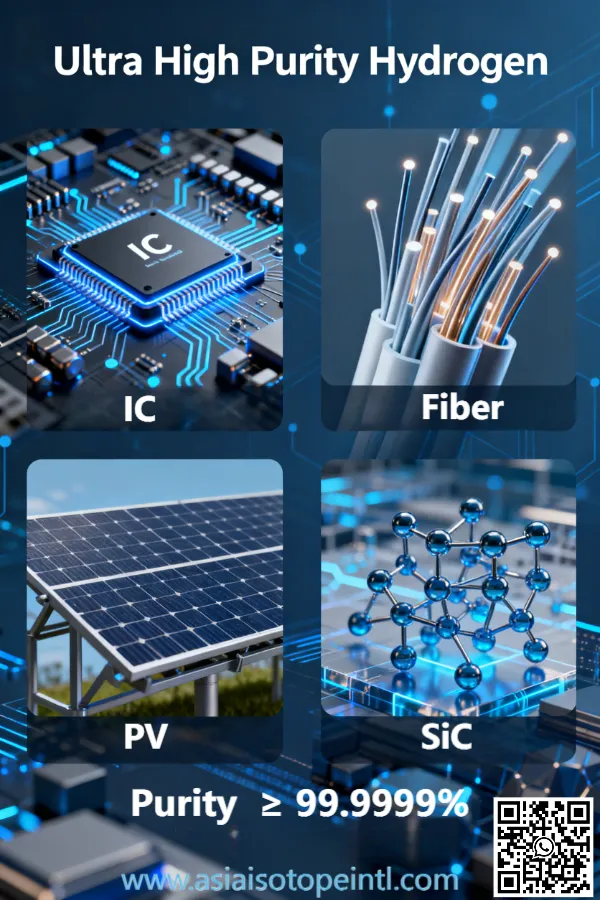
Understanding Hydrogen’s Critical Functions in Semiconductor Processing
Oxide Reduction and Surface Preparation
One of hydrogen’s most essential functions in semiconductor manufacturing involves the reduction of unwanted oxide layers from material surfaces. In a hydrogen purge reduction furnace, UHP hydrogen gas is introduced into a controlled thermal environment where semiconductor materials undergo reduction reactions. The fundamental chemistry follows a straightforward pathway:
Metal oxide + H₂ → Metal + H₂O
This reaction selectively removes oxide contamination while the continuous flow of hydrogen sweeps away water vapor by-products, preventing recontamination. The process requires precise temperature control—typically managed through advanced PID (proportional-integral-derivative) controllers—to optimize material properties without causing thermal damage.
The importance of starting hydrogen purity becomes evident when we examine what happens with contaminated gas. If the incoming hydrogen contains even trace oxygen, the reduction reaction becomes compromised; we essentially introduce oxidizing species through the very gas intended to remove oxides. Similarly, moisture contamination creates a chemical equilibrium that limits oxide removal efficiency.
Anneal and Defect Passivation
Beyond oxide reduction, hydrogen plays a crucial role in defect passivation during thermal processing. Semiconductor materials inevitably contain crystallographic defects—vacancies, interstitials, and dangling bonds that create electrically active states within the bandgap. These defect states act as recombination centers that reduce carrier lifetime and degrade device performance.
High-purity hydrogen, introduced during carefully controlled anneal cycles, can passivate many of these defect sites by forming stable hydrogen-defect complexes. The hydrogen atoms effectively “plug” dangling bonds at silicon surfaces and interfaces, reducing interface trap density and improving carrier mobility. This process is particularly critical for:
- Gate oxide interfaces in MOSFET devices
- Solar cell surface passivation
- Compound semiconductor device fabrication
The effectiveness of hydrogen passivation depends critically on gas purity. Contaminants such as oxygen or moisture compete with hydrogen for defect sites and can create new defect species rather than eliminating existing ones.
Carrier Gas Applications
In chemical vapor deposition (CVD) and epitaxial growth processes, hydrogen frequently serves as a carrier gas for reactive precursor species. The carrier gas transports volatile reactants to the substrate surface while maintaining appropriate partial pressures and flow dynamics. UHP hydrogen excels in this role because:
- Its low molecular weight enables excellent precursor transport
- It does not participate in unwanted side reactions (when pure)
- It can contribute beneficial reducing effects
- Its thermal properties support uniform temperature distribution
However, any contamination in the carrier gas directly enters the deposition zone and incorporates into growing films. A single oxygen molecule carried by contaminated hydrogen can nucleate an oxide inclusion that propagates through subsequent device layers, ultimately causing electrical failure.
Contamination Pathways and Their Impact on Device Yield
Understanding how contamination enters the hydrogen stream requires examining the entire gas delivery infrastructure. Even when bulk hydrogen meets stringent purity specifications at the source, multiple opportunities exist for contamination introduction before the gas reaches the process chamber.
Atmospheric Permeation and Leakage
Modern UHP gas systems employ electropolished stainless steel construction, orbital welding, and metal-sealed components to ensure corrosion resistance, minimal dead volume, and particle-free gas delivery. These engineering measures specifically address atmospheric permeation—the gradual diffusion of ambient air components through materials and seal interfaces.
UHP calibration systems are engineered to prevent ambient air from entering the gas stream through welded stainless steel assemblies, electropolished surfaces, and all-metal seals that reduce leak paths and eliminate elastomer permeation and outgassing. When ambient air does enter the gas stream, trace amounts of oxygen or moisture cause unintended oxidation or dielectric degradation at the wafer level.
The consequences at the device level are severe. Oxygen contamination during production can create defects that reduce conductivity by orders of magnitude. Moisture contamination promotes unwanted oxide growth that alters gate threshold voltages and increases leakage currents.
Outgassing from System Components
Even in well-designed gas delivery systems, internal surfaces can release adsorbed contaminants over time. This phenomenon, known as outgassing, is particularly problematic during temperature cycles or pressure changes that shift the adsorption-desorption equilibrium.
Advanced UHP gas systems address outgassing through specialized surface treatments. Electropolishing reduces surface area and removes microscopic crevices where contaminants might accumulate. Passivation treatments create stable oxide layers that resist further reaction. Pre-conditioning through extended purging with ultra-pure gases removes adsorbed species before production use.
In semiconductor manufacturing, nitrogen bakes at elevated temperatures accelerate outgassing from newly installed equipment, reducing the time required to achieve process-ready cleanliness levels. Similar principles apply to hydrogen delivery systems, where thermal conditioning can dramatically reduce outgassing rates.
Residual Contamination from Previous Operations
Gas delivery systems that handle multiple gas species face cross-contamination risks during transitions. UHP calibration systems employ automated purge cycles that flood lines with ultra-pure inert gas, clearing remnants of earlier mixtures. Without such purging, lingering molecules can combine with subsequent gases to form particles or trigger unwanted reactions.
For hydrogen systems, this concern extends to potential formation of hydride species if transition metals or halogens remain in the lines from previous operations. The resulting contamination may not be immediately detectable but can cause subtle yield degradation over time.
Ultra High Purity Hydrogen UHP H2
Detection and Monitoring Technologies
Ensuring hydrogen purity throughout the manufacturing process requires sophisticated analytical capabilities. The detection challenge is formidable: identifying single-digit ppb contamination levels in a rapidly flowing gas stream demands instruments operating at the edge of analytical feasibility.
Real-Time Gas Analysis
Modern semiconductor fabs integrate gas analyzers capable of detecting contaminants at parts-per-trillion levels, including moisture, oxygen, and volatile organics1. These analyzers monitor purity in real time, identifying impurities before they enter the process line.
Common analytical technologies for UHP hydrogen monitoring include:
Atmospheric Pressure Ionization Mass Spectrometry (APIMS): Provides broad-spectrum detection with ppt-level sensitivity for most contaminant species. Essential for identifying unexpected contamination events.
Cavity Ring-Down Spectroscopy (CRDS): Offers excellent sensitivity and specificity for moisture detection, critical given hydrogen’s sensitivity to water contamination.
Coulometric Detection: Provides continuous monitoring of trace oxygen with high accuracy and minimal maintenance requirements.
Non-Dispersive Infrared (NDIR): Enables carbon compound detection, including CO and CO₂ contamination.
The integration of multiple detection modalities provides defense-in-depth against contamination events, ensuring that no single analyzer’s limitations create blind spots in quality monitoring.
Fingerprinting and Metrology
Beyond real-time monitoring, semiconductor fabs employ advanced techniques such as fingerprinting and metrology to detect material impurities and correlate them with yield outcomes. Fingerprinting involves establishing baseline signatures for each gas supply and detecting deviations that might indicate contamination.
Each material undergoes a process called fingerprinting, which evaluates the raw material’s fundamental characterization. For UHP hydrogen, this might include trace impurity profiles, isotopic composition, and reactive impurity speciation. Deviations from the established fingerprint trigger investigation before the gas enters production use.
Engineering Solutions for Maintaining UHP Hydrogen Integrity
Material Selection and System Design
The choice of materials throughout the gas delivery infrastructure directly impacts achievable purity levels. Beyond basic stainless steel construction, advanced systems may incorporate:
Specialized Alloys: Nickel-based superalloys or high-chromium stainless steels that resist hydrogen embrittlement while maintaining low outgassing characteristics.
Surface Treatments: Advanced electropolishing, passivation, and coating technologies that minimize surface reactivity and contamination release.
Component Integration: Elimination of unnecessary fittings, valves, and dead volumes that could harbor contamination.
For handling ultra-high purity chemicals, UHP PFA (perfluoroalkoxy) components are sometimes employed in parallel systems, providing chemical compatibility while maintaining purity. While metals remain preferred for hydrogen service due to permeation concerns, hybrid systems can address specific contamination challenges.
Purge and Conditioning Protocols
Proper system conditioning is essential for achieving and maintaining UHP hydrogen integrity. When properly implemented, nitrogen or hydrogen purging can facilitate desorption of adsorbed contaminants from surfaces. The key lies in controlling temperature, pressure, and flow velocity to optimize desorption kinetics without causing particle generation.
Conditioning protocols typically involve:
- Initial Purging: Displacement of atmospheric gases with dry nitrogen
- Thermal Cycling: Elevated temperature treatment to accelerate outgassing
- Extended Flowing Purge: Continuous UHP gas flow to remove desorbed species
- Verification Monitoring: Analytical confirmation of target purity levels
- Ongoing Maintenance: Regular reconditioning to address gradual contamination accumulation
Leak Detection and Prevention
Even the most carefully designed systems require ongoing leak monitoring. The critical importance of leak-free operation drives investment in sophisticated detection technologies and rigorous maintenance protocols.
Helium leak detection provides the gold standard for identifying system integrity issues before they impact process gas purity. Regular scheduled testing, combined with continuous monitoring of system pressure behavior, creates a comprehensive leak prevention program.
Integration with Advanced Process Control
The evolution of semiconductor manufacturing toward increasingly automated operations has transformed how UHP gas quality is managed. Advanced process control (APC) systems use predictive models to ensure consistency in product quality. For gas delivery, this means integration of real-time analytical data with process control algorithms that can detect and respond to contamination events.
Machine learning approaches are increasingly applied to gas quality management. By analyzing sensor data from fabrication equipment and gas delivery systems, AI-based systems can predict when a machine will likely cause defects due to wear, contamination accumulation, or other degradation mechanisms4. This predictive capability enables proactive response before contamination impacts production wafers.
The integration of AI with gas quality management extends to:
Pattern Recognition: Identifying subtle contamination signatures that correlate with downstream yield impacts, even when individual measurements remain within specification.
Predictive Analytics: Forecasting when gas quality will degrade based on historical patterns, equipment age, and environmental factors.
Root Cause Analysis: Correlating contamination events with specific system components or operational conditions to guide corrective action.
Yield Impact and Economic Considerations
The investment in UHP hydrogen infrastructure and monitoring represents a significant capital commitment for semiconductor manufacturers. However, the return on this investment is substantial when measured against defect-related losses.
Statistical process control (SPC) implementation with multivariate analysis and time-series models enables detection of trends and anomalies before defect generation2. For UHP hydrogen systems, SPC approaches track not just instantaneous purity measurements but temporal patterns that might indicate developing contamination issues.
The yield impact of hydrogen purity varies by process application and device technology. In critical oxide reduction and passivation steps, contaminated hydrogen can cause:
- Incomplete oxide removal leading to high contact resistance
- Interface state generation reducing carrier mobility
- Particulate formation causing short circuits
- Film quality degradation reducing reliability
Each of these defect modes carries economic consequences that compound across the production volume of a modern fab. At wafer costs measured in thousands of dollars and production volumes of millions of wafers annually, even small yield improvements justify substantial investment in gas purity infrastructure.
Future Directions and Emerging Challenges
As semiconductor devices continue scaling to atomic dimensions, the requirements for UHP hydrogen will intensify. Several trends shape the future of gas purity management:
Sub-Angstrom Feature Control
Next-generation devices demand control of material composition at single-atom precision. This atomic-scale manufacturing places unprecedented demands on process gas purity, pushing specifications toward parts-per-quadrillion levels that challenge current analytical capabilities.
New Process Applications
Emerging applications for hydrogen in semiconductor manufacturing—including certain atomic layer deposition (ALD) processes and novel passivation chemistries—create new purity requirements and contamination sensitivities that must be characterized and addressed.
Sustainable Manufacturing
The semiconductor industry’s commitment to environmental sustainability drives interest in hydrogen recovery and recycling systems. Maintaining UHP specifications through recycling operations presents technical challenges that require ongoing innovation.
Advanced Analytics Integration
The continued advancement of AI-based process control will drive tighter integration of gas quality monitoring with overall fab management systems, enabling real-time optimization of contamination control alongside other process variables.
Concluding Perspective
Ultra-high purity hydrogen stands as an essential enabler of modern semiconductor manufacturing. Its unique combination of reducing capability, surface passivation potential, and carrier gas functionality makes it indispensable across multiple critical process steps. However, realizing hydrogen’s full potential requires unwavering commitment to purity throughout the gas delivery chain—from bulk production through final delivery to the process chamber.
As a specialty gas researcher who has witnessed the evolution of purity requirements over several decades, I remain impressed by the industry’s ability to meet each generation’s increasingly stringent demands. The path to atomic-level purity is paved with meticulous engineering, sophisticated analytical chemistry, and relentless attention to detail. For those of us who dedicate our careers to understanding gas behavior at the molecular level, the challenge of supporting next-generation semiconductor manufacturing remains as compelling as ever.
The pursuit of defect-free semiconductor production ultimately depends on recognizing that every molecule matters. In the world of UHP hydrogen, there is no such thing as “close enough” when atomic-scale perfection is the standard.
Would you like a deeper dive into any specific technical parameters or applications?
As an industry leader focused in Specialty Gases products, our goal is to support our customers by keeping them at the forefront of their industries. We’re here to help with any questions you might have so you can transform your ideas into reality, and tackle those big science challenges.
Get free consultant, our experts are ready to serve.
(Follow up our update articles on www.asiaisotopeintl.com or send your comments to tao.hu@asiaisotope.com for further communications)