Description
Product Name: Trifluoromethanesulfonate | Triflate
CAS: –
Packages: 1Kg / 5Kg / 25Kg / 100Kg (Custom packaging available upon request)
Main use: used as an excellent leaving group in organic synthesis, a powerful alkylating/methylating reagent, a catalyst in various organic reactions (including Suzuki couplings, Heck reactions, Mannich-type reactions, and Diels-Alder reactions), and as an electrolyte in batteries.
Availability: In Stock
What is Trifluoromethanesulfonate (Triflate)?
Trifluoromethanesulfonate, commonly referred to as triflate and abbreviated as OTf, is a functional group with the chemical formula CF₃SO₃⁻. It is the conjugate base of trifluoromethanesulfonic acid (triflic acid)—one of the strongest organic acids, with an acidity exceeding that of pure sulfuric acid. Both triflic acid and its conjugate base (triflate) are thermodynamically very stable and insensitive to general oxidation-reduction reactions.
Triflate is widely recognized as an excellent leaving group in organic chemistry, making it invaluable in various reactions such as nucleophilic substitution, Suzuki couplings, and Heck reactions. Alkyl triflates, in particular, are extremely reactive in SN2 reactions—approximately 10⁴ times faster than methyl iodide and dimethyl sulfate—and must therefore be stored under conditions free of nucleophiles (such as water).
Triflate compounds are available in various forms, including methyl triflate (MeOTf), sodium triflate (NaOTf), and other metal triflates, each offering unique properties for specific applications.
Certificate of Analysis
| Component | Unit | Specification |
|---|---|---|
| Purity | % | ≥98.0 (or customized: 99.0% / 99.5%) |
| Water Content | ppm | ≤50 |
| Appearance | / | White crystalline solid or powder |
| NaSbF₆ | % | ≥99.0 |
| Heavy Metals | ppm | ≤1 |
| Non-volatile Residue | ppm | ≤5 |
China Isotope Development Co.,Ltd ,as a emerging fluorinated specialty chemicals supplier, was supplying Trifluoromethanesulfonate (Triflate) to serve clients step by step , gaining their trust ranging from its quality / price / delivery. We know clients need, to solve their questions on site , and pursuit to continue serving clients better.
To conduct our commitment of being a reliable partner to offer solutions when you need special chemicals. Visit www.asiaisotopeintl.com for more information or call us for a in-time communications.
-
Trifluoromethanesulfonate | Triflate
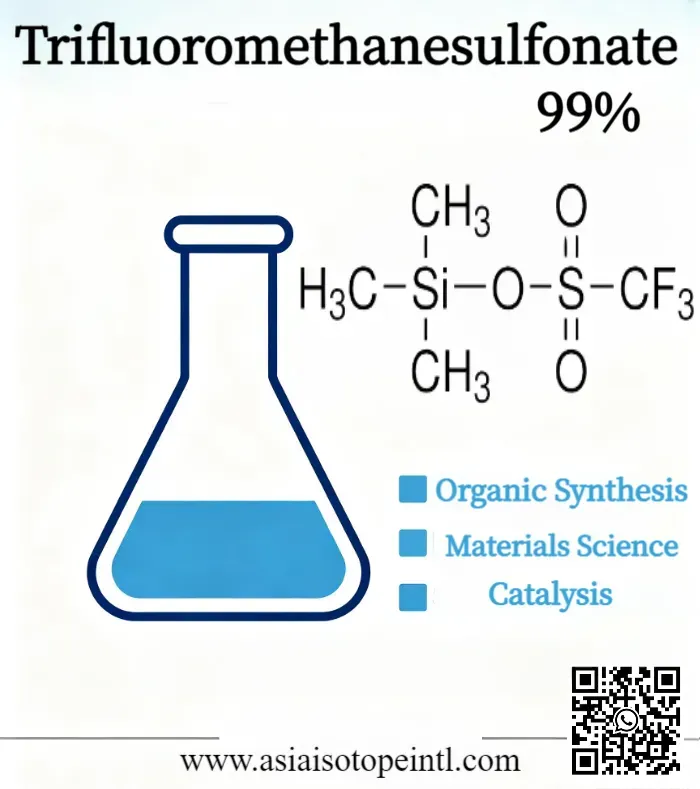
What are applications of Trifluoromethanesulfonate (Triflate)?
Organic Synthesis:
Triflate is a versatile reagent in organic synthesis. As an excellent leaving group, it facilitates nucleophilic substitution reactions, Suzuki couplings, and Heck reactions. Alkyl triflates are among the most powerful alkylating agents available.
Catalysis:
Metal triflates (such as sodium triflate, zinc triflate, and indium triflate) serve as efficient catalysts in various reactions, including catalytic asymmetric Mannich-type reactions, Mannich-type reactions in water, and Diels-Alder reactions. Trimethylsilyl triflate is used to catalyze allylation of acetals to form homoallyl ethers and the synthesis of 1,2-trans-glycosides.
Pharmaceutical Industry:
Triflate compounds are widely used as intermediates in pharmaceutical synthesis. Phenyl trifluoromethanesulfonate has been applied to the synthesis of complex pharmaceuticals, such as the ketoamide fragment of the protease inhibitor boceprevir, used in the treatment of hepatitis C. Triflic acid and its derivatives serve as catalysts and intermediates in the synthesis of nucleosides, antibiotics, steroids, proteins, glycosides, and vitamins.
Materials Science & Electrochemistry:
Sodium triflate is used as an electrolyte in batteries. Triflate compounds also find applications in OLED materials, where they serve as auxiliary ligands in phosphorescent light-emitting layers, optimizing exciton utilization and luminescence efficiency.
Radiochemistry:
Carbon-11 methyl triflate ([¹¹C]MeOTf) is commonly used in radiochemistry to synthesize radioactively labeled compounds for medical imaging.
Why Choose Our Trifluoromethanesulfonate (Triflate)?
High Purity & Stability
Consistent high purity 99%+ grades that protects your process, equipment, and final product from contamination-related failures.
Reliable & Stable Supply
As a professional supplier, we offer better supply security and scalability compared to traders and middlemen who depend on others for stock.
Lower Total Cost of Ownership
Direct supply = competitive price + fewer rejections + less downtime + higher yield. You save money where it matters most — not just on the product price.
Full Traceability & Compliance
Complete production traceability and international certifications that meet the demanding requirements of pharmaceutical and electronics industries.
Technical Expertise
Real manufacturer knowledge to support your specific application — not just selling chemicals, but helping you use them optimally.
Packaging & Delivery Options
Standard Package: 1Kg / 5Kg / 25Kg / 100Kg (Custom packaging available upon request)
Customized package, please contact us for details.
Frequently Asked Questions (FAQs)
Q1. What is Trifluoromethanesulfonate (Triflate) in simple terms?
A1. It is a chemical compound that contains the triflate group (CF₃SO₃⁻). It is widely used as a reagent in organic synthesis, often to help other molecules react more efficiently or to introduce specific chemical groups.
Q2. What are the main uses of triflate products?
A2. They are mainly used as catalysts, as intermediates in pharmaceutical production, as electrolytes in batteries, and in the manufacture of specialty materials like OLEDs.
Q3. What different types of triflate do you supply?
A3. We supply various forms, including alkyl triflates (e.g., methyl triflate), metal triflates (e.g., sodium triflate, zinc triflate), and silyl triflates (e.g., trimethylsilyl triflate). Each type suits different applications.
Q4. What purity levels are available for your triflate products?
A4. Our standard purity is ≥99%, and we can request for more demanding uses.
Q5. How should I store triflate compounds to keep them stable?
A5. Store them in tightly sealed containers, in a cool, dry, and well-ventilated place, away from moisture and direct sunlight. Keep the temperature below 30°C. Some types may need inert gas protection.
Q6. What safety equipment is required when handling triflate?
A6. Wear chemical-resistant gloves, safety goggles, and a lab coat. Avoid skin contact and inhaling vapors. Work in a fume hood if possible, and use spark‑proof tools.
Q7. What packaging sizes can I choose from?
A7. We offer packages of 1Kg / 5Kg / 25Kg / 100Kg . Custom packaging is also available for larger quantities.
Q8. Does triflate require special conditions for shipping?
A8. Yes, it must be shipped in sealed, leak‑proof containers, protected from moisture, rain, and strong impact. Some triflates are flammable or corrosive, so proper hazard labels are required.
Q9. Is triflate toxic or dangerous to health?
A9. Some triflate compounds can cause skin corrosion and eye damage if contacted. They may be harmful if inhaled or swallowed. Always follow the safety data sheet and use proper protective measures.
Trifluoromethanesulfonate | Triflate Recommend
| Product Name | CAS # |
| p-Tolyl Trifluoromethanesulfonate, 98% | 29540-83-8 |
| 2-Chlorophenyl trifluoromethanesulfonate, 98% | 66107-36-6 |
| Catechol bis(trifluoromethanesulfonate), 98% | 17763-91-6 |
| 4-Acetylphenyl trifluoromethanesulfonate, 98% | 109613-00-5 |
| 2-Methoxyphenyl trifluoromethanesulfonate, 97% | 59099-58-0 |
| 2-Naphthyl trifluoromethanesulfonate, 97% | 3857-83-8 |
| 4-Methoxyphenyl trifluoromethanesulfonate, 98% | 66107-29-7 |
| Phenyl trifluoromethanesulfonate, 98% | 17763-67-6 |
| 2-Bromophenyl trifluoromethanesulfonate, 97% | 129112-25-0 |
| Pentafluorophenyl trifluoromethanesulfonate, 98% | 60129-85-3 |
| 2-Acetylphenyl trifluoromethanesulfonate, 98% | 129849-05-4 |
***** Ready to Order Trifluoromethanesulfonate ? *****
- Get competitive pricing
- Fast response within 24 hours
- Technical consultation available
Contact Us tao.hu@asiaisotope.com