In-Depth Analysis of Zn-68: From Stable Isotope to the Cornerstone of “Theranostic” Nuclear Medicine
BY Tao, Published Jan 2, 2026
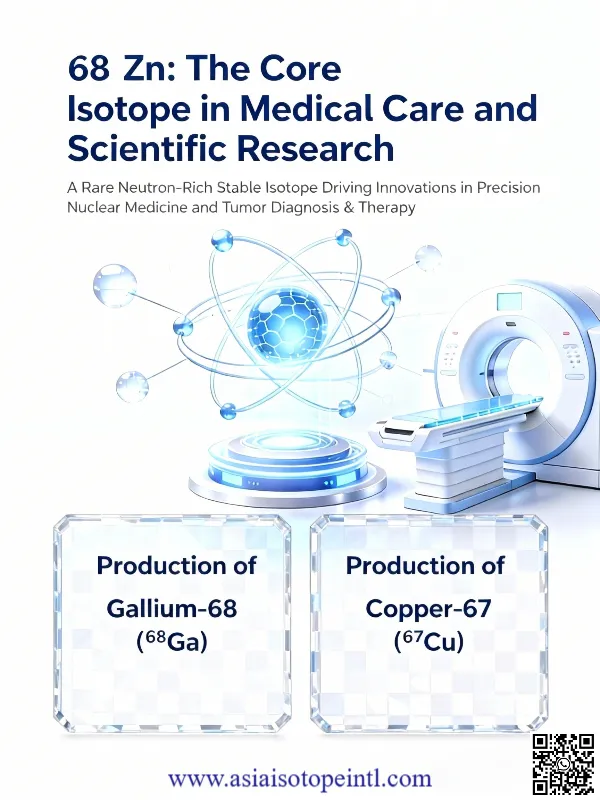
Zinc-68 (Zn-68, ⁶⁸Zn) looks unremarkable on a periodic table. It is stable, non-radioactive, and—outside of isotope circles—rarely discussed. Yet in today’s clinical reality, enriched Zn-68 has become one of the most strategically important materials in nuclear medicine because it enables high-yield, on-demand production of gallium-68 (⁶⁸Ga), the workhorse PET isotope powering much of modern “theranostics” (therapy + diagnostics). In practical terms: if you want reliable, scalable ⁶⁸Ga supply, you start with high-quality enriched Zn-68.
It explains, in clear but technically rigorous language, why Zn-68 moved from a niche stable isotope to a cornerstone target material, how it is used in cyclotron production of ⁶⁸Ga, what quality parameters truly matter, and where the field is heading next.
1. What Zn-68 Is (Why Its Natural Abundance Matters)
Zn-68 is one of zinc’s stable isotopes. In nature, it represents about 18–19% of all zinc atoms, a relatively high natural abundance by isotope-production standards. That matters because the “starting fraction” strongly influences the feasibility and cost of enrichment (how much feedstock you must process to obtain a given amount of enriched isotope). For zinc, the isotopic composition is well documented by international atomic-weight and isotopic-abundance evaluations. (CIAAW isotopic abundances: https://ciaaw.org/isotopic-abundances.htm)
In enrichment economics, nature’s 18–19% head start is significant. Compare that with isotopes whose natural abundance is a few percent (or less): the enrichment effort and cost escalate quickly. Zn-68 sits in a “sweet spot”: abundant enough to enrich efficiently, yet unique enough to enable a very clean and productive nuclear reaction pathway to Ga-68.
2. Theranostics in Plain Language: Why ⁶⁸Ga Became a Clinical Force
Theranostics in nuclear medicine is the practice of using:
- a diagnostic radiotracer (usually PET) to locate and quantify disease, and then
- a therapeutic radiopharmaceutical (usually beta- or alpha-emitting) targeting the same biological pathway to treat it.
The diagnostic scan answers: Where is the disease and how much is there?
The therapy answers: Can we deliver targeted radiation precisely to those lesions?
Ga-68 is central because it:
- is a PET isotope with a short half-life (about 68 minutes), enabling same-day imaging workflows,
- forms stable complexes with widely used chelators (chemical “claws” that hold the metal),
- supports a large family of tracers (PSMA, somatostatin receptor agents, FAP inhibitors, inflammation tracers, and more).
The nuclear decay parameters and half-life of Ga-68 are standard nuclear data. (NNDC NuDat database: https://www.nndc.bnl.gov/nudat3/)
The key bottleneck historically was not chemistry or clinical demand—it was supply. For many years, most sites relied on ⁶⁸Ge/⁶⁸Ga generators. Those generators work well, but they impose practical limitations: finite daily yield, replacement cycles, supply-chain constraints, and often higher cost per patient dose in high-throughput settings.
3. The Reaction That Makes Zn-68 So Valuable: ⁶⁸Zn(p,n)⁶⁸Ga
The core industrial logic is straightforward:
- Target (stable): Zn-68
- Projectile: proton (p) from a medical cyclotron
- Reaction: (p,n) meaning a proton goes in, a neutron comes out
- Product (radioactive): Ga-68
This reaction has several advantages that explain Zn-68’s rise:
- Low energy requirement
It can be performed on the many hospital cyclotrons designed for routine PET isotope production. That means Ga-68 production becomes decentralized—closer to patients. - High practical yield
With the right energy window and target design, yields scale well with beam current and irradiation time. - Cleaner impurity profile with high enrichment
When Zn-68 enrichment is high, formation of unwanted gallium isotopes (from other zinc isotopes) drops dramatically.
General production routes and nuclear reaction options for medical cyclotron radionuclides are summarized in IAEA technical resources. (IAEA Cyclotron Produced Radionuclides TRS: https://www.iaea.org/publications/search?query=cyclotron%20produced%20radionuclides)
Cross-section measurements and experimental reaction data are compiled internationally, including in EXFOR. (IAEA EXFOR database: https://www-nds.iaea.org/exfor/)
A practical rule from the production floor:
If you want high-activity Ga-68 batches with reproducible radionuclidic purity, you do not “optimize chemistry first.” You optimize isotopic enrichment, target thermal design, energy window, and purification workflow as one integrated system.
4. Why Enriched Zn-68 Is a Supply-Chain Game Changer Compared to Generators
4.1 The generator model (⁶⁸Ge/⁶⁸Ga)
Generators rely on long-lived germanium-68 (⁶⁸Ge), which decays to ⁶⁸Ga. ⁶⁸Ge has a half-life of roughly 271 days—useful for a generator, but it also means generator supply depends on specialized, limited production capacity. (NNDC NuDat database: https://www.nndc.bnl.gov/nudat3/)
Generators are excellent for:
- low to moderate patient volume,
- locations without a cyclotron,
- sites prioritizing simplicity.
But they are inherently constrained in maximum daily elutable activity and may become economically inefficient when patient throughput is high.
4.2 The cyclotron + Zn-68 model (direct production of ⁶⁸Ga)
Cyclotron production using enriched Zn-68 enables:
- multi-dose batches from one irradiation,
- predictable scheduling (you control when you produce),
- lower marginal cost per GBq at scale,
- better alignment with modern PET center workflows.
This is why Zn-68 is increasingly viewed as a “strategic raw material” rather than merely a target isotope: it directly determines whether a site can deliver theranostic imaging at modern clinical volumes.
5. Zn-68 Target Materials: Metal, Oxide, and Solution—What Works Best and Why
Zn-68 targets are commonly deployed in three forms. Each has real engineering trade-offs.
5.1 Solid metallic Zn-68 targets (the current mainstream)
Metallic Zn-68 is popular because it:
- offers high zinc atom density (more target atoms per volume),
- has predictable heat-transfer behavior when properly bonded to a backing,
- can be dissolved efficiently after irradiation.
However, zinc has a relatively low melting point, so thermal management is non-negotiable. Solid-target success depends on:
- backing material selection (often high thermal conductivity metals),
- robust bonding (to avoid delamination under beam heating),
- effective cooling (water/helium designs),
- controlled beam spot size and current.
From an operational perspective, well-designed solid targets have become the most reliable route for high-activity Ga-68 production—especially for sites aiming for routine clinical output.
5.2 Zn-68 oxide targets (specialized use)
ZnO (zinc oxide) targets can be easier to handle for some fabrication approaches and may be preferred in certain targetry workflows. But oxide often introduces different dissolution behavior and may require careful control to avoid particulate formation.
5.3 Liquid targets (emerging, attractive for automation)
Liquid targets—typically zinc salts dissolved in acid—promise simpler mechanics (no solid coin transfer, no electroplating/pressing). The trade-offs include:
- managing radiolysis (radiation-driven chemical changes in solution),
- corrosion control,
- solution chemistry stability,
- potential limitations on achievable isotopic concentration and recovery.
Liquid targets are a serious and growing area, but they are not a universal replacement. In my experience, high-throughput clinical production today still favors solid enriched Zn-68 because it offers superior atom density and well-understood impurity control—provided you have a mature target handling system.
6. The Unseen Heart of the Process: Chemical Separation, Purification, and Zn-68 Recovery
Producing Ga-68 is not just “irradiate and inject.” After irradiation, you must rapidly:
- dissolve the irradiated Zn-68 target,
- separate Ga-68 from bulk zinc (and trace metals),
- deliver Ga-68 in a chemical form suitable for radiolabeling,
- recover and recycle expensive enriched Zn-68.
6.1 Dissolution and separation (conceptual, not proprietary)
Typical workflows dissolve zinc in acid, then use resin-based or column-based separation to retain gallium while allowing zinc to pass (or vice versa), followed by elution into a formulation compatible with labeling chemistry.
The exact resin chemistry varies, but the performance goals are consistent:
- fast processing (Ga-68 is decaying),
- high recovery of Ga-68,
- very low zinc carryover (zinc competes in chelation),
- low levels of other metals (iron, copper) that can also compete.
6.2 Recycling Zn-68: the economic multiplier
Enriched Zn-68 is valuable. Facilities that treat Zn-68 as disposable consumable are at a permanent cost disadvantage. Mature operations implement closed-loop recovery to:
- reduce isotope purchasing volume,
- reduce waste,
- stabilize long-term supply.
Recycling is not just a financial decision—it is a resilience strategy, especially when global isotope logistics are disrupted.
7. Quality Requirements That Actually Matter in Clinical Theranostics
In clinical nuclear medicine, “quality” is not an abstract ideal. It is defined by patient safety, regulatory compliance, and reproducible imaging performance. The critical quality attributes for cyclotron-produced Ga-68 typically include:
7.1 Radionuclidic purity
This asks: Is it really Ga-68, and how much of anything else radioactive is present?
High enrichment Zn-68 reduces the probability of producing other gallium isotopes through reactions on minor zinc isotopes.
7.2 Radiochemical purity
This asks: Is Ga-68 in the correct chemical form for labeling or injection?
Impurities here can reduce labeling yields and compromise reproducibility.
7.3 Chemical purity (metal contaminants)
This is where Zn-68 target quality and downstream purification are decisive. Trace metals can compete with Ga-68 for chelators and reduce effective molar activity.
7.4 Sterility and endotoxin control
The final product must be sterile and safe for injection. In practice, sterilizing-grade filtration is one of the most important physical barriers in GMP-style workflows.
This is also where micro- and sub-micron filtration technology becomes directly relevant:
- removal of particulates generated during dissolution or column processing,
- sterile filtration of final drug product (commonly 0.22 µm),
- protection of downstream valves and microfluidic paths in automated synthesis modules.
For general sterile filtration practice and pore-size conventions in bioprocessing and pharmaceuticals, widely used technical references are available from established standards bodies and industry guidance. (FDA sterile drug products guidance landing pages and related references: https://www.fda.gov/drugs/guidances-drugs/sterile-drug-products-produced-aseptically-current-good-manufacturing-practice)
8. Clinical Impact: Why Zn-68-Enabled Ga-68 Scales Theranostics in the Real World
When Ga-68 supply becomes reliable and abundant, three things happen clinically:
8.1 High-throughput PET becomes feasible
Sites can move from “one generator, a handful of patients” to batch-based production that supports modern patient volumes.
8.2 Kit-like workflows accelerate adoption
As Ga-68 becomes easier to obtain routinely, tracer preparation becomes more standardized. That matters for multi-center consistency, which is essential for clinical trials and broad adoption.
8.3 Dosimetry and response assessment improve
Theranostics is not just “scan then treat.” Imaging is used for:
- selecting patients likely to benefit,
- estimating tumor burden,
- monitoring response over time,
- refining therapeutic strategies.
These trends are strongly associated with the rise of PSMA-targeted imaging in prostate cancer and somatostatin receptor imaging in neuroendocrine tumors, where Ga-68 tracers have become widely integrated into clinical pathways. For an accessible overview of nuclear medicine clinical practice and radiotracer adoption trends, professional society resources provide useful context. (SNMMI clinical practice resources: https://www.snmmi.org/ClinicalPractice/)
Zn 68 Isotope applications
9. What Makes a “Good” Zn-68 Target Material in 2025: A Practical Checklist
If you are sourcing enriched Zn-68 or designing a production line, the following parameters matter more than marketing labels:
9.1 Isotopic enrichment and isotopic assay method
- Enrichment level (atom % ⁶⁸Zn): higher enrichment generally means fewer impurity radionuclides.
- How enrichment is verified: mass spectrometry (e.g., TIMS/ICP-MS) with traceability.
9.2 Chemical form and purity
- Metallic Zn-68 vs ZnO vs salt solution.
- Trace metal content (Fe, Cu, Ni) should be tightly controlled.
9.3 Physical properties for targetry
- Density and uniformity (important for heat distribution).
- Mechanical stability under thermal cycling.
- Bonding quality to the backing.
9.4 Packaging and handling
For high-purity isotopes, contamination is often introduced during handling, not manufacturing. Packaging should be designed to minimize:
- airborne particulate contamination,
- moisture uptake (for reactive forms),
- cross-contamination from tools and containers.
10. Zn-68 and the Broader Isotope Ecosystem: Why This Is Not a “One-Isotope Story”
Zn-68’s impact is amplified because it plugs into a wider isotope network:
- Ga-68 supports PET diagnostics and theranostic matching with therapeutic isotopes such as Lu-177 and Ac-225 (used in therapy agents targeting the same receptors or antigens).
- The same cyclotron infrastructure and many of the same automation philosophies can be adapted to other radiometals.
- The operational maturity developed around Zn-68 targets—cooling, transfer, dissolution, purification, sterile filtration, QC—becomes a template for next-generation radiometal production.
For background on nuclear structure and decay data relevant to such isotopes, the IAEA LiveChart and related nuclear data services are authoritative starting points. (IAEA LiveChart of Nuclides: https://www-nds.iaea.org/relnsd/vcharthtml/VChartHTML.html)
11. The Next Wave: Where Zn-68-Enabled Production Is Heading
11.1 More automation, less variability
The industry trend is clear: integrated solid-target systems, automated dissolution, cassette-based purification, and standardized QC. The goal is not just “higher activity,” but repeatable GMP-like batches across many sites.
11.2 Smarter impurity control
As clinical expectations rise, “meeting minimum limits” is no longer enough. Advanced sites optimize:
- target enrichment strategy,
- energy window selection,
- chemical separation selectivity,
- filtration and materials compatibility (to prevent leachables/extractables).
11.3 Sustainability becomes a differentiator
Recycling and recovery of enriched Zn-68 will increasingly be treated as a core KPI:
- cost per patient dose,
- supply security,
- waste reduction.
In an era where theranostic demand is expanding globally, stable isotope recycling is not optional—it is a competitive advantage.
12. Expert Conclusion: Zn-68 as the Quiet Foundation of Theranostic Nuclear Medicine
Zn-68 is stable, but its role is catalytic in the broader sense: it accelerates and stabilizes the entire theranostic pipeline. Enriched Zn-68 enables reliable cyclotron production of Ga-68, which in turn enables high-throughput PET imaging for patient selection, therapy planning, and response monitoring—core pillars of modern precision oncology and theranostics.
If you want to understand why theranostic nuclear medicine scaled so quickly in the last decade, do not start by looking only at the radiopharmaceutical brand names. Start with the upstream material that made high-activity Ga-68 routine. Start with Zn-68.
Reference
- CIAAW (Commission on Isotopic Abundances and Atomic Weights), isotopic abundances: https://ciaaw.org/isotopic-abundances.htm
- NNDC NuDat 3.0 (Brookhaven National Laboratory), nuclear decay data: https://www.nndc.bnl.gov/nudat3/
- IAEA publications search portal (Cyclotron Produced Radionuclides resources): https://www.iaea.org/publications/search?query=cyclotron%20produced%20radionuclides
- IAEA EXFOR (Experimental Nuclear Reaction Data): https://www-nds.iaea.org/exfor/
- NNDC NuDat 3.0 (for ⁶⁸Ge and related decay data): https://www.nndc.bnl.gov/nudat3/
- U.S. FDA guidance entry point for aseptic processing / sterile drug products (cGMP context): https://www.fda.gov/drugs/guidances-drugs/sterile-drug-products-produced-aseptically-current-good-manufacturing-practice
- Society of Nuclear Medicine and Molecular Imaging (SNMMI), clinical practice resources: https://www.snmmi.org/ClinicalPractice/
- IAEA LiveChart of Nuclides: https://www-nds.iaea.org/relnsd/vcharthtml/VChartHTML.html
Would you like a deeper dive into any specific technical parameters or applications?
As an industry leader focused in Isotope products, our goal is to support our customers by keeping them at the forefront of their industries. We’re here to help with any questions you might have so you can transform your ideas into reality, and tackle those big science challenges.
Get free consultant, our experts are ready to serve.
(Follow up our update articles on www.asiaisotopeintl.com or send your comments to tao.hu@asiaisotope.com for further communications)