Ultra-High-Purity Krypton, a Reliable Global Supply Partner — China
Isotope Development Co., Ltd.
BY Eve, Published Nov 26, 2026
Krypton, one of the rarest gases in the atmosphere, is steadily becoming a base material of strategic value for high-end industries such as semiconductor manufacturing, laser processing and energy-efficient glazing.
From lithography and plasma etching for nanometre-scale chips to laser cutting and welding and specialised lighting, the purity of krypton and the control of its impurities bear directly on process stability and on the performance of the end product.
A stable supply of high-purity krypton rests both on large-scale production and analytical capability and on a sustained understanding of multiple product specifications and applications. If you are looking for a dependable supply partner, China Isotope Development Co., Ltd. is the natural choice.
The company holds hazardous chemicals trading and independent import/export licences, supplies high-purity krypton from 5N5 to 6N, and can take on orders from around the world directly. Its products are exported to Europe, the United States, Canada, Japan, Korea, India and Southeast Asia, giving high-end manufacturing and research customers a stable and reliable supply.
Founded in 2022, China Isotope Development Co., Ltd. is an advanced materials manufacturer integrating research and development, production and sales. Its portfolio covers rare gases, fluorinated fine chemicals and isotope products, each manufactured at one of three large plants. As plant capabilities have continued to improve, krypton capacity has reached 700 cubic metres per month, supporting a stable and reliable supply of products and services to high-end manufacturing and research worldwide.
I. Ultra-High-Purity Krypton
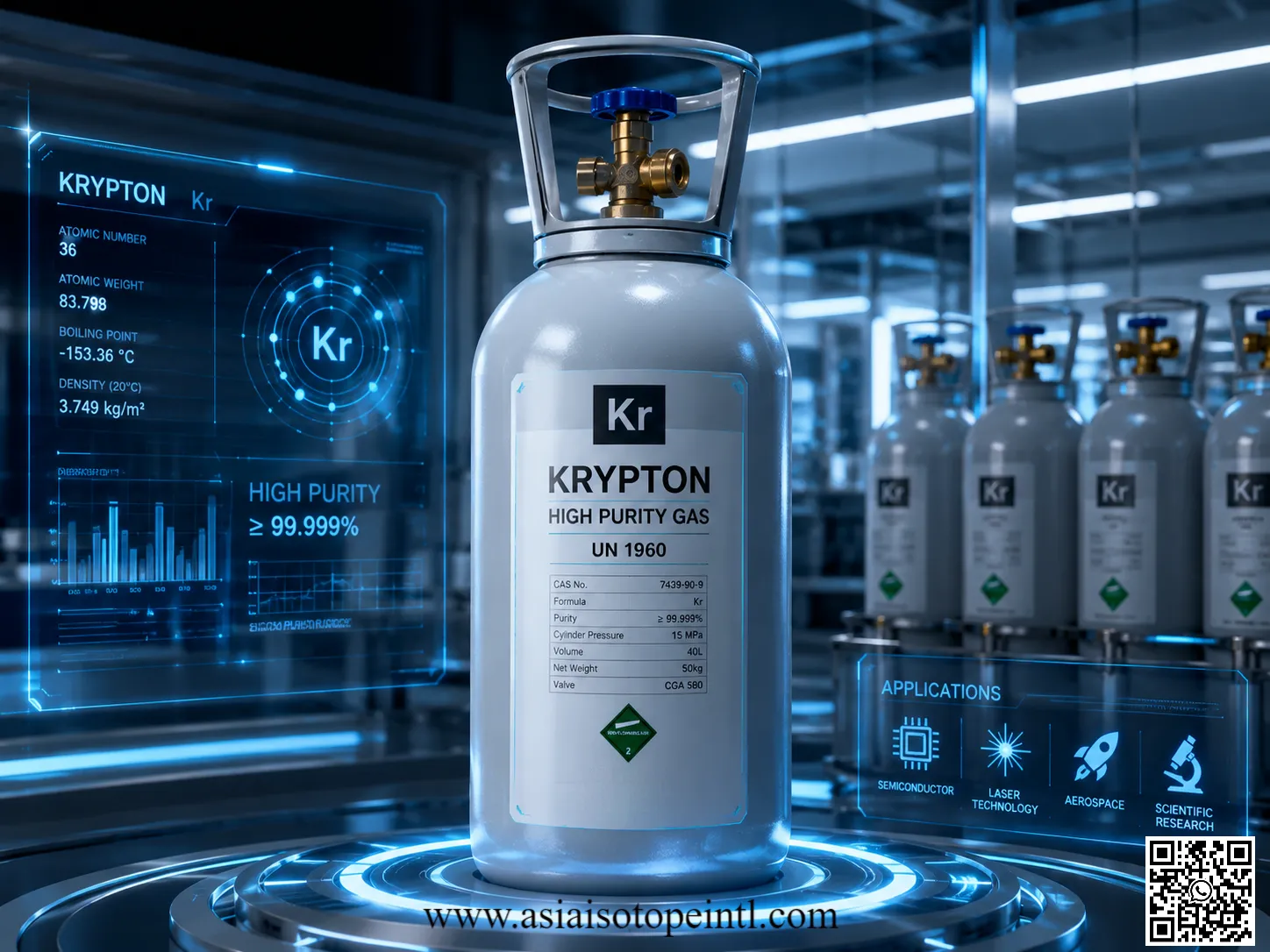
Ultra-high-purity krypton generally means krypton at a purity of 99.999% (5N) or 99.9999% (6N) and above. As a rare gas present in the atmosphere only in trace amounts, it has to be extracted by cryogenic separation and multi-stage rectification. What defines this grade is the extreme control of trace impurities: beyond meeting the total purity specification, more than ten key impurities — nitrogen (N₂), oxygen (O₂), moisture (H₂O), carbon monoxide (CO), hydrocarbons and xenon (Xe) — must each be held within limits as low as 0.1 ppm, or even 0.01 ppm. This precision is what allows krypton to serve the most demanding applications: semiconductor manufacturing, high-end lasers, specialty lighting and frontier scientific research.
Table 1 High-purity krypton
| Component | Specification |
| Kr | ≥99.999% |
| CH4 | ≤0.3 ppm |
| N2 | ≤2.0 ppm |
| H2O | ≤2.0 ppm |
| O2+Ar | ≤1.5 ppm |
| Xe | ≤2.0 ppm |
| H2 | ≤0.5 ppm |
| CF4 | ≤1.0 ppm |
| CO | ≤0.3 ppm |
| SF6 | ≤0.1 ppm |
| CO2 | ≤0.4 ppm |
Packaging: carbon steel cylinders (DOT 50 L, DOT 47 L, DOT 10.8 L, ISO 10 L) and aluminium cylinders (DOT 47.5 L, DOT 10.5 L, DOT 1.8 L, DOT 1 L), with CGA580 and DISS718 valve outlets as international standards.
Ultra-High-Purity Krypton
V. Main Application Areas
(1) Semiconductor manufacturing: a key process gas for lithography and etching
Krypton’s value in semiconductors comes from two process routes. First, it is the lasing medium of the KrF excimer laser (248 nm): krypton as the laser medium, fluorine as the reactive component and neon as the buffer gas, with a chamber mix of typically about 1% krypton, 0.1% fluorine and the balance neon, emitting 248 nm deep-UV light. Even after lithography moved to 193 nm immersion, KrF still exposes non-critical layers, thick photoresist and 3D structures, with steady demand in mature nodes, DRAM, 3D NAND and advanced packaging lithography. Second, krypton serves as a working or additive gas in plasma etching and sputtering.
On the etch side, krypton’s high atomic mass (83.8) and low ionisation energy (14.0 eV against 15.76 eV for argon) allow it, combined with argon or SF₆/C₄F₈ chemistries, to raise ion density and ion energy and so improve anisotropy and sidewall verticality in high-aspect-ratio structures. In cryogenic etching between −60 °C and −120 °C, krypton as an additive helps sustain a high ion flux and suppress excessive sidewall passivation, which makes it one of the process options for deep features such as 3D NAND channel holes and DRAM capacitor holes. In magnetron sputtering and ion-beam deposition, krypton sustains a stable discharge at lower pressure and raises the sputter yield of heavy-element targets such as tantalum, tungsten and ruthenium.
Semiconductor-grade krypton carries the tightest purity and impurity requirements: fluorine-bearing impurities (CF₄, SF₆), moisture, oxygen and metal ions directly affect laser energy stability, chamber lifetime and pattern defects. The industry generally supplies 5N (99.999%) and above, while advanced-node and laser-chamber customers are moving towards 6N product with a bottle-by-bottle impurity profile, in which fluorine-bearing impurities, H₂O and O₂+Ar must be held at ppm or even sub-ppm levels.
Kr Gas
(2) Laser gases: a base material for precision processing and photonics
Krypton serves as a laser medium or an additive in two main types of laser. The KrF excimer laser emits at 248 nm with short pulses and high peak power, and is used as a lithography light source and for micromachining (drilling and cutting of polyimide, glass and ceramics), as well as in research and in certain medical and dermatological systems. The krypton-ion (Kr⁺) laser emits a 647 nm red line and several other visible lines and has been widely used in microscopy, flow cytometry, holography and spectroscopy, although most such systems have now been superseded by diode-pumped solid-state lasers and remain only in legacy research and inspection equipment.
In laser premixes, what matters is not only the purity of the krypton itself but the accuracy of the blend and its impurity profile. A deviation of even 0.01 percentage point in fluorine content changes discharge stability and output energy; moisture, oxygen and fluorocarbons cause contamination of the optics and power decay. Premixes therefore have to be prepared in a clean environment, with each component controlled by partial pressure or gravimetry, and released batch by batch on analysis so that the energy curve stays consistent from lot to lot.
This field places three demands on the supplier: a continuous and stable source of 5N-or-better krypton; precise blending capability with batch-to-batch consistency; and cylinder preparation covering internal polishing, vacuum purging and bake-out. Residual moisture and heel gas that are not properly controlled show up directly as lower output efficiency in the laser.
(3) Acoustic insulating glass: a key material for energy efficiency and comfort in buildings
Heat transfer through an insulating glass unit follows three paths: conduction through the gas, convection and radiation; the fill gas suppresses the first two. Krypton’s thermal conductivity is about 0.0094 W/(m·K) at 0 °C — roughly 40% that of air (0.024) and 60% that of argon (0.016) — and its density is about three times that of air, so convection is suppressed more effectively. At an equal U-value, krypton therefore allows the gas cavity to shrink from the 16 mm that argon requires to 8–12 mm, freeing design space for narrow frames, slim profiles and triple-glazed units.
In fact, krypton is used mainly in premium windows for Passive House and near-zero-energy buildings, cold climates and high-wind-load regions. Two configurations are common: in a triple-glazed unit, krypton in the central cavity with argon on either side, balancing performance against cost; or a krypton/argon blend, which on most double-glazed units approaches the performance of pure krypton. Against argon, krypton lowers the whole-window U-value by roughly 10–20%, depending on cavity width and Low-E configuration; its contribution to sound insulation is limited — of the order of 1 dB — because acoustic performance is governed mainly by glass thickness, interlayers and unit construction.
Gas specification and cost are the two constraints in this field. The glass industry does not need electronic-grade purity — 99.9% to 99.99% is usually sufficient — but moisture and oil must be controlled to prevent internal haze and oxidation of the Low-E coating. Krypton, however, occurs in air at only about 1 ppm and can be obtained solely as a by-product of large air-separation units; supply is inelastic and the price far above argon, so it is reserved for high-value windows and the European market. Filling must control concentration, dew point and seal quality, backed by in-line inspection, otherwise leaks and mix-ratio drift cancel out the performance gain.
(4) Coating: a sputtering gas for high-performance functional films
In PVD processes such as magnetron sputtering and ion-beam deposition, krypton is used as the sputtering gas or as an additive. Because krypton ions are heavy and carry high incident energy, the sputter yield on heavy-element targets is clearly higher than with argon; krypton also sustains a stable discharge at lower working pressure, reducing the ion energy lost to gas scattering. The result is denser films with better adhesion and uniformity and less gas entrapment. In deep features, 3D structures and low-temperature deposition on flexible substrates, krypton sputtering is more directional and gives better step coverage than argon.
Applications span hard coatings (TiN, CrN, AlCrN, DLC) for tools, optical multilayer stacks (high-reflectance mirrors, filters, hard anti-reflective coatings), decorative PVD (gold, black, gunmetal), magnetic recording media and microelectronic metallisation (tantalum, tungsten and ruthenium barrier and seed layers). Where film density and residual stress are critical, krypton is often blended with argon to balance cost and performance.
Coating-grade krypton is typically 99.99% to 99.999%, with oxygen, moisture and hydrocarbons as the key impurities: these cause dark films, poor adhesion and target poisoning. In volume production, fluctuations in supply pressure translate directly into film-thickness variation, so a manifold, a pressure regulator and in-line purity monitoring are part of the specification.
(5) Halogen lamps: an efficient fill gas for professional lighting
Halogen lamps work on the dynamic balance between tungsten evaporation and the halogen cycle, and the thermal conductivity of the fill gas sets the convective heat loss from the filament and the filament temperature that can be reached. Krypton’s low conductivity and high molecular weight cut convective loss sharply, letting the filament run hotter at the same power — about 10% higher luminous efficacy than argon filling — and allowing smaller bulbs and higher colour temperatures. Together with a bromine or iodine halogen cycle it suppresses bulb blackening, keeps luminous flux stable and extends service life.
Typical applications include automotive headlamps and fog lamps, stage and studio lighting (Fresnel and PAR fixtures), projector light sources, optical instrument illumination, surgical shadowless lamps and photographic studio fixtures. Where instant start, high colour rendering, dimmability and vibration resistance are required, krypton-filled halogen lamps remain hard for LEDs to replace entirely, and demand in professional and specialty lighting stays steady.
Lamp-grade krypton is normally 99.9% to 99.99%, with oxygen, moisture, nitrogen and hydrocarbons as the critical impurities: traces of oxygen accelerate filament oxidation and burn-out and sharply shorten life, while nitrogen alters discharge and luminous characteristics. Lamp manufacturing is equally sensitive to fill-pressure accuracy, since pressure deviation directly affects flux and life consistency; supply must therefore offer small packages, low heel gas, batch stability and controllable pressure.
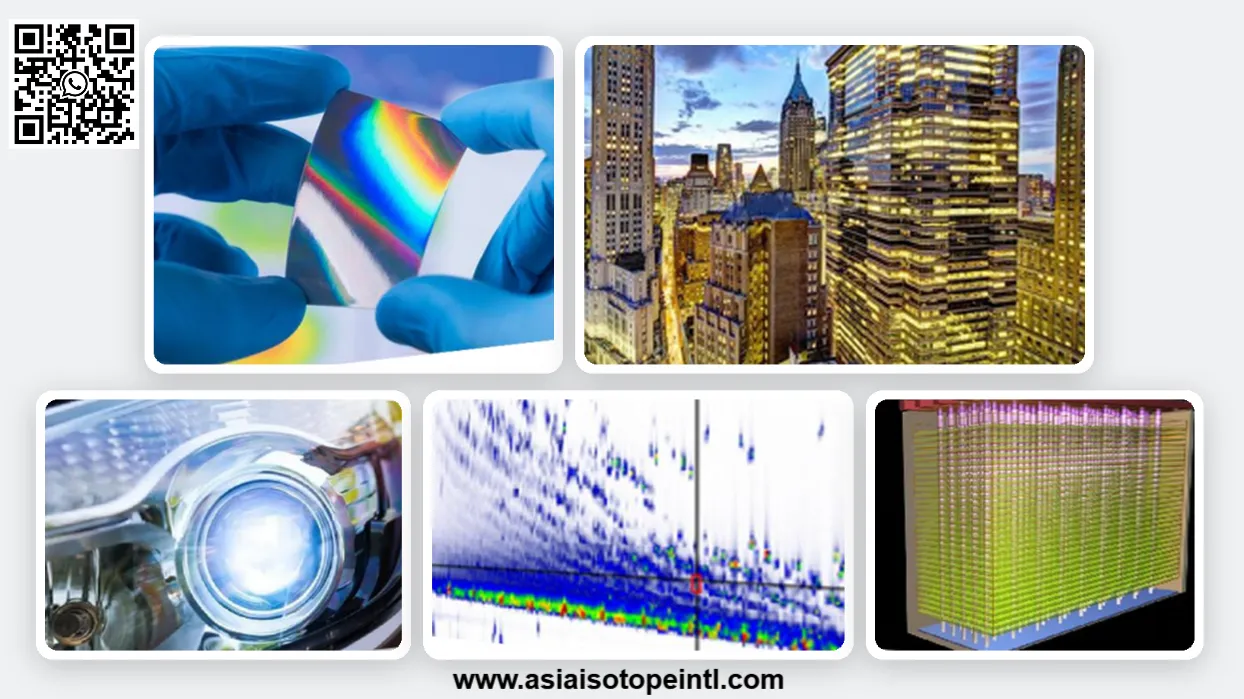
Would you like a deeper dive into any specific technical parameters or applications?
As an industry leader focused in Specialty Gases , our goal is to support our customers by keeping them at the forefront of their industries. We’re here to help with any questions you might have so you can transform your ideas into reality, and tackle those big science challenges.
Get free consultant, our experts are ready to serve.
(Follow up our update articles on www.asiaisotopeintl.com or send your comments to tao.hu@asiaisotope.com for further communications)